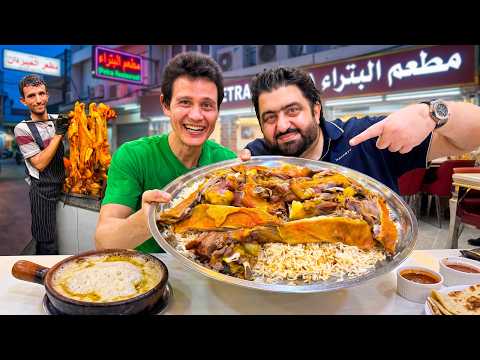
A shark steak from Muscat's fish market, chicken cooked against heated river rocks, camel hump fat, cardamom-heavy halwa, charcoal-baked Bedouin bread, and a whole lamb lowered into an underground pit give this journey an unusually broad culinary range. The strongest choice is that the food rarely appears without the people and circumstances surrounding it. Restaurant owner Allia Zidi discusses the changing opportunities for women in Oman while preparing shark; a desert host explains why his family remains attached to Bedouin life despite drought and logistical difficulty; and the elaborate preparation of shuwa becomes an opportunity to show the communal and religious traditions surrounding a celebratory meal. The enthusiastic reactions sometimes move faster than the explanations, and several cultural claims are accepted too casually, but the episode succeeds at making food a route into different parts of Omani life rather than simply assembling a sequence of unusual things to eat.
Muscat begins with one of the most attention-grabbing ingredients: shark purchased from a busy fish market. Allia selects a thick steak and later prepares it with spices, yogurt, tomato, lemon, potatoes, peppers, rice, cilantro, ghee, and smoke from hot coal before dramatically flipping the finished dish onto a platter. A second preparation uses dried shark mixed with onion, ghee, and lime, producing something described as intensely salty and sour. The cooking detail is excellent, particularly because viewers see ingredients layered rather than merely encountering the finished meal. The market discussion is less rigorous. Broad statements about Americans almost never eating shark and fishermen taking whatever sharks come from the ocean are conversational observations rather than established descriptions of fishing practices, species identification, consumption, or sustainability, and the episode never investigates those questions despite making shark its opening attraction.
The next restaurant shifts from ingredients to unusual cooking techniques. A buried vessel holds lamb and rice that have broken down into an almost porridge-like mixture, while heated river rocks are used to cook chicken and mutton. The owner connects the rock method to food from his childhood, giving the technique more context than simply presenting it as a novelty. The resulting chicken is described as carrying a subtle fresh or mineral quality, while the softened meat-and-rice mixture is dipped into rendered cow fat for an even richer texture. These sequences work because the preparation remains visible and tactile: digging into the earth, uncovering vessels, handling heated stones, and comparing the transformed food with its original ingredients make the methods easy to understand. Claims that the rocks themselves impart a particular flavor remain subjective tasting impressions rather than something demonstrated beyond the participants' reactions.
Omani halwa provides one of the episode's best production segments. At a family factory whose tradition is said to extend back through earlier generations, water and local cane sugar cook for hours over wood fire before walnuts, almonds, ghee, cardamom, saffron water, and additional fat gradually transform the mixture into a glossy, cohesive mass. Watching the texture change from sticky syrup into something that moves almost as a single unit gives the factory visit a genuine process-documentary quality. The subsequent tasting also benefits from uncertainty: rather than instantly declaring the unfamiliar dessert amazing, the host pauses to understand its warm, soft, fragrant texture and particularly strong cardamom character. That moment of hesitation feels more informative than automatic praise. The later car-side shawarma stuffed with Oman chips offers the opposite kind of food experience—fast, inexpensive, familiar in concept, and shaped around Muscat's heat and drive-up ordering culture—giving the city section useful variety.
The move into the desert substantially broadens the episode beyond street food. Camel appears first in several preparations, including stewed meat, tamarind gravy, green curry, and cubes of hump fat, before the journey continues to Bidiyah and a Bedouin family's home. The camel tasting is lively, but an impromptu explanation of halal and haram food becomes one of the weakest informational passages. Statements about slaughter direction, permitted animals, paws, hooves, snakes, crocodiles, rats, and animals eating their own waste are presented through casual conversation and jokingly described as a scientific examination, without establishing that the simplified rules accurately represent Islamic dietary law. The episode is much stronger when it stays grounded in what its hosts personally practice rather than turning brief exchanges into broad explanations of religious rules.
The visit with Badaar is the most valuable section because daily logistics provide context that food alone cannot. He describes driving roughly 10 miles for water, gathering wood, caring for animals, living in a permanent home after drought reduced the practical reasons for moving, and preferring the quiet isolation of the desert despite having studied IT. Coffee with cardamom and saffron, dates prepared into a soft mixture, bread flattened by hand and baked directly on hot coals, and chicken cooked with onion, garlic, dried Omani lime, spices, and turmeric emerge naturally from that environment. The family's camels, goats, chickens, and cow further connect meals to livestock and desert life, while Badaar's distinction between camels treated as part of his family and other camels purchased for meat complicates the host's earlier joking treatment of whether the animals are pets or food. Most importantly, the episode lets Badaar explain why he stays and what he hopes for his children rather than presenting desert life merely as exotic hardship.
Shuwa provides an appropriately ambitious finale because the meal requires considerably more than tasting. A lamb is slaughtered according to the family's halal practice, sectioned, seasoned with a salty, sour, garlicky, chili-containing mixture, wrapped with banana leaves inside a damp palm-leaf sack, secured with wire, and lowered into a heated underground tanoor. Stones retain heat while the pit is sealed with a lid and sand, and the production returns the following day to uncover the meat. The sequence gives the audience a strong sense of anticipation because the result depends on a process that cannot be checked continuously. Although the introduction describes shuwa as cooking for three days during celebrations, this particular lamb is retrieved after roughly 24 hours, a distinction the episode acknowledges but could explain more clearly. The final tasting makes extensive use of the animal—meat, ribs, liver, lungs, heart, tongue, head, and brain—showing that the feast extends well beyond familiar cuts.
Across the full journey, the host's willingness to participate is both an asset and a source of unevenness. Eating with his hands, trying unfamiliar organs, wearing local clothing after asking whether doing so is appropriate, helping retrieve the shuwa, visiting homes, and repeatedly asking hosts about their lives creates an energetic sense of involvement. The humor also keeps a long food marathon moving, particularly during potentially dry explanations of preparation. Yet jokes about religion, cultural clothing, camel attractiveness, slaughter, animal organs, and unfamiliar customs occasionally arrive before enough context has been established, and hyperbolic descriptions of foods as unique, ancient, or exclusive to Oman are not independently supported within the presentation. Those weaknesses do not erase the substantial cultural access on display, but a more disciplined distinction between a host's personal experience, local explanation, and broader factual claim would make an already ambitious episode considerably stronger.
Pros
- The journey covers a remarkably varied range of Omani food, from shark and halwa in Muscat to camel, Bedouin cooking, and underground shuwa.
- Allia's shark preparation, the halwa factory, charcoal bread, and shuwa pit provide detailed cooking processes rather than limiting the episode to tasting reactions.
- Badaar's desert home gives the food meaningful context through discussions of water, drought, livestock, education, family, mobility, and attachment to Bedouin life.
- The shuwa finale follows the meal from slaughter and seasoning through wrapping, underground cooking, excavation, and tasting, creating a satisfying culmination to the broader journey.
- Contrasting elaborate traditional preparations with a simple Oman-chip shawarma demonstrates that the country's food culture is not presented as exclusively ceremonial or historical.
- Hosts and cooks receive substantial opportunities to explain their own techniques, preferences, businesses, and lifestyles.
- The host's willingness to admit uncertainty about unfamiliar flavors makes several tastings feel more genuine than immediate, indiscriminate praise would.
Cons
- Casual explanations of halal and haram food oversimplify a religious dietary system and are not supported with enough context to treat them as authoritative.
- The shark-market section raises unanswered questions about species identification, fishing practices, consumption, and sustainability while making broad claims about how commonly shark is caught and eaten.
- Claims that certain foods or techniques are uniquely Omani, extremely old, or practiced in particular ways are often accepted from conversation without additional support.
- Constant jokes and hyperbole occasionally compete with cultural explanation, particularly around religion, slaughter, traditional clothing, and unfamiliar animal parts.
- The opening description of shuwa cooking for three days sits awkwardly beside the featured lamb being removed after roughly 24 hours, even though longer cooking is later mentioned.
- The enormous scope allows impressive variety but means some topics receive only enough explanation to create curiosity rather than a thorough understanding.
The episode is at its best when unusual food becomes the beginning of a deeper story, whether following a woman running a restaurant in Muscat, watching halwa change texture over a wood fire, sharing bread with a Bedouin family, or waiting overnight for lamb buried beneath the earth. Some cultural and religious explanations are too casual for the confidence with which they are delivered, but the combination of detailed cooking, generous local hosts, varied settings, and genuine curiosity makes this an unusually substantial food journey through Oman.