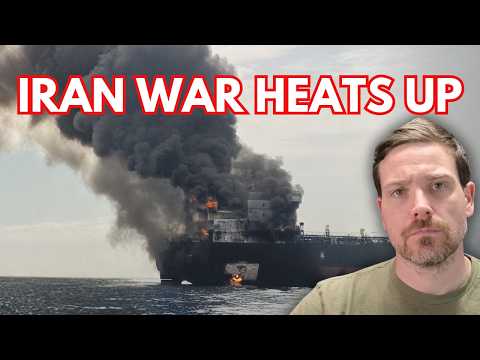
The concentration of American aircraft in Qatar becomes the central example in a much broader argument that Washington is moving military assets around the Middle East without defining what those forces are supposed to accomplish. Larry Johnson says contacts with recent U.S. military personnel describe people being recalled or repositioned while remaining uncertain about their mission. That account is presented secondhand and cannot be independently established within the discussion, but it supports the interview’s recurring concern: military activity appears to be advancing faster than a coherent political objective.
Much of the first half shifts away from Iran and Yemen to Russia, Ukraine, and Europe. Johnson argues that Moscow does not seek a preemptive war with Europe but increasingly expects one because of European support for Ukraine and rhetoric about confronting Russia. He draws heavily on his recent experiences in Moscow, conversations with Russian military figures, observations during reported Ukrainian drone attacks, and Russia’s historical memory of invasion. These anecdotes give the discussion immediacy, but the hosts frequently move from Russian perceptions to sweeping conclusions about European intentions and capabilities without seriously examining alternative interpretations.
That weakness is particularly noticeable during the discussion of Russian elections and the war in Ukraine. Johnson describes election observers as impressed by voting procedures and characterizes the election as fair, while the conversation gives little attention to objections raised by critics of Russia’s political system or to the disputed status of Ukrainian territories Russia claims to have incorporated. Similarly, predictions that Russia will take Kyiv and Odesa, that European territory may be used for attacks on Russian forces, and that Moscow would then retaliate against Europe are speculative scenarios rather than established developments. The speakers often deliver such possibilities with more certainty than the available support warrants.
The energy discussion is more concrete because Johnson at least attempts to quantify his argument. He compares Russian diesel exports with global consumption and argues that refinery attacks inside Russia cannot adequately explain the wider shortage being discussed, instead pointing toward disruption around the Strait of Hormuz. Whether every figure and causal inference is correct is not independently demonstrated here, but the use of specific numbers makes the reasoning easier to scrutinize than the interview’s broader geopolitical predictions. It is one of the better examples of the program attempting to build an argument rather than simply asserting one.
The Middle East portion is also stronger when it asks a practical military question: what would additional American airstrikes actually accomplish? Johnson points to previous operations against the Houthis and argues that air power failed to eliminate their ability to fight, while mountainous terrain, dispersed forces, limited infrastructure, and the possibility of retaliation against regional bases would complicate another campaign. The discussion usefully distinguishes the ability to conduct strikes from the ability to achieve a durable strategic objective. Its case would be more persuasive, however, with clearer sourcing for the casualty, equipment-loss, force-strength, and current Saudi strike figures repeatedly cited.
Johnson’s discussion of his experience observing U.S. special-operations exercises and operations in Iraq gives the interview its most substantial institutional critique. He argues that military organizations can mistake operational tempo for strategic progress, recalling kill-or-capture missions that continued even as attacks increased and contrasting them with later efforts to pay local security forces. Whatever one makes of the broader conclusions drawn from these experiences, this section identifies a meaningful analytical question: whether measurable military activity is actually producing the desired political result. That same test is then applied coherently to proposals for renewed strikes in Yemen.
The presentation is considerably less disciplined than the underlying strategic questions deserve. Long tangents about museums, tanks, jokes about European officials, immigrants, religion, and personal insults repeatedly interrupt the analysis, while provocative claims about impending war, European unrest, Houthi territorial gains, and American decline often receive little challenge from the host. The conversational chemistry keeps the lengthy exchange moving, but agreement between host and guest frequently substitutes for testing assumptions. As a result, the interview offers useful questions about escalation, logistics, energy supplies, and achievable war aims while remaining an openly argumentative discussion whose factual claims and forecasts require substantial outside verification.
Pros
- Raises the important distinction between deploying military power and having a clearly defined political objective for using it.
- Johnson’s discussion of operational planning and his Iraq experiences provides a concrete framework for questioning whether tactical activity produces strategic success.
- The energy section attempts to support its argument with specific production, export, and consumption figures rather than relying entirely on rhetoric.
- Connects potential operations against the Houthis to practical issues including terrain, dispersed forces, air-defense limitations, regional bases, fuel supplies, and escalation risks.
Cons
- Numerous consequential claims about Russian elections, military intentions, drone attacks, European shortages, Saudi operations, and force strengths are asserted without enough sourcing or competing evidence to assess them confidently.
- Speculative scenarios involving the capture of Kyiv and Odesa, European intervention, Russian retaliation, regional escalation, and Houthi advances are sometimes discussed with excessive certainty.
- The treatment of Russia and the Ukraine war is notably one-sided, with little sustained examination of interpretations that would challenge Johnson’s account.
- Personal insults, stereotypes, and lengthy tangents weaken the seriousness of an otherwise consequential foreign-policy discussion.
- The title’s focus on U.S. aircraft in Qatar represents only part of a sprawling conversation that spends substantial time on Russia, European politics, energy, and historical anecdotes.
The discussion asks worthwhile questions about what additional military escalation against Iran or the Houthis could realistically achieve, and Johnson’s emphasis on objectives, logistics, and lessons from earlier campaigns gives parts of the conversation genuine analytical value. Its usefulness is limited by weak sourcing, confident speculation, frequent digressions, and an overwhelmingly sympathetic treatment of the Russian perspective that leaves major claims insufficiently tested.