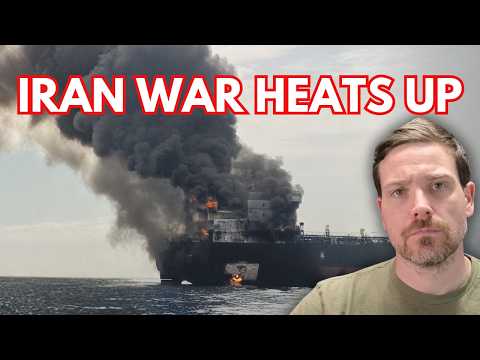
Economic pressure on Iran is presented as inseparable from military warfare, with Professor Saeed Muhammad Mahmoud Marande arguing that sanctions, attacks on shipping and broader regional operations amount to a coordinated effort to force Iran into submission. That framing gives the discussion a clear organizing idea: pressure will produce retaliation rather than capitulation. The prospect of Iranian attacks on American military and economic interests therefore becomes the interview’s central warning about where continued escalation could lead.
Marande is most useful when explaining the strategic logic he attributes to Iran. He says Iranian forces have shifted from a defensive to an offensive posture and describes attacks on naval and commercial targets as signals that American actions will now receive increasingly forceful responses. He also connects economic warfare to potential attacks on US-linked assets, banks and infrastructure around the Persian Gulf. Whether every specific account of recent military action is accurate cannot be established from the discussion itself, but the interview does clearly communicate the deterrence strategy Marande believes Iran is pursuing.
The conversation becomes more speculative when it turns to Donald Trump’s political calculations. Marande openly admits that he does not know why Trump would continue a war that could damage his electoral prospects, particularly through higher energy and food costs. His theory that Iran may intensify pressure before the November elections in hopes of worsening Republican losses is presented as his interpretation rather than established fact, which is an important distinction. Even so, assertions about Trump’s motives, Tucker Carlson’s private warnings and the likely political consequences receive little independent scrutiny from the host.
That lack of challenge is the interview’s biggest weakness. Marande makes sweeping accusations about Western responsibility for deaths caused by sanctions, conflicts in Syria, Yemen and Gaza, alleged support for extremist proxies, and current events involving Venezuela and Iran. A cited Lancet figure concerning millions of deaths attributed to sanctions sounds potentially significant, but its methodology, scope and precise findings are not examined. Other major claims are delivered without comparable sourcing, while George Galloway frequently reinforces the guest’s framing instead of testing it.
The Yemen discussion follows the same pattern. Marande offers a coherent explanation for why he believes Ansar Allah has gained military effectiveness and morale, emphasizing years of warfare, advances in drone and missile technology and the group’s support for Palestinians. Those observations provide a useful window into his interpretation of the conflict, but descriptions such as calling Ansar Allah Yemen’s legitimate government and repeatedly characterizing earlier Saudi-led operations as genocide are treated as settled premises rather than contested political and legal claims. Claims about territorial advances, the origins of the latest fighting and the conduct of regional governments likewise receive no evidentiary examination.
Presentation further undermines the seriousness of the subject. Galloway’s provocative jokes and insults, including comments about sailors in Thailand and Trump’s appearance, sit awkwardly beside discussion of civilian deaths and the possibility of a devastating regional confrontation. Marande is comparatively disciplined, repeatedly returning to sanctions, deterrence and escalation, and his willingness to acknowledge uncertainty about Trump’s motivations adds some welcome restraint. Still, the exchange functions much more effectively as an articulation of a strongly pro-Iranian geopolitical perspective than as a balanced examination of the conflict.
Pros
- Marande clearly explains the strategic logic he believes is driving Iran toward increasingly forceful retaliation against military and economic pressure.
- The discussion connects sanctions, regional military operations, shipping and electoral politics into a coherent argument about escalation.
- Marande explicitly acknowledges uncertainty when discussing Trump's motivations rather than pretending to know the answer.
- The Yemen section offers a substantive explanation of how drones, missiles and morale could affect an asymmetric regional conflict.
Cons
- Numerous consequential claims about sanctions deaths, military attacks, Western conduct and regional conflicts are asserted without enough evidence or scrutiny to establish them independently.
- Galloway largely reinforces Marande's perspective instead of challenging contested claims or introducing competing interpretations.
- Politically and legally disputed characterizations of governments, armed groups, wars and alleged genocide are frequently presented as settled facts.
- Flippant jokes and personal insults weaken the tone of an otherwise serious discussion about war and civilian suffering.
Marande provides a clear and unsettling account of why he believes mounting pressure on Iran could trigger a much broader cycle of retaliation, and his strategic argument is easy to follow. The interview is considerably less persuasive as an objective assessment because sweeping historical and contemporary claims repeatedly pass without verification or meaningful challenge. As perspective and warning it is revealing, but as geopolitical analysis it demands far more scrutiny than the conversation provides.