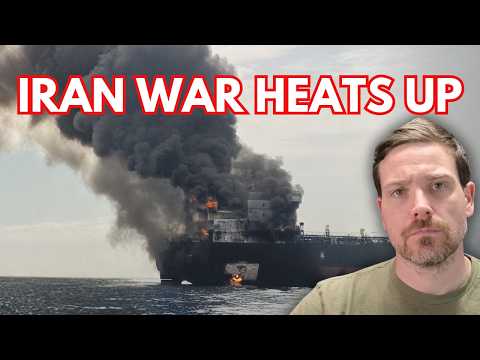
Iran’s worsening economic crisis provides one of the briefing’s clearest combinations of geopolitical conflict and consequences for ordinary people. Alongside reports of renewed U.S.-Iranian military tensions and Iranian drone activity, the segment gives striking figures for increases in food prices and includes a businessman describing how another war could make already difficult conditions worse. That human perspective is useful because it prevents the opening from becoming merely another summary of diplomatic and military maneuvering, although the extremely fast transition between claims leaves little room to examine their broader context.
The U.S. political and military stories are similarly dense. Reports about conservative veterans allegedly holding undisclosed Pentagon positions, leadership disputes within the Army and the Supreme Court’s ruling concerning President Trump’s planned White House ballroom all raise substantial questions about government authority and institutional accountability. The briefing generally identifies where major claims originate, including reporting attributed to the Washington Post, but its headline format means complicated controversies are compressed into short descriptions rather than examined from competing perspectives.
Coverage of Gaza, Ukraine and immigration enforcement places civilians prominently within stories that might otherwise be reduced to statistics. The Gaza section reports Palestinian deaths attributed to Israeli attacks and includes a UN spokesperson emphasizing protection for civilians and hospitals, while the Ukraine report uses a mother’s uncertainty about keeping her children safe during Russian attacks to convey the disruption of continued warfare. The Texas stories concerning an eyewitness released from immigration detention and a U.S. citizen allowed to return after being deported likewise give specific cases to a broader debate over immigration enforcement. These accounts are effective as human-centered journalism, though the format offers little opportunity to test official explanations or disputes surrounding individual incidents.
The catastrophic flooding in the Himalayas is among the most memorable stories because it combines an enormous reported death toll with an unusually concrete survival story. A school principal describes evacuating roughly 900 students shortly before floodwaters destroyed the building, giving the disaster an immediacy that statistics alone could not provide. The subsequent Grand Canyon flooding story introduces a climate explanation involving El Niño conditions, marine heat and atmospheric moisture, but the causal framing is presented very briefly; a subject involving attribution and extreme-weather science would benefit from more explanation of what experts can confidently connect to particular events.
Several domestic stories broaden the briefing beyond its dominant focus on war and disaster. The temporary halt to border infrastructure construction in Big Bend National Park introduces environmental and legal concerns, while the EEOC finding involving Cisco raises allegations of racist and Islamophobic workplace communications following October 7 and subsequent employee activism. These are serious subjects, and the report communicates the allegations clearly, but the rapid headline structure again limits discussion of responses from the institutions or individuals implicated.
The closing tribute to Wendell Berry is an effective tonal shift from the preceding stream of conflict, death and institutional controversy. Rather than merely listing his literary accomplishments, the segment connects his writing about rural communities and industrial society with his environmental activism and then lets him explain why he viewed civil disobedience as the next step after conventional political efforts had failed. It is a concise but meaningful ending that illustrates what the overall briefing does best: pairing major events with voices directly connected to them, even when the pace prevents deeper examination.
Pros
- Covers a remarkably broad range of international and U.S. stories without losing the basic thread of each headline.
- Firsthand voices from Iran, Nepal, Ukraine and Wendell Berry add human perspective to otherwise compressed news summaries.
- Frequently attributes major claims to identifiable reporting, officials or organizations rather than presenting every assertion without context.
- The Himalayan flood account provides an especially vivid combination of large-scale disaster reporting and an individual evacuation story.
- The Wendell Berry remembrance gives the closing section substance beyond a conventional obituary summary.
Cons
- Complex geopolitical, legal and institutional controversies are often compressed too heavily to provide meaningful competing perspectives or background.
- Several consequential claims depend on attributed reporting or official accounts that cannot be explored or scrutinized within the headline format.
- The explanation connecting climate conditions with deadly flooding moves quickly from scientific factors to particular disasters without much discussion of attribution or uncertainty.
- The relentless movement between unrelated stories can make significant developments feel briefly introduced rather than adequately contextualized.
The breadth and human-centered reporting make this an efficient and often compelling snapshot of a turbulent news cycle, particularly when firsthand voices give scale and emotion to conflicts and disasters. Its main limitation is inherent in the rapid headline approach: serious claims involving war, government power, immigration, workplace discrimination and climate science frequently need more context than the format provides.