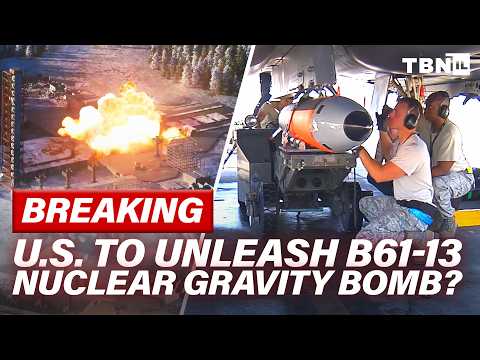
Pentagon discussions about expanding nuclear options are serious enough to warrant careful scrutiny without assuming that a nuclear strike has already become likely. The hosts build their case around reporting attributed to journalist Ken Klippenstein, including language from Pentagon officials about increasing options available to the president for deterring or responding to a “nuclear contingency.” That material provides a substantive basis for discussing nuclear planning, but the presentation quickly moves beyond what the cited language itself establishes.
The most important distinction is between preparing military options and deciding to use them. The hosts acknowledge this briefly, even noting that being “on the road” does not guarantee reaching the destination, yet one host subsequently declares that the odds favor the United States using a nuclear weapon. Nothing presented here establishes such a probability. The administration's reported consideration of nuclear contingencies, Trump's threatening rhetoric toward Iran, and previous discussions of nuclear capabilities may all justify concern, but they do not demonstrate that an order to conduct a nuclear strike is being prepared or that such a strike is now the likely outcome.
Historical quotations from Elbridge Colby add context but are used too aggressively. His 2011 comments about maintaining a devastating retaliatory capability are presented as evidence of a mindset relevant to current policy, which is a reasonable subject for examination. However, a statement about retaliatory nuclear deterrence does not by itself establish that Colby would support initiating a nuclear attack against Iran, much less the hosts' assertion that he would be comfortable wiping out civilians. The distinction between documented policy views and conclusions about an official's present intentions becomes increasingly blurred.
The discussion of “tactical” and “limited” nuclear weapons raises an important semantic and strategic issue, but it also oversimplifies it. The hosts are effective when emphasizing that softer terminology should not obscure the catastrophic consequences of nuclear use. They become less precise when insisting there is effectively no meaningful distinction at all and characterizing nuclear weapons as generally killing hundreds of thousands of people per use. No specific weapon, yield, target, fallout pattern, or proposed operational scenario is provided, making those casualty assumptions impossible to establish from the material presented.
From there, the argument becomes much more speculative. The hosts predict a coordinated progression in which media outlets will first dismiss nuclear concerns, then normalize nuclear options, followed by actual use. They similarly attribute Newt Gingrich's involvement, American military decisions, Israeli strategy, and an eventual nuclear attack to a unified effort serving Israel. These are sweeping claims about motives and future actions, yet the segment supplies little direct evidence connecting the individual pieces into that chain. Statements that America is “occupied” and governed by a foreign country push the commentary even further from the documentary evidence with which it began.
Presentation is another weakness. The hosts' anger is unmistakable, and their opposition to nuclear escalation gives the segment urgency, but repeated insults toward officials, Congress, Israel, and the media often replace analysis that would be more useful. The extended sponsor interruption also lands awkwardly in the middle of an argument about nuclear warfare. Most importantly, the rhetoric makes it difficult to separate what has reportedly occurred—Pentagon planning, congressional briefings, official statements and Trump's threats—from what the hosts predict or infer will happen next.
Pros
- Centers the discussion on reported Pentagon language about expanding nuclear options rather than relying exclusively on Trump's public rhetoric.
- Correctly treats any serious consideration of nuclear weapons as deserving close scrutiny and emphasizes the potentially catastrophic human consequences of their use.
- Provides relevant historical context through earlier statements attributed to Elbridge Colby and discussion of proposed nuclear capabilities.
- Briefly acknowledges that preparation for an option does not necessarily mean that option will ultimately be used.
Cons
- Leaps from evidence of nuclear contingency planning to the unsupported prediction that the odds favor an actual U.S. nuclear strike.
- Uses Colby's earlier comments about retaliatory deterrence to make much stronger claims about his willingness to initiate mass civilian killing than the quoted material establishes.
- Oversimplifies tactical and limited nuclear weapons while making broad casualty claims without specifying a weapon, yield, target, or scenario.
- Attributes American policy, Israeli strategy, congressional behavior, media coverage, and Newt Gingrich's involvement to a coordinated pro-Israel agenda without demonstrating those causal connections.
- Repeated insults and declarations that the United States is controlled or “occupied” by a foreign country overwhelm the more concrete reporting at the center of the segment.
- The lengthy sponsor break sharply interrupts an exceptionally serious discussion.
The underlying reporting about nuclear contingency planning raises consequential questions that deserve sustained public attention, but the commentary repeatedly converts reasons for concern into predictions presented with far more certainty than the evidence supports. Its strongest material is the documented official language; its weakest is the speculative chain connecting that language to an allegedly likely nuclear attack and a sweeping theory of foreign control over American policy.