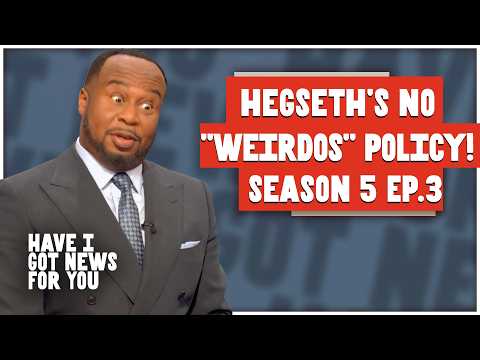
Pete Hegseth's dismissal of Lieutenant General Brett Sylvia provides the opening controversy for another sharp, politically charged installment of Have I Got News for You US. Using its familiar Offendometer format, the panel examines allegations of classified information leaks, questionable Pentagon personnel decisions, and the increasingly contentious relationship between political leadership and military officials. The discussion eventually moves to offensive statements attributed to a Pentagon religious advisor and renewed legal action against former FBI Director James Comey. Throughout, the comedians blend pointed criticism with exaggerated jokes, creating a segment that is entertaining and occasionally insightful, even when its political perspective leaves limited room for competing interpretations.
The discussion surrounding Sylvia's dismissal establishes one of the segment's more substantive concerns: the difficulty of determining whether disciplinary action is justified when officials responsible for making those decisions have already lost the panel's trust. Hegseth's reported reliance on failed polygraph examinations becomes a central point of criticism, with the comedians emphasizing the limitations of lie-detector testing. Sylvia's denial of leaking classified information and his acknowledged interactions with journalists add important context, particularly alongside the suggestion that he had challenged military planning involving Iran and Ukraine. The panel raises the possibility that the dismissal reflects an effort to remove dissenting voices, although that interpretation remains speculative rather than established.
One particularly revealing exchange occurs when a panelist acknowledges that Sylvia could genuinely have committed misconduct but admits being predisposed to defend him because of Hegseth's previous personnel decisions. That admission captures both the segment's appeal and its limitations. The comedians are willing to recognize uncertainty, yet their broader distrust of the administration often determines how they interpret incomplete information. Jokes about the number and demographics of dismissed military officials reinforce the political criticism, but the segment provides little systematic evidence for evaluating whether those personnel changes follow a consistent discriminatory or ideological pattern.
The examination of Pentagon religious advisor Ryan Higgins offers some of the segment's most concrete material. Drawing on CNN's reporting about historical social media posts, the show highlights inflammatory statements concerning immigrants, women, and LGBTQ people. The quoted remarks give the criticism a more substantial foundation than the speculation surrounding Sylvia's dismissal, while the Pentagon's supportive response creates a striking contrast between the allegations and the administration's stated confidence in Higgins. The comedians respond with increasingly outrageous punchlines, but the underlying issue remains serious: whether someone holding an advisory position concerning religious affairs can credibly serve a diverse military population after making such statements.
The second major controversy concerns Attorney General Todd Blanche and the Justice Department's renewed pursuit of James Comey over alleged disclosures of sensitive national security information. Here, the presentation becomes more legally focused, examining the significance of the alleged conduct occurring approximately a decade earlier and the prosecution's apparent attempt to address an expiring statute of limitations. The distinction between filing an indictment and filing a criminal information receives particular attention, supported by commentary from legal analyst Jeffrey Toobin questioning the government's approach. While the panel characterizes the effort as political retaliation, the legal discussion provides a more specific basis for questioning the prosecution's procedural strategy without independently establishing its motives.
Blanche's own statements about working for President Trump provide an effective conclusion to the substantive discussion. The panel contrasts his openly expressed loyalty to the president with expectations surrounding the Justice Department's institutional independence, turning a complicated constitutional and political issue into an accessible exchange. However, the segment does not fully examine the distinction between an attorney general's relationship with an elected president and the department's responsibility to administer justice impartially. Instead, the comedians largely treat Blanche's remarks as confirmation of their existing interpretation. This works within the show's satirical format but limits its usefulness for viewers seeking a more comprehensive explanation of the controversy.
As comedy, the Offendometer structure keeps the material moving through recognizable personalities, news clips, rapid questions, and spontaneous reactions. The panel's chemistry is particularly evident when serious allegations give way to unexpected jokes about military leadership, polygraph examinations, and the Attorney General's podcast appearances. The strongest humor emerges naturally from the contrast between official statements and the surrounding controversies. Nevertheless, some extended sexual jokes and personal insults contribute little to the political analysis, occasionally interrupting the momentum of otherwise focused discussions. The result is a lively and frequently funny political comedy segment that works better as satirical commentary than as a balanced examination of the events it covers.
Pros
- Uses the Offendometer format effectively to connect several major political controversies through an accessible, fast-moving comedic structure.
- Raises legitimate questions about the reliability of polygraph examinations and the difficulty of evaluating allegations against dismissed military officials.
- Includes Sylvia's denial and acknowledges uncertainty about the reasons for his dismissal rather than presenting every allegation as established fact.
- Grounds its criticism of Ryan Higgins in specific reported statements and contrasts those remarks with the Pentagon's public defense of his position.
- Explains the procedural controversy surrounding the Comey case, including the statute of limitations and the distinction between an indictment and a criminal information.
- Incorporates relevant news footage, legal commentary, and officials' own statements to support the discussion.
- Features energetic panel interactions and sharp observational humor that make complicated political developments more approachable.
Cons
- Frequently interprets disputed personnel and prosecutorial decisions through an openly hostile view of the administration without thoroughly examining alternative explanations.
- Suggests that Sylvia's dismissal may have been retaliation for policy disagreements but provides insufficient evidence to establish that motivation.
- Offers limited examination of the legal and institutional distinctions underlying the Justice Department's relationship with the White House.
- Some broad criticisms concerning Pentagon personnel decisions are asserted without enough supporting detail to evaluate their accuracy.
- Extended sexual jokes and personal insults occasionally distract from stronger political observations and reduce the seriousness of the discussion.
This is an entertaining and often incisive political comedy segment that succeeds by pairing absurd official controversies with energetic panel reactions and carefully selected news material. Its strongest moments combine specific reporting with humor that exposes contradictions in the conduct and explanations of powerful officials. Although its partisan framing, occasional speculative conclusions, and uneven joke selection limit its analytical depth, the segment remains an engaging example of topical satire that encourages viewers to question political authority.