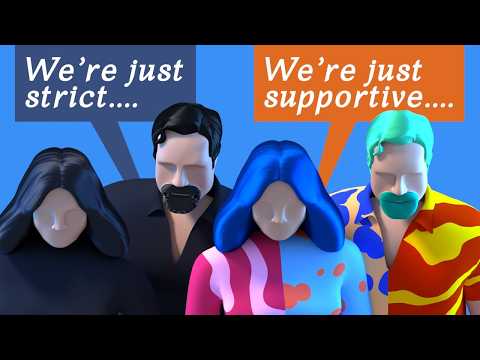
Parenting decisions that once remained private have become an increasingly prominent source of social media entertainment, controversy, and public criticism. This reaction compilation examines a collection of questionable parenting moments, ranging from children displaying disrespectful behavior to adults demonstrating entitlement, poor judgment, and apparent disregard for their children's well-being. The host approaches these examples with sarcastic humor and outspoken criticism, creating an entertaining presentation that occasionally develops into a more meaningful discussion about parental responsibility.
The opening clips establish the recurring theme of children learning behavior through the examples set by their parents. A young child speaking aggressively toward his mother and a father encouraging his child to take Halloween candy intended for other children provide contrasting illustrations of inappropriate conduct. The host makes a worthwhile distinction between criticizing children and holding adults accountable for the behavior they encourage. His observation that children deserve better guidance introduces a compassionate perspective beneath the otherwise confrontational humor.
The most substantial discussion concerns a mother advocating an unschooling approach in which her daughter's interests determine the direction of her education. The host challenges her comparison between naturally acquiring language and developing knowledge across subjects such as mathematics, history, and science. His argument that independent curiosity and structured instruction can coexist is particularly reasonable, as is his acknowledgment that homeschooling itself is not necessarily problematic. However, predictions about the child's future academic difficulties and susceptibility to misinformation extend beyond what can reasonably be established from the mother's statements alone.
Public entitlement becomes another prominent subject through clips involving a father demanding that a Disney attraction reopen after closing, parents bringing an infant into a horror movie, and a mother expecting strangers to acknowledge her son's dancing in a supermarket. These examples allow the host to examine the distinction between accommodating children's needs and expecting unrelated individuals to accommodate every parental preference. His willingness to acknowledge that the dancing child does not appear to be obstructing anyone demonstrates that he is occasionally prepared to challenge the assumptions surrounding the clips rather than automatically endorse their negative framing.
A discussion involving a mother drinking wine during her son's football practice provides one of the more balanced moments. Instead of immediately condemning her conduct, the host considers the amount consumed, transportation arrangements, and the apparent double standard between mothers drinking wine and fathers drinking beer at sporting activities. He also recognizes that the available information is insufficient to determine whether the behavior reflects a more serious problem. This measured approach demonstrates how the presentation benefits when contextual uncertainty takes precedence over immediate judgment.
Other examples address a mother charging her son gas money for collecting sushi, potentially unsafe recreational activities involving an infant, a distracted father looking at his phone, and a parent harshly criticizing a young athlete. These segments reinforce concerns about financial fairness, attentiveness, physical safety, and emotionally supportive parenting. Unfortunately, the subsequent discussion involving a toddler's physical appearance undermines some of the host's earlier compassion. Reading and participating in jokes about a young child's size shifts the entertainment away from parental accountability and toward unnecessary personal ridicule.
The reaction format maintains an energetic pace through frequent transitions, spontaneous observations, and selected social media comments. Nevertheless, the reliance on short clips limits the ability to establish context, verify accusations, or determine whether individual incidents represent broader patterns of parenting behavior. The host's profanity, exaggerated predictions, and occasional sweeping assertions can also weaken otherwise legitimate arguments, while the premise of parents disabling their comments receives relatively little direct examination. The result is engaging social commentary that works better as entertainment than as a comprehensive assessment of parenting practices.
Pros
- The diverse selection of clips explores meaningful issues involving parental responsibility, discipline, education, and public consideration.
- The discussion of unschooling raises worthwhile questions about balancing independent curiosity with structured education.
- The host frequently recognizes that children should not bear responsibility for the inappropriate examples established by their parents.
- The examination of alcohol consumption during sports practice demonstrates a welcome willingness to consider context and potential double standards.
- The discussion of public entitlement highlights the importance of respecting employees, strangers, and shared environments.
- The energetic delivery and sarcastic observations maintain engagement throughout the compilation.
Cons
- The limited context surrounding individual clips makes definitive judgments about parenting practices difficult to support.
- Speculative predictions about children's future development occasionally undermine the credibility of legitimate concerns.
- The jokes about a toddler's physical appearance conflict with the presentation's broader emphasis on protecting children from inappropriate treatment.
- Frequent profanity and personal insults sometimes overshadow more constructive observations about parental responsibility.
- The significance of parents disabling their social media comments receives insufficient direct examination.
The presentation offers an entertaining and occasionally insightful examination of the responsibilities adults assume when raising children and sharing their experiences online. Its commentary is most persuasive when the host considers context, distinguishes parental behavior from childhood innocence, and challenges unreasonable expectations in public spaces. Greater restraint in its personal ridicule and more consistent acknowledgment of uncertainty would elevate it beyond the limitations of conventional reaction entertainment.