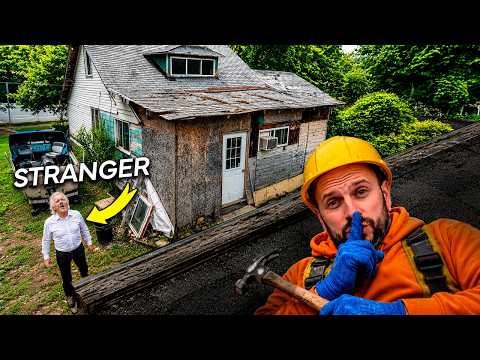
The scale of this cleanup becomes clear gradually rather than through a single dramatic reveal. What initially looks like an overgrown property turns out to contain a driveway obscured by vegetation and debris, a largely inaccessible backyard, buried fencing, discarded shopping carts, glass, branches and enough woody growth to require professional equipment. That discovery gives the project a stronger sense of progression than a routine mowing transformation, because much of the satisfaction comes from uncovering usable space that Angela herself says she had never really seen.
The video also gives the cleanup a concrete purpose beyond appearance. Angela describes being displaced from a nearby home, staying with her daughter and hoping eventually to move into this property with family members after the house was gifted to them. The yard work therefore functions as one part of making the property usable rather than as a purely cosmetic rescue. The presentation benefits from allowing Angela and her son DJ to explain portions of that situation themselves, although the host repeatedly summarizes their hardship and gratitude in ways that occasionally make an already affecting story feel more heavily emphasized than necessary.
Sean's work is methodical and unusually visible. He trims trees, chips branches, removes trash, edges pavement, clears roots, mows through heavy growth, retrieves bricks and broken materials, deals with glass and repeatedly cleans the newly exposed driveway. The extended attention to ordinary labor makes the final result credible because the transformation is shown as the product of many repetitive tasks rather than a few convenient montage cuts. At the same time, the driveway receives so much screen time that even Sean jokes about viewers being tired of it, and that self-awareness does not entirely eliminate the pacing drag.
One of the stronger practical decisions is recognizing when the property exceeds what one person can efficiently handle. After attempting to manage the woody debris manually, Sean contacts Cast and his crew, whose equipment and tree work accelerate the process considerably. He explicitly frames the decision as working smarter rather than proving he can complete everything alone. That makes the project feel more responsible, particularly around larger trees, and the crew avoids a tree near a power line that they cannot safely address.
The episode also preserves complications that prevent the transformation from feeling artificially effortless. Sean burns himself on the chipper, works through considerable heat and humidity, stops for a passing rainstorm and then finishes in wet, muddy conditions. Some of these moments are played for humor, along with soccer juggling, childhood references and running commentary about tools, but they generally keep a lengthy cleanup personable. The sponsored shirt segment is comparatively brief, though it still arrives early enough to interrupt momentum just as the physical work is beginning.
The most meaningful reveal is Angela's reaction to the restored backyard and driveway. Her surprise at how far the property extends, the increase in light after selected trees are removed and the realization that the garage and driveway are genuinely accessible give the result a practical payoff. Small choices also show useful restraint: a religious statue found among the debris is preserved rather than discarded, usable sporting equipment is returned to neighboring children and vegetation intentionally serving as a border is left intact. Those details distinguish clearing neglected property from simply removing everything indiscriminately.
The basement visit broadens the family's problem but is handled more cautiously than the landscaping. Sean sees standing water, discusses downspouts and says he will contact someone who can evaluate drying, sealing or remediation, while also acknowledging that the issue is outside his expertise. His observation that there is not a strong mold or mildew smell should not be treated as evidence that the basement is free of moisture-related hazards, and the video does not claim that a diagnosis has been made. Ending with an intention to seek qualified help is therefore more responsible than attempting to convert a visual inspection into a technical conclusion.
Pros
- Builds the transformation around restoring genuinely usable access to an obscured driveway, backyard and garage rather than focusing only on cosmetic mowing.
- Shows substantial portions of the physical cleanup, including trimming, chipping, edging, debris removal, glass collection and repeated clearing of the driveway.
- Recognizes when professional equipment and tree expertise will make the work safer and more efficient instead of insisting on completing everything alone.
- Angela and DJ's reactions provide a clear human payoff tied directly to being able to use and eventually occupy the property.
- Preserves meaningful or reusable items instead of treating everything uncovered in the neglected yard as trash.
- Acknowledges that the basement water problem falls outside the host's expertise and proposes bringing in someone better qualified to assess it.
Cons
- The driveway-clearing process is documented at greater length than necessary, creating noticeable repetition before the backyard transformation advances.
- Angela's hardships and gratitude are repeatedly restated even after her own comments have already established the emotional stakes.
- The early sponsorship and channel promotion interrupt the transition from the family's story into the cleanup.
- The basement discussion includes informal observations about odor and likely remediation despite the absence of a professional assessment.
- The outside cleanup is completed effectively, but the larger question of whether the home is ready for Angela to occupy remains unresolved by the end.
This transformation works because the visual payoff corresponds to a meaningful practical change: a family gains access to outdoor space, a driveway and a garage that had effectively disappeared beneath years of neglect. The labor is convincingly documented and the decision to bring in professional help strengthens the project, even though repetition and emotional reinforcement make the episode longer than it needs to be. The unresolved basement problem appropriately prevents the ending from suggesting that clearing the property alone has solved every obstacle to moving in.