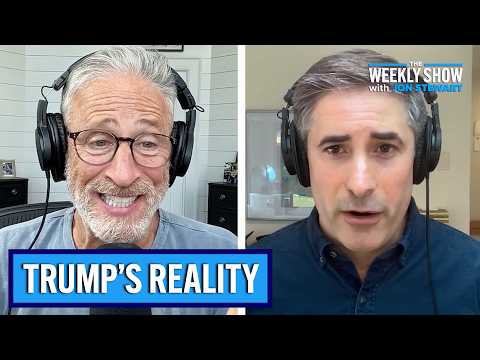
An uncannily convincing imitation of The Office characters discussing tariffs immediately gives the discussion its strongest hook. The hosts are genuinely impressed by how closely the fabricated voices and personalities resemble the originals, while also recognizing the unsettling implications of making recognizable actors appear to say things they never said. Their mix of amusement and alarm captures an important tension surrounding synthetic media: the technology can be creatively entertaining while simultaneously creating obvious questions about consent, intellectual property, impersonation and political manipulation.
The broader discussion of artificial intelligence is engaging but considerably less disciplined. Sam Altman’s reported comments about progress toward artificial general intelligence and Bill Gates’s warnings about economic disruption are presented as evidence that rapid change may be approaching, yet the hosts openly admit uncertainty about whether such predictions represent genuine danger or industry hype. That acknowledgment is useful, but terms such as AGI and claims about being “80%” of the way there receive little explanation, making dramatic forecasts sound more concrete than the discussion establishes.
Trump’s reported desire to speak at the New York September 11 memorial provides the episode with a more focused political argument. The hosts explain that politicians have not been allowed to speak at the site since 2012 because organizers seek to keep the ceremony nonpartisan, then contrast that tradition with Trump’s alleged interest in delivering remarks. Playing his 2001 comments about the height of his building after the attacks offers a striking example supporting their criticism of his tendency toward self-focused responses, although describing him categorically as a “pathological narcissist” moves from political commentary into an unsupported psychological characterization.
That combination of substantive criticism and aggressive partisan framing continues in the discussion of corporations preparing for possible Democratic congressional investigations. The hosts raise legitimate questions about companies giving money or courting political influence and about whether future congressional oversight should scrutinize relationships involving Trump and his family. However, repeatedly calling such conduct “bribes” without establishing the legal or factual basis for that conclusion goes substantially beyond the evidence presented. Their argument is strongest when focused on transparency, conflicts of interest and oversight rather than presumed criminal intent.
Comedy keeps the pacing lively, although it sometimes overwhelms the underlying politics. The prolonged mockery of Congressman Mike Lawler’s clothing is memorable but offers virtually no substantive evaluation of his campaign message, and the hosts explicitly promote his Democratic opponent immediately afterward. That advocacy makes the program’s political orientation unmistakable, which is preferable to pretending neutrality, but it also means viewers should understand that the commentary is designed to persuade as well as entertain.
The foreign-policy section is more cautious. Discussion of CIA Director John Ratcliffe’s reported Moscow trip includes several possible motivations involving Ukraine, Iran and warnings against attacks on NATO, and the hosts repeatedly identify their own uncertainty rather than presenting each theory as settled fact. Their treatment of autonomous weapons also raises an important concern about AI-assisted targeting, though the brief description is too limited to establish exactly how much human control the referenced systems retain.
A final segment about the anonymous online figure called Data Republican raises potentially serious civil-liberties questions after the hosts say she created an interactive database mapping Democratic Socialists of America members and a wider political network while also being associated with Pentagon contracting. The hosts appropriately ask whether government resources were involved, but they do not establish that they were, and their jokes quickly replace further investigation. That is characteristic of the episode as a whole: it frequently spots worthwhile questions and delivers them with exceptional comic energy, yet too often treats inference, allegation and fact as interchangeable when sharper evidentiary boundaries would make its political criticism more persuasive.
Pros
- The synthetic Office clips provide a vivid and memorable illustration of both the entertainment potential and impersonation risks surrounding rapidly improving generative media.
- The September 11 discussion gives useful context about the memorial’s longstanding restrictions on political speeches before criticizing Trump’s reported request.
- The hosts occasionally acknowledge uncertainty, particularly when discussing AGI predictions and possible motives for the CIA director’s Moscow trip.
- Fast conversational chemistry and frequent humor make a wide range of political and technological subjects consistently engaging.
Cons
- Serious assertions about corporate “bribes,” political corruption and personal motives are sometimes presented more confidently than the supplied evidence supports.
- Calling Trump a “pathological narcissist” substitutes an unsupported psychological diagnosis for more defensible criticism of his documented remarks and behavior.
- Complex topics including AGI, autonomous weapons and alleged political databases receive limited explanation despite potentially significant implications.
- Extended partisan jokes and personal ridicule, particularly around Mike Lawler’s appearance, sometimes crowd out substantive analysis.
The episode succeeds as energetic progressive political entertainment and is particularly effective when its humor is attached to concrete examples such as synthetic celebrity impersonation or established memorial rules. Its credibility is less consistent when suspicion becomes accusation or ridicule replaces evidence, leaving several potentially strong arguments weaker than they need to be.