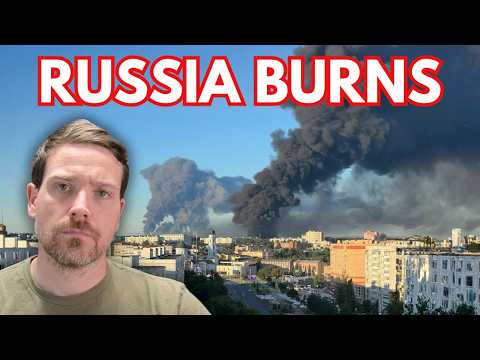
The strongest portion of this update is the opening coverage of the fire at a Wildberries distribution center in Tula. The presenter uses dramatic images and video to convey the scale of the blaze, then connects the site to a broader pattern of attacks he says has affected 16 Wildberries warehouses in less than three weeks. The accompanying map and “bingo board” make that campaign easy to follow, while the seller’s complaint that vendors cannot retrieve inventory adds a practical consequence beyond the spectacle of another burning building. Where the segment becomes less reliable is in the leap from repeated attacks to confident predictions that Ukraine will soon destroy the remaining facilities and effectively end Wildberries before moving on to another retailer.
That pattern continues through the refinery coverage. Strikes in Ufa, Yaroslavl, Saratov and Taman are presented with maps, satellite images and claimed strike histories, giving the update a useful logistical focus rather than treating each explosion as an isolated event. The repeated attacks on Yaroslavl in particular support the presenter’s larger argument that Ukraine is attempting sustained disruption rather than one-off damage. At the same time, assessments such as a refinery being rendered ineffective, damage being “good,” or repairs hopefully taking a long time remain commentary unless independently established, and the video often treats visible fire or structural damage as sufficient evidence of operational consequences.
The discussion of Russia’s fuel supply is more informative because it tries to examine adaptation as well as destruction. The presenter acknowledges that shortages and long lines have apparently eased in major cities, then attributes part of that stabilization to allowing lower-grade fuel and explains the claimed differences between Euro 2 and Euro 5 standards. This is one of the few sections where the narrative concedes that Russia has found a way to mitigate some pressure rather than simply moving from one Russian setback to the next. However, the categorical assertion that modern cars cannot run on Euro 2 fuel and may fail immediately is presented without qualification or supporting detail, making a technically specific claim sound more certain than the material here establishes.
The strongest logistical material concerns Crimea and occupied territories. Damaged ferries reportedly being repurposed as barges, tugboats moving them across the strait, destroyed bridges forcing traffic onto slower detours, and drone units targeting trucks around those chokepoints all combine into a coherent explanation of how infrastructure damage can create secondary vulnerabilities. Maps and visual examples help enormously here. Yet the analysis also slips casually into advocating additional attacks on ferries, tugboats, electrical systems and other targets, and claims such as every power plant or substation in Crimea having been destroyed are repeated at face value rather than carefully separated from the source making them.
The episode becomes substantially less disciplined when it turns to the reported Moscow restaurant bombing and then the Russian strikes on Kyiv. The account of a general’s death is built partly through inference: because he reportedly attended the party and later had a funeral, the presenter concludes that he “must have” died in the explosion. That may be plausible within the narrative provided, but plausibility is not confirmation. By contrast, the material from Kyiv conveys civilian danger much more effectively, particularly through descriptions of deaths, damaged civilian facilities and the consequences of depleted air defenses. Even there, however, statements that Russia’s intended targets are specifically civilian areas and that attacks are simply “terrorism” are asserted as conclusions rather than carefully distinguishing documented strike effects from demonstrated targeting intent.
The final third loses much of the evidentiary discipline established earlier. Reduced American air-defense deliveries are quickly connected to speculation that the Trump administration may be deliberately pressuring Ukraine to surrender territory, followed by claims of a financial motive involving future business deals with Russia. The presenter briefly calls this a conspiracy theory and later says incompetence is the simpler explanation, but he still spends considerable time developing an allegation for which no direct evidence is provided here. The subsequent discussion of Iran goes further, declaring that the United States has lost the war, that Iran effectively controls the Persian Gulf, that American military strength is at its lowest point since World War II, and that allies cannot rely on the United States. These are sweeping geopolitical judgments delivered with far more certainty than the material presented can support.
The closing discussion of North Korean missile personnel and the devastated hometown visited by a Russian soldier restores some emotional focus but not greater caution. The possibility that North Korea wants battlefield experience and weapons testing is presented as an inferred motive, while the soldier’s reaction to his destroyed town gives the episode a genuinely human ending. The presenter interprets the scene as an indictment of the military the soldier serves, which is consistent with the video’s openly pro-Ukrainian perspective, but claims that all residents were killed or forced out and that the town will never return are stated categorically without further substantiation. Across the full update, there is a large amount of potentially useful open-source material, but the presentation repeatedly blurs the boundary between what images appear to show, what outside sources reportedly claim, what the presenter infers, and what he treats as settled fact.
Pros
- Uses maps, satellite imagery, strike histories and video clips to make complicated logistical campaigns comparatively easy to follow.
- The Wildberries, refinery, ferry and trucking sections connect individual attacks into broader operational patterns rather than presenting disconnected explosions.
- Acknowledges some Russian adaptation, particularly the apparent easing of fuel shortages in major cities.
- The Crimea ferry and damaged-bridge examples clearly illustrate how infrastructure disruption can create secondary transportation vulnerabilities.
- Coverage of Kyiv gives sustained attention to civilian consequences and the practical importance of air-defense shortages.
Cons
- Frequently converts visible destruction or reported strikes into confident claims about operational shutdowns without establishing the actual extent or duration of the damage.
- Predictions that Ukraine will eliminate the remaining Wildberries sites and then move to other retailers are speculative but presented with considerable certainty.
- Several technical and strategic claims, including assertions about Euro 2 fuel, Crimea’s power grid and refinery effectiveness, receive little qualification.
- The reported death of a Russian general is partly reconstructed through inference and then treated as essentially confirmed.
- Speculation about the Trump administration deliberately withholding air defense to force Ukrainian concessions and pursuing personal financial benefits is not supported by direct evidence presented here.
- Sweeping declarations about Iran, American military weakness and the reliability of U.S. alliances move far beyond the specific evidence shown.
- Open advocacy for additional Ukrainian strikes and mocking commentary sometimes overtakes careful analysis of what can actually be verified.
The update is most effective when it stays close to maps, imagery and concrete logistical consequences, particularly around warehouses, refineries, ferries and transportation routes. It becomes much less dependable when those observations expand into predictions, inferred motives and sweeping geopolitical conclusions presented as though they were equally well established. The result is engaging and often informative war commentary, but its strongest evidence would carry more weight with substantially tighter separation between documentation, interpretation and speculation.