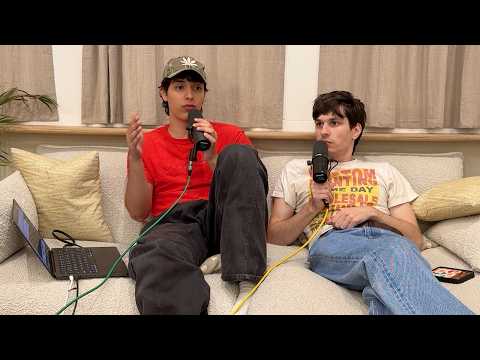
Human brain tissue grown in a mouse, a streaming service asking whether anyone is still listening, and a bizarre chicken commercial establish the compilation’s formula immediately: find something unsettling or unusual, add a suspicious interpretation, and let humor keep the material moving. The host is at his best when he treats that formula playfully. Jokes about becoming “half Chuck E. Cheese,” extraterrestrial craft looking insufficiently stealthy, and escaping prison with a pencil give the collection a personality beyond simply recycling strange clips.
The biggest problem is that the compilation mixes genuinely interesting subjects with extraordinary claims without consistently separating the two. The segment about human brain tissue at least acknowledges potential medical research applications and explicitly rejects notions of human intelligence or mouse “superpowers.” Elsewhere, however, speculation about occult symbolism in advertising, genetically engineered pandas, celebrity cloning, hidden activity in Antarctica, geoengineering, staged history, and a coordinated 2030 transformation is presented with far less skepticism. The host occasionally pushes back—most notably by questioning whether an Alexa demonstration really constitutes psychic remote viewing—but that standard is applied unevenly.
The panda section demonstrates the problem particularly clearly. Details about reproduction, bamboo consumption, zoo arrangements, and the species’ relationship with China are assembled into an elaborate theory that pandas were artificially bred from bears to control bamboo and effectively function as a government-owned biological patent. Even within the segment, the leap from observations about an unusual animal to deliberate state engineering is enormous. The humorous comparison to leased cars makes the theory entertaining, but entertainment does not supply the missing evidence, and the presentation gives viewers little help distinguishing biological facts from internet speculation.
Similar issues appear in the paranormal and conspiracy material. Reports of “glimmer men,” a supposedly transparent woman, celebrity clones, and mysterious figures appearing during a news broadcast are intriguing as unexplained or visually ambiguous clips, but the footage described here cannot establish the supernatural explanations attached to it. The celebrity-cloning sequence is especially weak as an argument because changes in appearance, personality, music videos, movies, rumors, and supposed visual “glitches” are treated as mutually reinforcing clues rather than independent evidence. By contrast, the host’s jokes often work precisely because they do not require viewers to accept the claims literally.
The 2030 sequence is the clearest example of pattern-finding overtaking analysis. It connects CERN, fusion research, digital currency policy, Mars missions, automation, and United Nations goals because various dates allegedly converge around the end of the decade, then escalates those coincidences into claims about humanity, frequency, the Higgs field, and a coordinated transformation. The host’s response—wondering what happened to ordinary particle research—is funny, but the segment would be considerably stronger if it explicitly challenged the causal connections rather than merely reacting to their strangeness.
Not every entry depends on grand theories. The prison escape story has a straightforward sequence of events and an amusing punchline, while the malfunctioning doll, mysterious mushroom, disappearing nail, South Pole footage, and unsettling street recordings work as compact curiosities. These portions suit the compilation format better because viewers can enjoy the oddity without being asked to accept sweeping conclusions. The rapid movement between subjects also prevents any one weak clip from dominating, although it comes at the cost of meaningful investigation whenever a subject actually deserves scrutiny.
Pros
- The host’s frequent jokes and reactions give a large collection of unrelated clips a consistent personality.
- Some segments acknowledge uncertainty or offer mundane alternatives rather than automatically accepting the most sensational interpretation.
- The variety ranges effectively from paranormal footage and technological oddities to historical claims, unusual objects, and a prison escape.
- Shorter mystery clips fit the fast-moving compilation format particularly well.
Cons
- Extraordinary claims about pandas, celebrity cloning, geoengineering, Antarctica, occult activity, and 2030 are often given far more attention than the evidence supporting them.
- Established information, personal interpretation, coincidence, rumor, and conspiracy theory frequently appear alongside one another without sufficiently clear distinctions.
- Several visual anomalies are treated as potentially paranormal despite the limited ability of the presented material to establish what actually occurred.
- The rapid compilation structure leaves little room to verify or seriously examine claims before moving to the next mystery.
The compilation succeeds most consistently as humorous entertainment built around strange footage and unsettling internet claims, with the host’s reactions providing much of its momentum. Its credibility becomes considerably weaker whenever intriguing observations are allowed to grow into elaborate theories without comparable evidence or sustained skepticism. A clearer distinction between documented oddities and speculative explanations would make the rabbit-hole format both more compelling and more trustworthy.