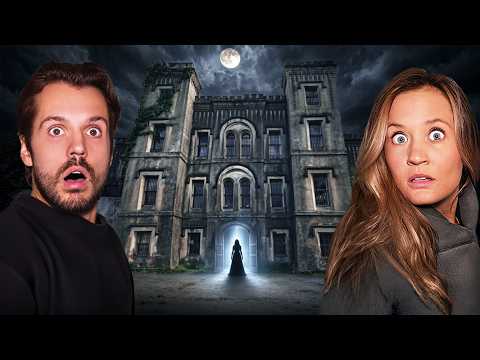
Thirty East Drive arrives with an unusually dense collection of paranormal stories already attached to it, and that reputation immediately shapes the investigation. The group recounts the Pritchard family’s alleged experiences beginning in 1966, including moving objects, unexplained water, a violently shaking bed, apparent strangulation marks and sightings of a hooded figure. The historical framing is effective at establishing why the property became famous, but several details are presented as inherited accounts rather than documented facts, while the proposed connection to an executed monk is explicitly acknowledged as debatable.
The tour becomes more interesting when Two Ghost Girls describe experiences from their own previous visits. A shadow reportedly crossed the living-room doorway, a bag fell shortly afterward, a REM pod appeared to react as though something were descending the stairs, and a loud bang was captured by a camera elsewhere in the building. These accounts give the location a sense of continuity, although the most dramatic incidents were either not filmed directly or occurred under circumstances that make their causes impossible to establish.
Some welcome skepticism appears during the walkthrough. A bedroom door that reportedly opens by itself is discussed alongside the possibility of floorboard pressure, while a gust of cold air near the boiler is traced to an opening that could provide a straightforward explanation. When a light briefly dims, the group also notes the type of fixture rather than immediately declaring paranormal activity. These moments strengthen the investigation because they show at least some willingness to consider the building itself before reaching for supernatural explanations.
The doll room pushes the presentation in the opposite direction. Donated dolls arrive with stories about scratching people, mysteriously returning to owners and generating activity, while mirrors are discussed as possible portals and nightmares are attributed to sleeping opposite them. The investigators occasionally recognize psychological suggestion — particularly when several people react negatively to an eyeless doll — but claims about mirrors, demons disguising themselves as children and particular objects carrying energy are largely treated as accepted paranormal principles without evidence.
The most questionable interpretive leap comes when bodily sensations are assigned specific supernatural meanings. A squeezing sensation around the heart is said to indicate feminine energy, while perceived presences, anger and repeated impressions of “go away” become part of the developing narrative. These experiences may be sincere, but there is no demonstrated method for establishing that a physical sensation identifies a spirit’s gender or that an internal impression originates from an external entity. The distinction between personal intuition and independently observable evidence becomes especially important in a location where everyone already knows the haunting stories.
What gives the closing section genuine tension is the sequence of unexplained sounds. Footsteps, knocks and heavier noises appear to come from elsewhere in the house while the four investigators remain together, and the group repeatedly tries to provoke another response by retelling the same account. The apparent repetition is intriguing, particularly when Two Ghost Girls say they have not previously heard someone seemingly walking around upstairs in that manner. Yet without controlled cameras covering the relevant rooms, examination of neighboring or exterior noise, or a systematic attempt to reproduce the sounds through the structure, their source remains unresolved rather than demonstrably paranormal.
Pros
- The house tour provides useful context for both the property's famous haunting claims and the investigators' previous experiences there.
- Two Ghost Girls add firsthand continuity by describing specific incidents from earlier visits rather than relying entirely on the property's broader legend.
- Several ordinary possibilities, including floorboard pressure, airflow and building fixtures, are at least considered during the investigation.
- The repeated footsteps, knocks and heavier upstairs sounds create an effectively tense final stretch without revealing an obvious source.
- The investigators occasionally recognize the possibility of psychological suggestion rather than treating every uneasy reaction as proof of a haunting.
Cons
- Much of the property's historical and paranormal lore is repeated without enough sourcing to separate documented history from later legend.
- Claims about mirrors, demons, feminine energy and intuitive spirit communication are presented with little evidentiary basis.
- Personal sensations and impressions are frequently incorporated into the supernatural narrative without independent corroboration.
- The unexplained footsteps and impacts are not investigated under sufficiently controlled conditions to eliminate structural, exterior or other ordinary causes.
- Stories attached to donated dolls contribute atmosphere but also increase expectation and confirmation bias before experiments even begin.
Thirty East Drive provides an excellent setting for paranormal entertainment, and the unexplained noises near the end give this first installment some legitimately effective suspense. Its evidentiary case is considerably weaker, with folklore, intuition and paranormal assumptions often carrying more weight than controlled testing. As an atmospheric investigation it works well, but its strangest moments remain unanswered questions rather than convincing evidence of a Black Monk or any other supernatural presence.