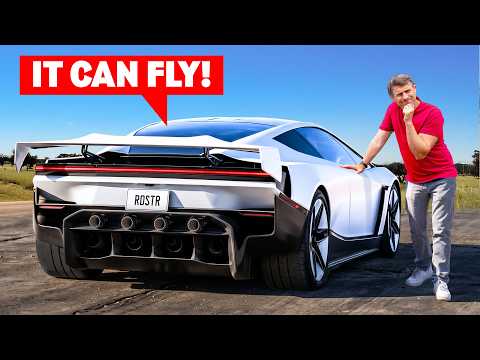
A sports car capable of lifting off the ground, performing aerial maneuvers, and accelerating from zero to 60 mph in less than a second sounds more like a science fiction experiment than a conventional automotive launch. Tesla's latest Roadster presentation embraces that extraordinary premise, combining SpaceX-derived propulsion technology with aggressive aerodynamic engineering and a series of dramatic demonstrations. Elon Musk and his engineering team present the vehicle as both a flying car and an exceptionally capable driver's machine, delivering an entertaining spectacle while raising substantial questions about practicality, safety, and whether its remarkable performance can translate into a production vehicle.
The most unusual feature is the combination of a powerful underbody suction system and compressed-air thrusters. According to the presenters, the suction system can generate up to two g's of downward force, potentially allowing the Roadster to remain attached to surfaces even when inverted. The claimed benefits extend beyond theatrical demonstrations, with additional traction intended to improve acceleration and cornering performance. The engineering team also describes two high-pressure storage vessels holding a combined 600 liters, approximately 250 kilograms of air, and ten propulsion nozzles. These specifications provide welcome technical substance, although the presentation does not establish how consistently the system can deliver its claimed capabilities under real-world conditions.
The flying demonstrations provide the event's biggest entertainment moments. Musk describes a vehicle equipped with attitude-control thrusters and rear propulsion capable of controlled flight, rolls, and other aerial maneuvers. A longer flight sequence, including a maneuver jokingly identified as a kickflip, reinforces the presentation's deliberately outrageous atmosphere. The presenters' enthusiasm and spontaneous reactions make these sequences particularly engaging, but the demonstration offers limited independent evidence about flight stability, repeatability, or operational safety. Musk's acknowledgment that the vehicle is not necessarily optimized for safety is especially significant given the extreme forces and unconventional operating conditions being discussed.
The physical Roadster reveal brings the presentation back toward recognizable automotive engineering. Its clean exterior incorporates aerospace-inspired styling, while the two-seat cabin features seats molded into the chassis to reduce weight. Steer-by-wire steering, braking, and throttle controls emphasize the unconventional approach. The engineering team also explains how the car switches between low-drag and high-downforce configurations, using variable aerodynamic components and a dynamically adjustable rear wing. These details help connect the futuristic spectacle to legitimate vehicle-design considerations, although questions about mechanical complexity, component reliability, and maintenance receive little attention.
Acceleration becomes another major attraction when the presenters attempt to demonstrate the Roadster's ability to reach 60 mph in less than one second. After some confusion surrounding the live timing display, the reported result settles at an extraordinary 0.81 seconds. The team also claims that four rear thrusters produce more than 80 kilonewtons of thrust, with exhaust traveling faster than sound. Musk suggests that a lighter production version could achieve even better acceleration. These are impressive figures as presented, but without independently verified measurements, detailed test conditions, or meaningful comparisons, they remain claims made during a manufacturer-controlled demonstration rather than conclusively established production-car performance.
The event becomes increasingly ambitious as the discussion turns toward future demonstrations and maximum speed. Musk and his colleague propose revisiting Evel Knievel's famous Snake River Canyon jump, while discussing speeds exceeding 230 mph and potentially approaching half the speed of sound. Their willingness to entertain such extreme possibilities contributes to the presentation's playful energy, but it also blurs the distinction between demonstrated engineering, projected capability, and speculative ambition. The promised 2028 production timeline receives similarly little supporting detail, leaving unanswered questions about manufacturing readiness, regulatory approval, pricing, and whether customers could legally operate the vehicle's more extraordinary features.
What ultimately distinguishes the presentation is its combination of genuine engineering discussion and unapologetic showmanship. The technical explanations surrounding traction, aerodynamic configurations, pressure vessels, and propulsion provide enough substance to make the event more interesting than a conventional promotional reveal. Musk's humor and the engineering team's enthusiasm also keep the proceedings lively, even when demonstrations encounter minor delays. Nevertheless, the consistently celebratory atmosphere offers almost no meaningful scrutiny of the vehicle's limitations. Practical concerns involving compressed-air replenishment, energy consumption, repeated high-performance operation, passenger protection, and everyday usability deserve considerably more attention than they receive.
Pros
- The combination of controlled flight, rocket-inspired propulsion, and extreme acceleration creates a highly unusual and entertaining automotive presentation.
- Specific explanations of the suction system, compressed-air storage, propulsion nozzles, and adaptive aerodynamics give the ambitious concept meaningful technical substance.
- The reported 0.81-second acceleration result provides a concrete performance claim, making the demonstration more informative than vague promises of exceptional speed.
- The exterior and interior reveal offers useful insight into the Roadster's lightweight construction, unconventional controls, and aerospace-influenced design.
- The presenters' enthusiasm, humor, and spontaneous exchanges create an energetic atmosphere that makes the technical material approachable.
Cons
- Extraordinary acceleration, flight, cornering, and propulsion claims lack independent verification and sufficiently detailed testing information.
- Safety receives inadequate examination despite the explicit acknowledgment that the vehicle is not necessarily optimized for occupant protection.
- Practical engineering questions involving compressed-air replenishment, energy demands, durability, maintenance, and repeated operation remain largely unanswered.
- Speculative speed targets and proposed stunt demonstrations sometimes overshadow realistic discussion of the vehicle's capabilities.
- Regulatory requirements, pricing, everyday usability, and the feasibility of the announced 2028 production schedule receive insufficient scrutiny.
- The promotional presentation provides little opportunity for challenging questions about whether the technology can become a commercially viable road car.
Tesla delivers an ambitious and thoroughly entertaining showcase that pushes the traditional sports car concept into territory normally associated with experimental aircraft. The engineering explanations, unconventional design, and dramatic demonstrations make the Roadster fascinating, but the absence of independent testing and meaningful discussion of safety and practicality prevents the presentation from fully substantiating its extraordinary promises. As a display of technological imagination and automotive showmanship, it succeeds impressively, even if its ultimate credibility depends on evidence that has yet to be provided.