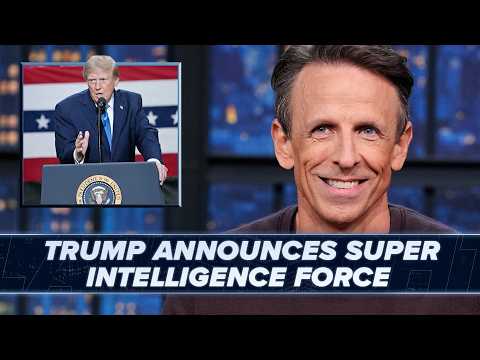
Donald Trump's suggestion that Ukraine should replace President Volodymyr Zelenskyy provides the central controversy in this fast-moving political commentary from the MeidasTouch Network. Speaking to reporters outside the White House, Trump argues that Zelenskyy repeatedly rejected opportunities to negotiate peace with Russia and declares that Ukraine needs a different leader. Ben responds by portraying those remarks as evidence of Trump's willingness to accommodate Vladimir Putin while placing responsibility for the continuing war on Ukraine. The confrontation raises important questions about American foreign policy, Ukrainian sovereignty, and the political consequences of Trump's approach to Russia.
The opening benefits considerably from playing Trump's actual statements rather than relying entirely on the host's interpretation. Viewers hear the president criticize Zelenskyy's leadership, claim the war would never have happened under his presidency, and demand that Ukraine stop attacking Russian oil refineries. Ben also highlights a supportive response attributed to Russian official Kirill Dmitriev, who celebrates Trump's remarks as historic. That reaction provides useful political context, although the commentary moves too quickly from Russian approval to suggesting that Trump's decisions necessarily reflect Putin's objectives. The distinction between a policy benefiting Russia and evidence of deliberate coordination deserves more careful examination.
One of the presentation's strongest sections concerns the apparent contradictions between Trump's previous positions on Russian energy and his current approach. A compilation shows Trump criticizing European countries and India for purchasing Russian oil, while Ben discusses a reported arrangement involving Russian diesel shipments to the United States. Another montage revisits Trump's repeated 2024 promises to end the Ukraine war within 24 hours. These comparisons effectively expose tensions between campaign rhetoric and subsequent policy decisions. However, the reported diesel arrangement, its timeline, and the suggestion that a particular tanker establishes prior negotiations are not independently substantiated within the presentation.
The discussion broadens considerably when Ben turns to escalating violence across the Middle East. Reports of an attack on Riyadh's international airport, tanker strikes near the Strait of Hormuz, and warnings issued to commercial vessels create a disturbing picture of regional instability. The presentation references a Financial Times account of approximately 50 injured people receiving hospital treatment and distinguishes that report from an unconfirmed death toll. Footage attributed to Iranian authorities adds immediacy, but the rapidly changing circumstances require greater caution. Assertions about American aircraft carrier movements, Iranian targeting intentions, and the strategic vulnerability of naval forces receive limited supporting explanation.
A particularly serious weakness emerges during the discussion of American military casualties. Ben reports an official Pentagon figure of 21 deaths and 865 wounded personnel, then argues that the actual number of injured troops could reach between 5,000 and 7,000. His concern about traumatic brain injuries following missile attacks is understandable as a potential investigative question, but the dramatically higher estimate is presented without medical records, casualty documentation, or other verifiable evidence. The suggestion that officials may be manipulating casualty classifications also remains unproven. Such allegations concern military accountability and public trust, making evidentiary precision especially important.
An inserted climate segment offers a more policy-focused examination of how military conflict and energy dependence affect American consumers. The contributor connects rising fuel costs with the administration's reported relaxation of vehicle efficiency standards, arguing that greater fossil fuel consumption could increase household expenses and long-term emissions. The comparison with Britain's reported savings from wind and solar generation provides a useful international perspective. Nevertheless, the segment supplies limited sourcing for its economic figures and regulatory projections, while its placement interrupts the central discussion of Ukraine and Russia. Additional detours involving Trump's Nobel Peace Prize complaints and comments about a possible public execution further weaken the presentation's focus.
Ben's delivery remains energetic throughout, and the extensive use of political clips gives viewers opportunities to assess several statements directly. Mike Pence's criticism of easing Russian energy sanctions introduces a notable dissenting Republican perspective, reinforcing that objections to Trump's approach are not confined to Democrats. Yet Ben frequently substitutes insults and assertions about Trump's personal loyalty to Putin for sustained analysis of competing policy explanations. Claims that Trump wants Russia to win or is effectively working to destroy the United States are explicitly framed at times as opinion, but their repetition creates an impression of certainty unsupported by the material presented. The result is engaging partisan commentary with several legitimate questions, rather than a consistently rigorous examination of international developments.
Pros
- Direct footage of Trump's remarks allows viewers to assess his criticism of Zelenskyy and demands concerning Russian oil refineries.
- Compilations of Trump's earlier Ukraine peace promises and statements opposing Russian energy purchases expose meaningful inconsistencies in his political messaging.
- The reported Russian reaction and Mike Pence's criticism provide relevant perspectives on the diplomatic consequences of Trump's position.
- Coverage of Middle Eastern attacks, shipping disruptions, and military casualties conveys the broader international stakes of escalating conflict.
- The climate segment connects energy policy with fuel prices, consumer expenses, and dependence on international oil markets.
- Ben's energetic presentation and frequent supporting clips maintain urgency across a substantial collection of developments.
Cons
- Repeated accusations that Trump is deliberately serving Putin's interests rely heavily on political interpretation rather than demonstrated evidence of intent.
- The estimate of 5,000 to 7,000 American military injuries and suggestions of concealed casualties lack sufficient documentation.
- Claims about Russian diesel shipments, naval deployments, and rapidly developing military incidents receive inadequate independent verification.
- Frequent personal insults and emotionally charged descriptions undermine the credibility of otherwise substantive foreign policy criticism.
- The rapid movement between Ukraine, Iran, Saudi Arabia, climate regulations, military casualties, and unrelated presidential remarks creates a fragmented narrative.
- Limited consideration of alternative diplomatic and strategic explanations makes the discussion more persuasive to an existing audience than informative to undecided viewers.
Ben delivers an urgent and frequently revealing critique of Trump's approach to Ukraine, with particularly effective comparisons between the president's earlier promises and his current statements. Direct political footage and relevant international developments strengthen the presentation, but speculative casualty estimates, sweeping allegations about presidential motives, and an increasingly scattered structure undermine its journalistic reliability. The result is compelling political commentary that raises worthwhile questions about American foreign policy while falling short of the evidentiary discipline needed to answer them convincingly.