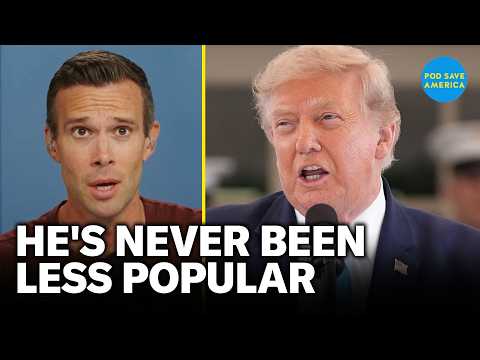
A $400 million political war chest provides the opening conflict, with the hosts questioning whether money supposedly intended to strengthen Republicans in the midterms is instead being used to promote Donald Trump personally. Their central exhibit is a super PAC advertisement filled with praise for Trump’s courage, resilience and leadership but, as they point out, remarkably little discussion of specific accomplishments or congressional candidates. That is a sharp observation grounded directly in the material they play, and their description of the ad as vaguely inspirational rather than strategically informative gives the segment an effective starting point.
The analysis becomes more speculative when the hosts move from criticizing the advertisement to interpreting Trump’s motives. One suggests that Trump almost seems uninterested in preventing a Republican defeat, while another offers the more nuanced possibility that he expects losses and is preparing to blame congressional Republicans. They identify the SAVE Act and disputes over recess appointments as areas of tension, but the broader claim that Republicans are becoming a receptacle for Trump’s poor approval ratings remains an interpretation rather than something demonstrated here. The discussion would have been stronger with more detail about the spending itself, which races Republicans believe need assistance, and evidence that party officials are actually “livid” about how the money is being deployed.
From there, the program largely leaves midterm campaign strategy behind and becomes a rapid tour through statements and behavior from prominent administration figures. J.D. Vance’s comments about the Antichrist and the end times prompt a lengthy discussion of his religious worldview and whether his policies are compatible with his stated desire to do “God’s work.” The hosts connect that question to immigration enforcement, Haiti, Medicaid, tariffs and economic hardship, but several serious assertions are introduced without enough supporting information to independently assess them. The moral critique is clear; the evidentiary foundation is considerably thinner.
An unexpectedly revealing moment comes when the hosts themselves become confused about the meaning of “blood libel.” Their improvised discussion cycles through the crucifixion of Jesus and the Passover story before they eventually arrive at a description of the antisemitic accusation involving the ritual murder of non-Jewish children. The willingness to correct themselves is preferable to confidently leaving the error unaddressed, and the exchange is genuinely funny in places. Still, it illustrates the danger of freewheeling commentary on historical and religious subjects: several inaccurate explanations are offered before the correction arrives.
The Sean and Rachel Campos-Duffy segment is more straightforward comedy. After playing Sean Duffy’s argument that Sydney Sweeney demonstrates that “men are still men” and “women are still women,” the hosts ridicule the attempt to transform attraction to a celebrity into a broader statement about gender, religion and political culture. Their point that the controversy appears inflated into a symbolic culture-war battle is clearly expressed, although the conversation quickly becomes deliberately crude and spends considerably more time mocking the Duffys than examining any substantive political significance.
Jeanine Pirro’s weightlifting clip then provides an almost entirely comic closing sequence, with mock coaching about her bench-press form and jokes about administration officials producing personal-content spectacles. It is amusing as podcast banter and fits the hosts’ chemistry, but by this stage the original question about Trump’s campaign resources has almost completely disappeared. Viewers arriving primarily for an examination of Republican midterm finances will therefore get far less analysis than the title suggests.
Across the program, the hosts are at their best when reacting to material immediately in front of them: noticing what Trump’s advertisement fails to say, questioning grandiose interpretations of celebrity culture, and puncturing political self-seriousness with quick humor. Their conversational chemistry keeps an eclectic collection of clips moving, and they occasionally challenge one another rather than presenting perfectly synchronized opinions. The tradeoff is rigor. Important political, economic, immigration and historical claims frequently receive less verification than the jokes surrounding them, while the promising opening story about campaign spending is never developed into the detailed examination it could have been.
Pros
- The critique of the Trump super PAC advertisement focuses effectively on its lack of concrete accomplishments or support for individual midterm candidates.
- The hosts distinguish between different possible explanations for Trump’s relationship with congressional Republicans rather than settling immediately on a single motive.
- Their willingness to correct the confused discussion of blood libel prevents the initial historical errors from standing unchallenged.
- Strong conversational chemistry and quick humor keep a wide-ranging collection of political and culture-war clips engaging.
Cons
- The headline subject of Trump’s $400 million war chest receives surprisingly little detailed examination, with no meaningful breakdown of spending, targeted races or documented Republican objections.
- Claims about Trump’s motives and his preparation to blame Republicans for possible midterm losses are largely speculative.
- Serious assertions involving immigration, Haiti, Medicaid, tariffs and poverty are introduced without enough evidence or contextual detail to evaluate them properly.
- The extended confusion over blood libel exposes weaknesses in the hosts’ command of historical and religious material before they eventually reach a correction.
- Later segments about Sydney Sweeney and Jeanine Pirro prioritize comedic mockery over the substantive midterm analysis established at the beginning.
The opening campaign-finance discussion identifies a legitimate strategic question and makes an incisive point about an advertisement that promotes Trump without explaining much of a midterm case. Yet the program soon turns into a broader comedic roundup, where energetic chemistry consistently outpaces depth and several consequential claims receive insufficient support. It succeeds as lively partisan political entertainment more than as the focused examination of Republican midterm spending its central premise promises.