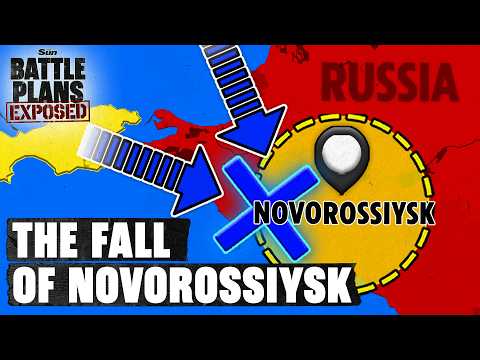
Ukraine’s efforts to disrupt Russian advances across the Donetsk region take center stage in Philip Ingram’s latest Battle Plans analysis, which examines a series of counterattacks, deep strikes, and emerging military technologies. Rather than treating individual battlefield successes as isolated incidents, Ingram connects them to a broader strategy aimed at undermining Russia’s ability to sustain offensive operations. The central argument is that Ukrainian forces are increasingly seizing the tactical initiative while systematically attacking the logistical and industrial infrastructure supporting Russian advances. It is an engaging assessment of modern warfare, although the presentation frequently expresses greater certainty about battlefield outcomes than the supporting information establishes.
The discussion opens with several examples of Ukrainian strikes against Russian military assets, including an ammunition depot, a mobile air defense position, an oil refinery, and a helicopter. These incidents illustrate how relatively inexpensive unmanned systems can threaten valuable equipment and disrupt essential supply networks. Ingram is particularly effective when explaining why destroying ammunition reserves, fuel infrastructure, and transportation assets can have consequences beyond the immediate explosions. His examination of a Russian gunner attempting to defend a truck-mounted weapon against an incoming drone also highlights the vulnerability of conventional defensive positions. However, descriptions of catastrophic destruction and crippling logistical consequences are often presented without detailed damage assessments or independently established evidence of their wider operational effects.
The most substantial battlefield analysis concerns Ukrainian counterattacks around the Donetsk fortress belt, including reported territorial gains near the Siverskyi Donets–Donbas Canal and fighting around Kostyantynivka. Ingram explains how these operations could disrupt Russian attempts to outflank fortified Ukrainian positions, drawing connections between the earlier Operation Vivaldi near Lyman and what he identifies as a possible second phase farther south. His use of maps and geographic references helps clarify the importance of defensive corridors, supply routes, and Russian efforts to establish favorable attack positions. The discussion becomes especially interesting when he describes Ukrainian forces employing coordinated assault formations, drones, artillery, and electronic warfare to challenge Russian spearheads. Nevertheless, the identification of these actions as a developing Vivaldi 2.0 operation remains speculative, and claims that Russia has lost its ability to outflank the fortress belt would benefit from more cautious qualification.
A recurring theme is the relationship between Ukraine’s tactical counterattacks and its longer-range campaign against Russian industrial infrastructure. Ingram argues that attacking oil refineries, chemical facilities, and military production sites could prove more consequential than destroying individual weapons after they reach the battlefield. This distinction between tactical and operational warfare gives the presentation analytical depth and helps explain the strategic reasoning behind strikes hundreds of kilometers from the front. He also raises the possibility that fuel shortages and competing domestic priorities could weaken Russian military operations during winter. However, the reported diversion of fuel supplies toward Moscow and predictions about Russia’s economic vulnerability receive limited substantiation, making the broader conclusions less convincing than the underlying logistical principles.
The examination of Ukrainian drone innovation provides another valuable dimension. Ingram discusses reports of balloons carrying attack drones and explains how autonomous guidance systems, onboard navigation, and terminal visual recognition could reduce reliance on external satellite communications. His comparison with guidance methods used in cruise missiles makes the technology understandable without requiring extensive technical knowledge. The suggestion that domestically developed systems could give Ukraine greater operational independence from foreign restrictions is particularly significant. Still, the presentation moves quickly from describing technological capabilities to asserting that Ukraine has effectively overcome external targeting limitations and Russian electronic warfare defenses. These sweeping conclusions are not accompanied by enough technical evidence to establish their full reliability or practical limitations.
One of the more memorable sections shifts away from high-technology warfare to recount a Ukrainian territorial defense unit's reported 28-day effort to excavate an underground infiltration route through a narrow irrigation pipe in June 2024. The account describes the physical hardship, confined working conditions, dangerous encounters, and eventual use of the tunnel to bypass Russian defenses. It provides a compelling reminder that modern combat still depends on conventional engineering, endurance, and tactical improvisation. Ingram strengthens the segment by connecting the operation to historical siege mining and the extensive tunneling conducted during the First World War. Although the historical comparison effectively illustrates the enduring importance of military engineering, the detailed account of the tunnel operation would carry greater weight with clearer attribution and supporting evidence.
Ingram's presentation benefits from a consistent strategic framework and a willingness to explain how seemingly separate military developments might influence one another. His commentary connects battlefield maneuvers, industrial production, autonomous weapons, and political pressure surrounding potential peace negotiations into a coherent interpretation of Ukraine's military position. However, the political developments introduced at the beginning receive little sustained attention afterward, leaving the relationship between Washington's diplomatic efforts and battlefield conditions underexplored. The language also frequently adopts an enthusiastic perspective toward Ukrainian achievements, with descriptions of decisive victories and devastating Russian setbacks sometimes replacing measured assessments of uncertainty. While the analysis offers useful military insights, the limited consideration of Russian adaptations, Ukrainian constraints, and alternative battlefield outcomes prevents it from achieving the balance expected of a comprehensive strategic assessment.
Pros
- Philip Ingram connects Ukrainian counterattacks, deep strikes, and logistical disruption into a coherent explanation of modern battlefield strategy.
- The map-based examination of the Donetsk fortress belt helps clarify the geographic importance of Ukrainian defensive positions and Russian flanking attempts.
- The discussion of Operations Vivaldi and the possible follow-up offensive provides an interesting framework for understanding coordinated Ukrainian countermeasures.
- The examples involving ammunition depots, fuel infrastructure, and transportation routes effectively explain why logistical targets can influence frontline combat effectiveness.
- The examination of autonomous drone navigation and unconventional aerial deployment offers accessible insight into evolving military technology.
- The account of Ukrainian soldiers constructing an underground infiltration route highlights the continuing importance of combat engineering and physical endurance.
- The historical comparisons with siege warfare and First World War tunneling add useful perspective to the discussion of contemporary battlefield tactics.
Cons
- Several claims of decisive Ukrainian victories and severe Russian logistical damage are presented without sufficient supporting evidence or detailed independent assessments.
- The suggested Vivaldi 2.0 operation remains speculative, yet the discussion occasionally treats its potential strategic consequences as nearly established.
- Assertions about Russian fuel shortages, economic deterioration, and the redistribution of military supplies lack enough substantiation to support the strongest conclusions.
- The discussion of autonomous drone technology overstates the certainty of Ukraine's independence from foreign targeting restrictions and its ability to overcome Russian defenses.
- The consistently favorable portrayal of Ukrainian operations provides limited consideration of Russian countermeasures, Ukrainian vulnerabilities, or alternative interpretations of battlefield developments.
- The opening discussion of American diplomatic pressure and potential peace negotiations is not sufficiently developed or integrated into the subsequent military analysis.
Philip Ingram delivers an informative and strategically focused examination of Ukraine's efforts to disrupt Russian offensives through coordinated counterattacks, innovative drone technology, and sustained pressure on military logistics. The geographic explanations, operational connections, and historical comparisons make complicated battlefield developments accessible, but the analysis is weakened by overly confident conclusions and insufficient scrutiny of several important claims. It is a worthwhile military briefing that offers valuable insight into Ukraine's evolving strategy, provided viewers distinguish plausible operational interpretations from independently established battlefield outcomes.