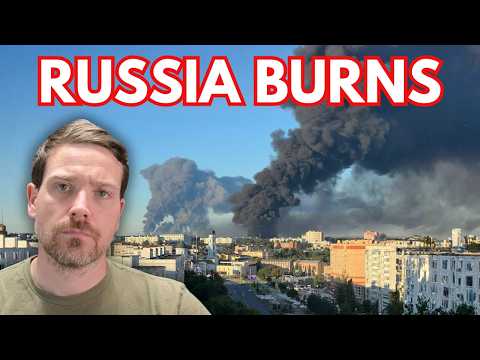
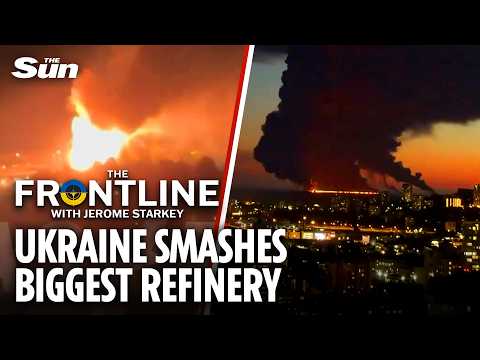
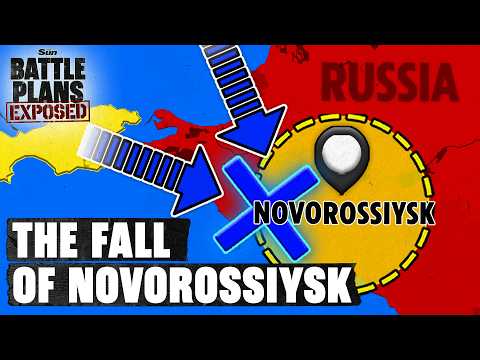
Ukraine’s expanding campaign against Russian military production facilities marks a significant shift in how Kyiv is attempting to weaken Moscow’s ability to sustain its war effort. Rather than concentrating exclusively on battlefield targets or intercepting incoming weapons, Ukrainian forces are increasingly striking factories responsible for manufacturing the components that make those weapons possible. The report examines several attacks on Russian industrial infrastructure, explaining their potential strategic importance while connecting the offensive to renewed British military assistance and reported disruptions affecting Starlink communications.
The opening discussion focuses on strikes against two industrial facilities in Voronezh: an aircraft manufacturing plant and a petrochemical complex. The presenter explains how synthetic rubber production supports military applications ranging from aircraft tires and armored vehicle components to specialized missile-related materials. This connection between seemingly conventional industrial production and weapons manufacturing provides useful context for understanding Ukraine’s targeting decisions. Russian claims of intercepting more than 100 drones are contrasted with reported fires and eyewitness footage of smoke near the facilities. However, the report appropriately acknowledges that the full extent of the damage remains uncertain, leaving the actual operational consequences unresolved.
The analysis becomes more substantial when examining the reported attack on the Energy plant in Yelets, which produces specialized batteries and power supplies used in Russian military systems. By identifying potential applications in ballistic missiles, guided aerial bombs, and other equipment, the presentation demonstrates why disabling a component manufacturer could create problems across several weapons programs. The discussion of four Storm Shadow missiles striking the facility, along with reported damage to a production building, gives the segment a concrete foundation. Nevertheless, claims that the attack dealt critical damage to Russian military capabilities would benefit from independent assessments of remaining production capacity, replacement suppliers, and potential recovery timelines.
A similar argument drives the coverage of the Proton electronics plant in Oryol. The facility is described as producing semiconductor devices and specialized electronics reportedly used in Russian missile and air-defense systems. Footage of multiple impacts and substantial structural damage reinforces the seriousness of the reported attack, while the explanation of how component shortages can affect several weapons programs simultaneously adds strategic depth. However, the assertion that the factory became unusable is presented with greater certainty than the available evidence clearly establishes. Visible destruction does not necessarily reveal the status of every production line, inventory reserve, or alternative manufacturing arrangement.
British support for Ukraine’s long-range strike capabilities provides an important secondary dimension. The explanation of the Storm Shadow missile’s purpose, its substantial warhead, and its suitability for attacking protected stationary targets helps viewers understand why these weapons are valuable against industrial facilities. Connecting renewed missile supplies to Ukraine’s broader campaign also creates a coherent strategic narrative. Yet the discussion of British replenishment lacks information about quantities and delivery schedules, making it difficult to determine how directly new assistance contributed to the attacks described. The reported agreement involving President Zelensky and British Prime Minister Andy Burnham also requires stronger sourcing, particularly because the presentation provides no supporting documentation for that diplomatic claim.
The Starlink and Starshield discussion introduces another potentially consequential issue but receives comparatively little examination. The presenter suggests that disruptions to these services complicated Ukrainian military operations and contributed to renewed emphasis on European long-range weapons assistance. However, the nature, duration, and operational effects of those disruptions remain unexplained. More importantly, the connection between communications difficulties, Storm Shadow deliveries, and the timing of the industrial strikes is asserted rather than demonstrated. The report would be more convincing if it distinguished confirmed operational developments from interpretations about how different events influenced Ukrainian decision-making.
The presentation remains accessible through its rapid progression between locations, specific industrial targets, and descriptions of their roles in Russian military production. References to eyewitness footage, Ukrainian military confirmations, Russian regional statements, and reported factory damage give the coverage immediacy. However, much of the evidence comes from Ukrainian official statements or selected footage, with limited independent verification of the damage assessments. The consistently emphatic language also creates a sense of certainty that occasionally exceeds what the reporting establishes. Although the closing membership promotion is relatively brief, it adds little to an otherwise focused military analysis. Ultimately, the report offers a useful overview of Ukraine’s industrial targeting strategy but falls short of demonstrating the precise military consequences of the attacks.
Pros
- Explains Ukraine’s strategic shift toward disrupting Russian military production and supply chains rather than relying exclusively on battlefield engagements and defensive interceptions.
- Identifies specific industrial facilities in Voronezh, Yelets, and Oryol, providing concrete examples of the reported long-range strike campaign.
- Clearly connects specialized batteries, semiconductors, synthetic rubber, and other industrial products to the manufacturing and operation of Russian military equipment.
- The discussion of the Energy plant effectively illustrates how damaging a specialized component manufacturer could affect several weapons programs simultaneously.
- Explaining the Storm Shadow missile’s capabilities provides valuable technical context for understanding Ukraine’s choice of targets.
- Incorporating Russian interception claims, Ukrainian military statements, and reported footage helps establish the competing accounts surrounding the attacks.
- Connects industrial strikes with broader challenges involving military assistance, communications systems, and shortages of defensive interceptors.
Cons
- Assertions that specific factories became unusable or suffered critical production losses are not supported by sufficiently detailed independent damage assessments.
- The claimed relationship between Starlink disruptions, British missile replenishment, and Ukraine’s intensified strike campaign receives limited supporting evidence.
- The reported diplomatic agreement involving Zelensky and Andy Burnham is presented without sourcing or documentation that would establish its accuracy.
- Little attention is given to Russia’s potential ability to restore damaged facilities, relocate production, or obtain replacement components.
- Reliance on official Ukrainian statements and selected impact footage limits the ability to independently evaluate the effectiveness of the attacks.
- Emphatic descriptions of devastating damage and strategic consequences sometimes blur the distinction between confirmed events and projected military effects.
Ukraine’s campaign against Russian military-industrial facilities receives an informative and strategically focused examination that successfully explains why specialized manufacturing targets matter beyond the immediate destruction of buildings. The coverage is particularly effective when connecting individual factories to broader weapons production networks, but its confident conclusions about operational damage, diplomatic developments, and communications-related disruptions require stronger verification. Despite those limitations, the report provides an engaging and accessible introduction to an increasingly important dimension of the conflict.