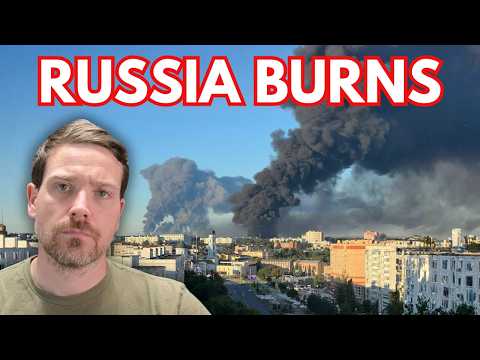
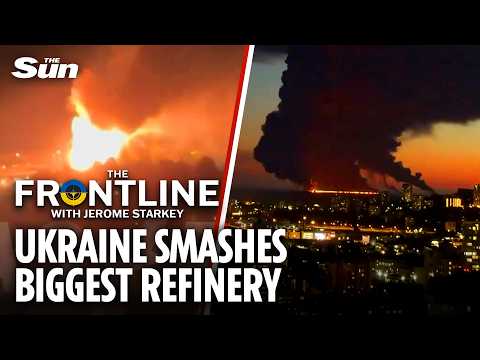
Burning industrial sites, damaged buildings and eyewitness recordings give this update an immediate sense of scale as the host pieces together reports of a major Ukrainian drone attack around Moscow. The Kapotnya refinery receives most of the attention, with multiple fires used to argue that the facility suffered extensive damage. The abundance of footage makes the report visually persuasive as an account of a chaotic morning, but some of the host’s strongest conclusions arrive well before the evidence presented can firmly establish them.
The refinery discussion is particularly consequential because the host describes it as critical to supplying Moscow and predicts fuel shortages as a result of the strike. He goes considerably further by declaring the facility effectively gone and forecasting that it will remain out of operation for months. Those are major assessments to make from early images and eyewitness footage alone, especially when he acknowledges that fresh satellite imagery is not yet available. The distinction between visible fires, probable damage and verified long-term loss of refining capacity is not maintained consistently enough.
Where the update works better is in showing the geographic relationship between the targets and Moscow. Maps are used to locate the refinery, surrounding districts, warehouses and Zhukovsky airfield, while the host discusses the challenge Ukrainian drones face in reaching targets around a heavily defended capital. He also identifies what he believes are particular Ukrainian weapons and Russian interception attempts. However, statements about air-defense effectiveness, interception rates, weapons performance and Russia’s inability to scale drone interceptors are presented confidently without supporting evidence sufficient to independently establish those figures or conclusions.
The eyewitness material adds immediacy and occasionally useful context. Residents react to explosions and fires, while the host translates or interprets their remarks and contrasts the scenes with an official statement describing the attack as having been repelled without serious damage. That contrast is one of the report’s clearest journalistic points: whatever the ultimate extent of the damage, the footage shown depicts substantial fires at multiple locations. At the same time, individual reactions from residents cannot support broader claims about what Russians generally think of the war, and the host sometimes extrapolates too much from a handful of sarcastic comments.
The report also suffers when analysis turns openly celebratory or dismissive. Jokes about blasted windows, predictions of Russian disintegration and comments about a future “Moscow’s People’s Republic” make the host’s sympathies unmistakable, but they weaken the analytical discipline of an update that also acknowledges a high-rise building was hit. His speculation that Russian air defenses may have contributed to residential damage is presented without enough evidence to determine exactly what struck the buildings. In a report involving civilian areas, clearer separation between confirmed observations, plausible interpretations and speculation would substantially improve credibility.
Presentation is energetic and impressively current, with numerous clips, maps and apparent eyewitness perspectives assembled around a fast-developing event. The host openly notes what he does not yet have, including new satellite imagery, and recognizes that some Ukrainian drones were intercepted rather than portraying the attack as completely unopposed. Yet repetition around Russian air-defense weakness and the scale of the refinery damage, combined with two promotional interruptions, makes the update less concise than it could be.
Pros
- Extensive eyewitness footage gives the report a strong visual record of fires, explosions and the immediate aftermath around Moscow.
- Maps provide useful geographic context for the refinery, warehouse sites and other locations discussed.
- The host acknowledges Ukrainian drone interceptions and the absence of fresh satellite imagery rather than presenting every detail as completely settled.
- Comparing visible damage with the quoted Moscow mayoral statement raises a legitimate question about how official descriptions correspond to the scenes being shown.
Cons
- Major claims about the refinery being effectively destroyed, remaining offline for months and producing an imminent Moscow fuel crisis are asserted before the report presents enough evidence to establish them.
- Claims about interception rates, Russian air-defense capabilities and specific weapons are delivered with more certainty than the supporting material warrants.
- Eyewitness reactions are sometimes generalized into broader conclusions about Russian public attitudes.
- Celebratory jokes and political speculation blur the line between battlefield commentary and careful reporting, particularly when residential damage is also being discussed.
- Repetition and promotional interruptions reduce the efficiency of an otherwise fast-moving update.
The large collection of eyewitness material makes this a vivid snapshot of a significant attack and gives viewers useful visual evidence to examine for themselves. Its value as analysis is more limited because early observations repeatedly become firm conclusions about damage, military effectiveness and future consequences before sufficient verification is presented. A more disciplined separation of confirmed events from inference would make the reporting considerably stronger.