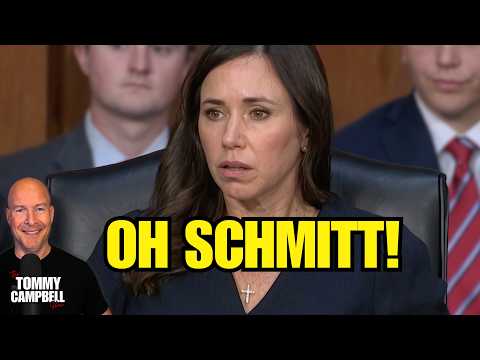
Eric Schmitt’s attempt to place Jack Smith at an Atlanta Hawks game becomes the centerpiece of a segment built around Republican efforts to discredit the former special counsel. The exchange is unusually effective material because viewers can watch the accusation develop in real time: Schmitt presents text messages as a potential contradiction, warns Smith about perjuring himself, and links the supposed Atlanta visit to developments involving Fani Willis. Smith instead recalls attending a Maryland-Iowa college basketball game, and the program subsequently says it confirmed that Iowa played Maryland on February 3, 2024.
Before reaching that embarrassment, Nicolle Wallace establishes the larger stakes by playing Smith’s defense of his prosecutions of Donald Trump. Smith says his charging decisions were based on evidence rather than Trump’s politics or candidacy and maintains that the investigation produced proof beyond a reasonable doubt of serious crimes. Those are Smith’s assertions about his prosecutorial decisions, and the segment appropriately lets viewers hear them directly, although Wallace’s framing strongly endorses his account rather than independently interrogating it.
The discussion of congressional phone records provides more substantive material than the basketball mistake. Smith explains that investigators sought records because they were examining efforts by Trump and alleged co-conspirators to use the January 6 violence to delay congressional proceedings, citing interviews and recorded voicemails as part of that investigative picture. Wallace characterizes such subpoenas as a standard investigative step and argues that Republicans failed to challenge the underlying January 6 facts, but the segment does not present the Republican case for why obtaining lawmakers’ records was objectionable or potentially excessive.
Schmitt’s mistake nevertheless makes for a powerful piece of political television because the relevant claim is unusually easy to test. The confidence of his questioning—including telling Smith that investigators possessed information he supposedly did not know about—creates an enormous contrast with the correction that follows. Wallace is justified in treating a factual error made during such an accusatory line of questioning as significant, particularly when the allegation was being used to imply a potentially consequential connection to events in Georgia.
The analysis becomes much less disciplined once the panel begins celebrating the failure. Wallace describes Smith in extraordinarily admiring terms, presenting him as a near-ideal embodiment of intelligence, strength and apolitical integrity rather than maintaining analytical distance. Her guest escalates further with insults about Schmitt’s intelligence, jokes about his ability to read and sweeping statements about Republicans and MAGA supporters. Those remarks may satisfy an audience already aligned with the hosts, but they contribute little to understanding either Smith’s investigation or the Senate hearing.
That imbalance ultimately defines the segment. It has a concrete, demonstrable example of a senator launching an aggressive accusation from apparently mistaken information, and showing the exchange is more persuasive than simply asserting that Republicans embarrassed themselves. Yet the presentation repeatedly turns an effective factual critique into partisan ridicule, while giving viewers little opportunity to assess whether Republicans raised any stronger objections elsewhere in the hearing. A closing membership promotion also arrives abruptly after the panel discussion, though it is separate from the substantive argument.
Pros
- The Schmitt-Smith basketball exchange provides a specific, readily understandable example supporting the segment’s central criticism.
- Smith is given substantial uninterrupted time to explain his charging decisions and the investigative rationale for obtaining congressional phone records.
- The reported confirmation of the Maryland-Iowa game directly addresses the factual dispute at the heart of Schmitt’s attempted gotcha.
- Connecting the embarrassing exchange to the broader questions surrounding January 6 gives the segment more substance than a simple compilation of political mistakes.
Cons
- Wallace’s exceptionally reverential description of Smith undermines the analytical distance expected from a serious examination of a contentious prosecution.
- The panel repeatedly substitutes partisan insults and ridicule for further examination of the legal and investigative issues.
- Republican objections concerning congressional phone records receive little substantive exploration beyond Smith’s response and Wallace’s characterization.
- Focusing so heavily on one spectacular mistake leaves viewers with an incomplete picture of the wider hearing and whether other Republican questioning was more consequential.
Schmitt’s failed basketball-game accusation gives the segment unusually strong evidence for its central criticism, and allowing viewers to see both the confident setup and factual correction makes the self-inflicted embarrassment difficult to dismiss. The coverage is considerably weaker when it shifts from documenting that mistake to celebrating Smith and mocking Republicans, limiting its usefulness as a balanced assessment of the hearing.