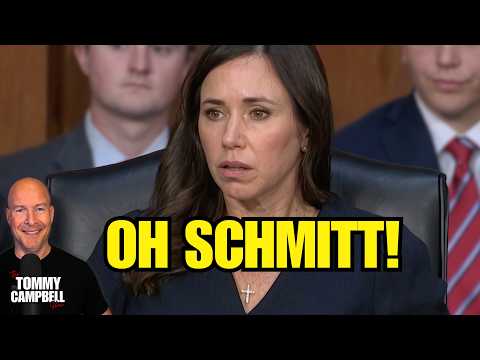
Eric Schmitt’s attempt to connect Jack Smith to an Atlanta Hawks game provides the segment with an unusually clean comic centerpiece. Seth Meyers walks through the senator’s confident accusation, Smith’s recollection of attending a Maryland-Iowa college game, and the apparent confusion over which “Hawks” were actually involved. The humor works because the segment does not merely declare the exchange embarrassing; it lets the questioning unfold before repeatedly returning to the gap between Schmitt’s certainty and the information he appears to possess.
The strongest stretch comes from the treatment of the poster board supposedly supporting Schmitt’s accusation. Meyers seizes on how quickly it is displayed and removed, then builds increasingly absurd “smoking gun” metaphors around evidence he portrays as anything but conclusive. Amy Klobuchar’s request to see the material again gives the segment another useful piece of the hearing itself rather than leaving Meyers to carry the criticism alone. Schmitt’s later explanation that his team had information about a basketball game, identified an NBA game that night and therefore asked about Atlanta further supports Meyers’ central argument that the questioning moved from uncertainty to accusation too quickly.
From there, the segment broadens its case by showing other Republican senators questioning Smith. Chuck Grassley’s inquiry about former CIA director John Brennan abruptly ends when Smith says he has never met him, while Ted Cruz’s comparison of Smith to Javert from Les Misérables becomes material for an extended Broadway riff. These exchanges support the broader comedic theme of poorly executed attempts to corner the witness, although they are not as substantial or revealing as the Schmitt sequence. The result is strongest when Meyers stays tightly attached to the actual back-and-forth rather than treating every awkward moment as equally consequential.
The opening material is considerably looser. Extended jokes about Mitch McConnell’s age, a previous Senate discussion of airline employees in the furry community, and Trump’s repeated insults toward Smith establish the show’s aggressively irreverent tone, but they delay the hearing that eventually supplies the episode’s best material. The McConnell jokes in particular rely heavily on personal ridicule rather than sharpening the political argument. They may land for viewers already comfortable with the show’s style, but they contribute little to the substantive critique that follows.
Meyers also frames the hearing from an unmistakably partisan perspective. Republicans are consistently depicted as incompetent Trump loyalists seeking material for friendly media outlets, while Smith is introduced sympathetically and is not subjected to comparable scrutiny. The clips shown give the host considerable ammunition for mocking specific lines of questioning, but they do not establish that every Republican argument made during the broader hearing was meritless. Claims about motivations, coordination and the purpose of the hearing therefore remain Meyers’ interpretation rather than conclusions demonstrated simply by the selected exchanges.
As comedy, however, the writing is energetic and unusually good at turning procedural awkwardness into memorable imagery. The “smoking banana” escalation, courtroom demonstration parody and Wendy’s misunderstanding analogy all translate the weakness Meyers sees in Schmitt’s questioning into accessible jokes. The pace is fast, and the segment continually returns to source clips before launching another punchline, preventing most of the commentary from becoming a detached monologue. Some jokes run longer than necessary, especially when supporting senators become characters in elaborate side riffs, but the central Schmitt sequence is focused enough to survive those excesses.
Pros
- Schmitt’s basketball-game questioning provides a concrete exchange that Meyers can analyze rather than merely ridicule from a distance.
- The poster-board sequence and Democratic request to examine it more closely strengthen the central criticism with material from the hearing itself.
- Schmitt’s post-hearing explanation gives viewers additional context for judging how the accusation developed.
- Inventive analogies make a confusing congressional exchange easy to follow and give the segment several memorable comedic payoffs.
- Clips involving Grassley and Cruz reinforce the broader theme without requiring the audience to accept Meyers’ characterization on its own.
Cons
- The lengthy opening about McConnell and furries postpones the far stronger Jack Smith material.
- Several age- and appearance-based jokes substitute personal ridicule for political criticism.
- The presentation is openly one-sided and gives little attention to whether Republicans raised stronger arguments elsewhere in the hearing.
- Meyers sometimes treats his interpretation of Republican motives as settled rather than distinguishing it from what the selected clips directly demonstrate.
- Some extended character jokes and tangents dilute the precision of an otherwise effective central critique.
The segment succeeds most when congressional overconfidence supplies the comedy for Meyers, particularly in the basketball-game exchange where the accusation can be evaluated directly against Smith’s response. Its partisan framing, personal ridicule and occasional overextended riffs reduce its value as a comprehensive account of the hearing, but as a tightly targeted late-night critique of several conspicuously awkward exchanges, it is frequently sharp and very funny.