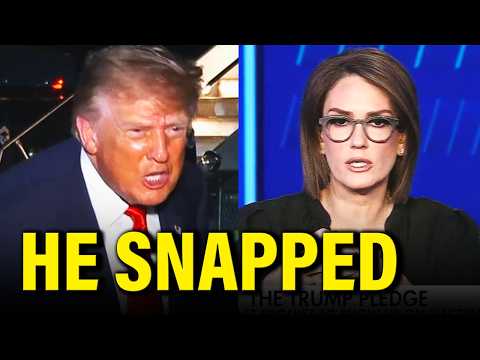
Trump’s business interests, family relationships and presidential power are presented as parts of a single organized system of self-enrichment rather than as separate ethical controversies. The argument moves rapidly through cryptocurrency, prediction markets, FIFA, Venezuela, real estate, casinos and Trump’s relatives, building a portrait of corruption that supposedly stretches from his early business career through his current presidency. That breadth gives the piece considerable momentum, but it also creates its central problem: accusations of dramatically different evidentiary strength are repeatedly folded into the same sweeping conclusion.
The most substantial material concerns specific legal and financial events. The presentation points to the Trump Organization’s criminal convictions, Donald Trump’s 34 felony convictions and his civil liabilities while also discussing family business interests and cryptocurrency ventures. These examples at least give the broader corruption argument concrete anchors. Yet even here, the rhetoric routinely moves beyond describing documented legal outcomes or potential conflicts of interest and declares Trump a “mafia boss,” the head of a “crime family” and the most corrupt president in American history. Those are argumentative characterizations, not conclusions established merely by the cases cited.
The cryptocurrency and prediction-market sections could have provided the sharpest examination of conflicts between public authority and private financial interests. The narrator alleges enormous Trump-family crypto revenue, extraordinary retail losses surrounding the Trump meme coin, suspiciously successful Polymarket accounts and major financial gains connected to Donald Trump Jr.’s business relationships. These are serious claims, but the presentation supplies figures and causal connections at such speed that viewers are given little opportunity to assess how they were calculated, what evidence links particular trades to privileged information, or whether suspicious timing establishes insider trading. Suggestive relationships are frequently treated as though the underlying misconduct has already been proven.
That evidentiary problem becomes more pronounced in the FIFA and foreign-policy sections. The piece connects favorable government actions, personal relationships, investment interests and sporting decisions into a narrative of presidential influence, while its discussion of Venezuela describes American policy explicitly as an imperialist resource seizure. The narrator’s framing is unmistakable, which is preferable to disguising advocacy as neutrality, but extraordinary allegations involving bribery cases, match-official decisions, oil revenues and presidential intervention require especially careful sourcing and chronology. Instead, proximity and sequence often do much of the argumentative work: one event happens after another, and the presentation strongly implies that the first caused the second.
The historical material attempts to show that the alleged pattern predates politics by decades. Housing discrimination litigation, New York construction, Atlantic City casinos, organized-crime figures, Roy Cohn and Trump’s treatment of contractors are assembled into a biography built around money, influence and self-preservation. This section has value because it tries to establish continuity rather than portraying present controversies in isolation. At the same time, association with people connected to organized crime is not itself proof that Trump participated in organized crime, and the piece too readily converts business relationships, social connections and historical allegations into confirmation of its “crime family” thesis.
Presentation is energetic and unusually dense. Trump’s own remarks about Fifth Avenue, Al Capone, Venezuelan oil and not expecting to reach heaven provide memorable punctuation and allow viewers to hear statements that the narrator considers revealing. But quotations are repeatedly interpreted in the most incriminating possible way: a boast, joke or provocative remark becomes evidence of a larger doctrine or even personal awareness of wrongdoing. The closing speculation that Trump might alter rules, seek another term or start a war to retain power goes further still, shifting from criticism of described conduct into predictions about future behavior for which the piece offers no demonstrated basis.
As political advocacy, the result is forceful, coherent and effective at assembling a large number of controversies around a recognizable thesis about conflicts of interest and concentrated power. As an investigative case, however, it is substantially less disciplined. The strongest version of the argument would separate convictions and documented financial relationships from allegations, circumstantial connections, causal inferences and outright speculation, while giving viewers enough sourcing to independently evaluate the remarkable numbers and events being presented. By treating nearly every item as another piece of an already-proven criminal enterprise, the piece sacrifices evidentiary precision for rhetorical certainty.
Pros
- Builds its corruption argument around numerous specific legal, financial, political and business examples rather than relying entirely on generalized criticism.
- Raises legitimate questions about potential conflicts between presidential authority, family business interests and cryptocurrency ventures.
- Uses Trump’s own recorded remarks to illustrate the rhetoric and attitudes the narrator is criticizing.
- Connects current allegations with earlier business controversies to present a coherent historical thesis rather than an isolated collection of complaints.
- Maintains a clear point of view and brisk presentation despite covering an unusually wide range of subjects.
Cons
- Frequently presents serious allegations, financial figures and causal relationships without enough sourcing or methodological detail for viewers to independently assess them.
- Blurs documented convictions and liabilities together with allegations, associations, circumstantial evidence and the narrator’s characterization of Trump as a mafia-style crime boss.
- Often treats chronological proximity or overlapping relationships as evidence that one event caused another without sufficiently demonstrating the connection.
- Interprets provocative Trump quotations as evidence of broader motives or consciousness of wrongdoing beyond what the remarks alone establish.
- The sheer number of subjects—from crypto and FIFA to Venezuela, organized crime and casinos—limits the depth available for verifying any individual case.
- Closing predictions about changing rules, running again or starting a war to preserve power are speculative and weaken an argument that is stronger when focused on specific conduct.
A formidable catalogue of controversies raises worthwhile questions about conflicts of interest, family enrichment and the relationship between private wealth and presidential power. Its advocacy is clear and often compelling, but the repeated conversion of suspicion, association and chronology into certainty prevents it from functioning as a comparably rigorous investigation. Greater sourcing and sharper distinctions between established facts, allegations and interpretation would make the case substantially more persuasive.