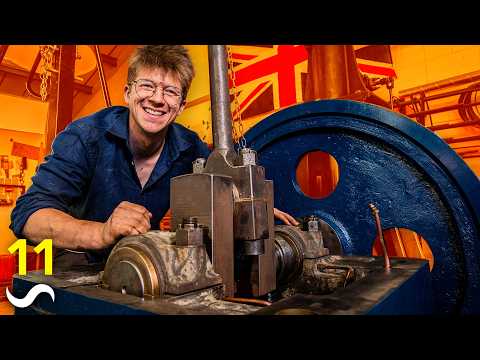
After roughly 70 days of restoration work, the enormous power hammer is finally beginning to resemble a complete machine again. What makes this installment particularly satisfying is the transition from cleaning and repairing individual components to assembling a complex mechanical system where every measurement matters. The creator begins by centering the base plate around the anvil, carefully checking clearances and correcting the frame's position before lowering the massive standard into place. Watching the components align after months of effort provides a genuine sense of accomplishment, although the excitement is tempered by the knowledge that the machine still requires considerable adjustment before it can operate.
The installation of the standard is one of the most rewarding sequences, combining heavy lifting with surprisingly delicate positioning. The creator discovers that nearly all the mounting bolts align without resistance, an encouraging indication that the earlier restoration work has paid off. Cleaning damaged threads, lubricating fasteners, and using string to guide nuts into inaccessible locations demonstrate the practical ingenuity required when working with industrial machinery. The presentation benefits from the creator's infectious enthusiasm and natural exchanges with Jamie, making even repetitive assembly tasks entertaining. However, the absence of documented torque specifications means some critical fasteners are tightened by feel, a limitation the creator openly acknowledges rather than presenting the process as mechanically definitive.
Reinstalling the pump piston and its rings introduces another challenge, particularly because the rings must compress while entering a section of the cylinder that offers limited access. The creator consults the manual, experiments with grease to hold the rings closed, and eventually finds that the cylinder's chamfer and careful positioning make installation possible. The sequence captures the trial-and-error nature of restoration without pretending that every recommended technique works as intended. Discovering an access hole that would have simplified an earlier disassembly adds an amusing moment of hindsight. These practical revelations give the installment instructional value, although viewers unfamiliar with power hammer construction may struggle to follow some of the component relationships without additional mechanical explanation.
The foot treadle and its control linkage provide another compelling example of the tension between historical accuracy and functional restoration. After comparing photographs of other machines, the creator concludes that several bends in the treadle were probably introduced after manufacture and begins straightening them with heat. Reassembling the mechanism reveals how the foot control interacts with the hand lever and its locking arrangement, giving viewers a clearer understanding of how the hammer will eventually be operated. The process also exposes the uncertainty involved in reversing previous modifications. When the straightened treadle interferes with another component, further bending becomes necessary, illustrating why reproducing an original configuration does not automatically guarantee correct operation. The creator's willingness to reconsider decisions is a strength, even if the repeated adjustments occasionally make the sequence feel somewhat circular.
The technical discussion becomes particularly interesting when attention turns to the valve settings, lubrication system, and drive belts. A factory-stamped reference mark suggests that a valve component no longer sits at its original specified position, but evidence of previous welding raises the possibility that earlier operators deliberately altered the mechanism. Rather than immediately restoring the factory setting, the creator decides to leave it unchanged until the machine can be tested. This cautious approach recognizes the difference between an apparent deviation and a confirmed mechanical problem. The visit from a belt supplier also adds useful professional input, explaining the potential advantages of banded V-belts when vibration might cause individual belts to move against one another. Unfortunately, a lengthy electrolyte drink sponsorship interrupts the mechanical progression, and its claims about hydration and performance are presented promotionally rather than independently demonstrated.
The final alignment work provides the installment's most technically substantial material. Although the anvil had initially been centered within the base plate, installing the ram reveals that the upper and lower dies do not naturally align. Examination of the original bottom die suggests that previous operators modified its locating feature to compensate for this offset. The creator considers relocating the assembly but ultimately prioritizes getting the die faces parallel while retaining the existing bottom die position. Hydraulic pressure, pry bars, indicators, and repeated measurements gradually reduce the misalignment to a few thousandths of an inch. The detailed explanation of these adjustments is particularly valuable because it shows that geometric alignment involves more than simply centering visible components. At the same time, the use of heavily loaded rigging and hydraulic force introduces risks that could benefit from more explicit discussion of precautions and safe working practices.
By the conclusion, the standard, piston, treadle linkage, lubrication system, and drive belts have all moved substantially closer to operational readiness. The motor is positioned and bolted down, while additional support for the variable-frequency drive and other finishing work remain outstanding. The creator also acknowledges an earlier calculation error involving stuffing box clearance, thanking viewers for identifying the mistake while explaining why the adjustment has not yet been corrected. That transparency strengthens the credibility of the restoration, even though it leaves an important mechanical question unresolved. The approaching visit from a special guest creates urgency, but the installment wisely ends with assembly progress rather than claiming the hammer is ready to run before it has been demonstrated.
Pros
- Captures the emotional payoff of reassembling a massive industrial machine after approximately 70 days of demanding restoration work.
- Demonstrates practical mechanical techniques for positioning heavy components, restoring damaged threads, installing piston rings, and assembling difficult-to-access fasteners.
- Explains the challenges of aligning the anvil, ram, and dies through actual measurements, mechanical adjustments, and indicator readings.
- Shows thoughtful decision-making when historical modifications conflict with original factory specifications or when their purpose remains uncertain.
- Incorporates useful outside expertise during the V-belt selection process, including an explanation of banded belts and vibration-related concerns.
- Maintains an engaging, personable atmosphere through spontaneous reactions, workshop humor, and collaborative problem-solving.
- Openly acknowledges mistakes, unsuccessful techniques, and unresolved mechanical questions rather than presenting the restoration as flawless.
Cons
- Some assembly sequences assume substantial familiarity with power hammer components, making the mechanical relationships difficult for newcomers to follow.
- Repeated adjustments to the treadle and linkage occasionally slow the pacing without always establishing a clear technical conclusion.
- Critical fastener tightening and certain mechanical adjustments proceed without confirmed specifications, limiting their usefulness as authoritative restoration guidance.
- The extended electrolyte sponsorship interrupts an otherwise absorbing technical narrative and includes promotional performance claims without independent supporting evidence.
- Potential hazards associated with heavy lifting, tensioned rigging, and hydraulic alignment receive less explicit safety discussion than the complexity of the work warrants.
- The hammer remains untested, leaving the effectiveness of several important adjustments and the overall operational outcome unresolved.
This is a thoroughly engaging restoration installment that combines impressive mechanical work, genuine enthusiasm, and an unusually transparent look at the uncertainties involved in rebuilding old industrial equipment. The meticulous alignment work and major assembly milestones make it especially rewarding, while some inaccessible technical explanations, undocumented adjustments, and an intrusive sponsorship slightly diminish the experience. Although the machine has not yet proven itself operational, the progress is substantial enough to make the approaching first run an exciting prospect.