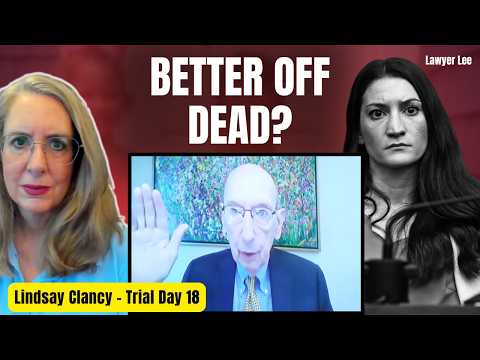
The Commonwealth’s strongest challenge to the defense emerges through a deceptively simple point: strangling three children and then attempting suicide required a sequence of choices about location, order, method and timing. Peter Tragos treats that argument seriously rather than dismissing it because of his developing view of the case. He repeatedly acknowledges that the prosecution’s experts have raised legitimate problems for a psychosis theory, particularly the organized nature of the acts, the reported inconsistencies surrounding the alleged command hallucination and the unusual claim that a voice appeared only once and never returned.
That willingness to separate plausibility from the legal burden is the analysis’s greatest strength. Tragos says he has not been persuaded beyond a reasonable doubt that Lindsay Clancy experienced a psychotic break, but correctly emphasizes that this is not what the defense must establish. His central question is whether the Commonwealth has proved criminal responsibility beyond a reasonable doubt under the applicable standard as he explains it. That distinction becomes especially important as competing experts offer different interpretations of the same behavior: one can find the prosecution’s explanation more likely without necessarily finding the alternative so implausible that reasonable doubt disappears.
Kirk receives particularly balanced treatment. Tragos considers him the Commonwealth’s best witness while highlighting testimony that could substantially assist the defense, including his acknowledgment that Clancy suffered from a mental disease or defect, experienced adverse medication reactions and made a serious suicide attempt. Kirk’s interpretation of the killings as connected to suicide and an unwillingness to leave the children behind gives the Commonwealth an alternative to command hallucinations, yet Tragos identifies a significant strategic tension: earlier prosecution suggestions that the suicide attempt was staged or otherwise questionable sit awkwardly beside an expert opinion that relies heavily on its seriousness. Calling that inconsistency potentially damaging is well grounded in the testimony discussed, although describing it as almost deserving to lose the case pushes rhetorical criticism beyond the more careful legal analysis surrounding it.
Reddington’s cross-examination is assessed with similar nuance. Tragos credits him with establishing Kirk’s limited experience with postpartum conditions, exposing reliance on research that Kirk acknowledged had been superseded by work he did not know, and obtaining confirmation that psychological testing did not indicate exaggeration, lying or malingering. At the same time, he grades the cross only around a C-plus, noting that Reddington sometimes bulldozed the witness and risked alienating jurors with remarks such as “obviously.” The repeated observation that an aggressive lawyer’s style can become either persuasive command or counterproductive hostility depending on the jury is a useful reminder that courtroom effectiveness cannot be measured solely by points scored on paper.
The final Commonwealth psychiatrist initially appears even more promising because of extensive forensic experience and work with psychosis, but Tragos becomes increasingly skeptical of how individual details are interpreted. The expert emphasizes differing accounts of when the alleged voice began, the takeout and CVS searches, the added errand, the crushed medication and the sequence involved in Clancy’s suicide attempt. Tragos fairly presents the prosecution inference that these facts demonstrate planning and controlled decision-making while repeatedly supplying plausible alternatives: medication for a child’s constipation was genuinely needed, takeout was an ordinary family decision, and an 18-to-20-minute window hardly resembles an obviously comfortable plan. Those alternatives do not disprove the expert’s interpretation, and Tragos generally avoids claiming that they do; instead, he frames them as precisely the unresolved possibilities that matter when the prosecution carries the burden.
The presentation is less disciplined than the legal analysis. Nearly two hours of commentary includes extensive viewer questions, membership acknowledgments, jokes, discussion of clothing and courtroom clutter, repeated requests for likes, personal anecdotes about Tragos’s father, and recurring observations about the final expert’s extremely slow delivery. Live interaction gives the coverage personality and allows Tragos to test arguments against viewers who disagree with him, but it also produces repetition and occasionally encourages conclusions before the underlying point has been fully established. His comments about the witness’s cadence become excessive, although he appropriately corrects course after being reminded that a medical issue may have affected the witness and stresses the need for kindness.
Some medical and psychiatric discussion also needs stronger boundaries. Tragos repeatedly acknowledges that postpartum medicine is outside his expertise, which is important, and he is appropriately cautious when viewers introduce medication effects, diagnostic criteria or personal experiences. Still, suggestions involving psychosis, bipolar disorder, antidepressants and postpartum conditions occasionally become conversationally blended with legal conclusions without enough emphasis that clinical causation cannot be established from viewer comments or courtroom impressions alone. His brief willingness to entertain “demon possession” as a possible way some people might conceptualize behavior is particularly unnecessary and adds nothing evidentiary to an already complicated psychiatric case. The strongest portions remain those in which he stays firmly within legal analysis: competing expert opinions, credibility, evidentiary inconsistencies and whether the Commonwealth has eliminated reasonable alternatives to the degree its burden requires.
Pros
- Consistently distinguishes whether a psychotic break seems plausible from the much more important question of whether the Commonwealth has proved criminal responsibility beyond a reasonable doubt.
- Gives meaningful credit to the Commonwealth’s strongest evidence, particularly the sequential decisions involved in the killings, inconsistencies surrounding the alleged voice and the unusual reported course of the hallucination.
- Identifies a significant tension between earlier attacks on the suicide attempt and Commonwealth experts who characterize that attempt as genuine and serious.
- Evaluates Reddington’s cross-examination critically rather than automatically treating every defense point as successful.
- Offers plausible alternative interpretations of the takeout, CVS and medication evidence without pretending those alternatives establish what actually happened.
Cons
- Extensive livestream interaction, repetition, jokes, acknowledgments and side discussions make an already complicated expert-evidence review considerably longer and less focused.
- Some criticism of the Commonwealth becomes rhetorically stronger than the underlying analysis, particularly the suggestion that its handling of the suicide-attempt theory is almost enough to justify losing the case.
- Medical and psychiatric issues raised by viewers sometimes receive more speculative discussion than their evidentiary support warrants.
- Repeated attention to the final expert’s slow speaking style risks distracting from the substance of his opinions, even though Tragos eventually acknowledges a possible medical explanation.
- The brief discussion of demon possession is speculative and unnecessary in a case already requiring unusually careful distinctions between psychiatric evidence, personal belief and legal responsibility.
Careful attention to the burden of proof makes this a valuable examination of why strong Commonwealth rebuttal testimony can create serious doubts about psychosis without necessarily resolving the legal question of criminal responsibility. The analysis is most persuasive when comparing expert theories and exposing internal tensions in the competing cases, but the lengthy livestream format and occasional speculative detours dilute an otherwise thoughtful assessment.