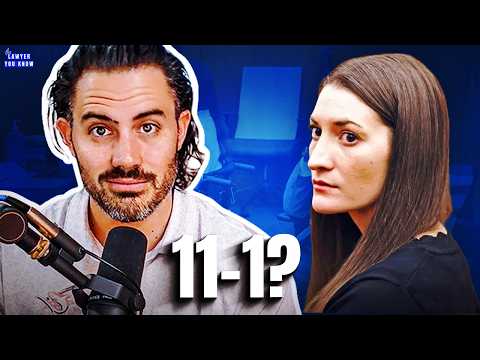
Dr. Kirk Heilbrun’s reference to Catholic teaching transformed an otherwise methodical expert examination into the most contentious courtroom moment of the day. The presentation does an excellent job reconstructing why the judge reacted so strongly: prosecutors had already raised the concept of mortal sin while questioning Lindsay Clancy’s mother-in-law, only to be immediately stopped. When Heilbrun independently approached the same subject while discussing Clancy’s reported expectation of joining her children in heaven, the judge ordered the jury to disregard the testimony and later denied the defense request for a mistrial.
The legal analysis of that confrontation is one of the discussion’s strongest elements because Lawyer Lee does more than characterize the judge as angry. She connects Massachusetts criminal-responsibility law to the distinction between understanding an act’s criminality and appreciating its moral wrongfulness, then argues that Clancy’s own reported statements about God, heaven, and killing the children could make her religious beliefs relevant to assessing her explanation. Importantly, she presents this as an argument rather than declaring the judge legally wrong. Her suggestion that the court might have explored the proposed testimony further before excluding it is thoughtful, although the analysis remains necessarily incomplete because neither the expert’s intended full answer nor the sidebar discussions are available.
Even more consequential is the apparent convergence between the prosecution and defense experts over Clancy’s motive. Both Dr. Heilbrun and defense expert Dr. Resnick are presented as believing that she was suicidal and thought the children would suffer without her, leading her to kill them as part of an effort to prevent that suffering. The presentation rightly emphasizes how unusual this overlap is without pretending that the experts therefore agree about criminal responsibility. Their crucial disagreement remains whether this thinking arose from psychosis that impaired Clancy’s responsibility or from nonpsychotic depression, desperation, and a longstanding need for control.
Heilbrun’s reasons for doubting the reported command hallucination receive particularly clear treatment. He regarded it as unusual that a previously unheard voice allegedly appeared only during the roughly 18-minute period in which the children were killed, noted differing accounts of what that voice supposedly said, questioned how specific memories could later emerge after Clancy initially reported memory loss, and interpreted her first reported statement to Patrick after the event—focused on her suicide attempt rather than the voice—as potentially significant. These are presented as Heilbrun’s professional interpretations rather than settled medical facts, which is essential in a case where competing experts have reached materially different conclusions about Clancy’s mental state.
The evaluation of expert credibility is also unusually effective. Heilbrun is described as persuasive partly because he acknowledges evidence favorable to Clancy, including her academic success, psychiatric symptoms, suffering, and extensive attempts to obtain treatment. By contrast, prosecution expert Dr. Avram Mack is shown becoming defensive and overly technical during cross-examination, even when defense attorney Kevin Reddington’s questioning appears muddled or substantively weak. That distinction captures an important courtroom reality: a witness can lose persuasive force through demeanor and communication even when the opposing lawyer has not exposed a decisive flaw in the underlying opinion.
There are nevertheless places where the commentary becomes less rigorous than its courtroom analysis. The explanation of Catholic doctrine relies on information obtained from ChatGPT while simultaneously acknowledging unfamiliarity with the theology, making that portion considerably weaker than the legal reasoning surrounding relevance. The repeated characterization of developments as “wild,” “surreal,” and astonishing adds energy, but it can overstate how completely the prosecution and defense theories have merged when their disagreement over psychosis is precisely the issue that may determine criminal responsibility. Similarly, judging how particular testimony will affect jurors is plausible courtroom commentary rather than something that can be established from the proceedings themselves.
Taken as a whole, the coverage succeeds because it identifies the increasingly narrow question at the center of the case instead of becoming distracted by every adversarial exchange. Clancy’s suicidality, severe distress, reported belief that the children would suffer without her, and the killings themselves appear far less contested here than the explanation for the mental state producing those actions. By ending with that distinction, the analysis turns an unusually dramatic trial day into a coherent examination of motive, psychosis, legal responsibility, evidentiary relevance, and the enormous importance of expert credibility.
Pros
- Carefully explains why the mortal-sin testimony created a serious evidentiary dispute rather than merely focusing on the judge’s emotional reaction.
- Clearly distinguishes the experts’ surprising agreement about Clancy’s apparent motive from their crucial disagreement over whether psychosis produced that thinking.
- Presents Heilbrun’s reasons for questioning the reported command hallucination in a specific, understandable sequence without treating his conclusions as established medical facts.
- Insightfully compares expert presentation and credibility, showing why Heilbrun’s concessions may strengthen his persuasiveness while Mack’s defensive communication weakens his.
- Keeps the central criminal-responsibility question in focus despite a day filled with procedural drama and contentious cross-examination.
Cons
- The discussion of Catholic doctrine relies on an informal ChatGPT lookup despite religion becoming central to a significant evidentiary argument.
- Repeated descriptions of the testimony as “wild” and “surreal” sometimes exaggerate the degree of agreement between experts whose psychosis conclusions remain fundamentally opposed.
- Predictions about how strongly the judge’s instruction or witness demeanor will influence jurors are reasonable impressions but cannot be established from the courtroom exchanges shown.
- The argument that the judge may have excluded relevant religious testimony would be stronger with the missing context of the sidebar discussion and a clearer indication of what Heilbrun actually intended to say.
A dramatic courtroom dispute becomes a surprisingly focused analysis of the narrow psychological and legal question now separating two increasingly similar accounts of why the killings occurred. Strong explanation of expert reasoning and criminal responsibility outweighs occasional sensational phrasing and an unnecessarily shaky excursion into theology.