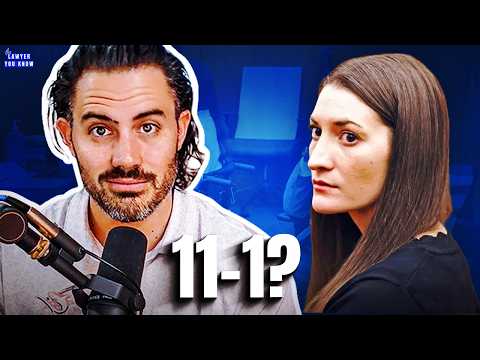
Lindsay Clancy’s first trial ended without a verdict after jurors repeatedly reported that they could not reach unanimity, but the most revealing part of this account is the dispute over why they were stuck. Lawyer Lee reconstructs the progression from the initial deadlock through a reasonable-doubt instruction, individual questioning of jurors, increasingly specific notes about one holdout, an emergency appeal and finally a mistrial. That chronology gives an unusually complicated courtroom day a clear narrative shape without losing sight of the legal question at its center.
The conflict over the holdout juror is handled particularly well because both interpretations receive meaningful attention. The defense argued that the foreperson’s note showed a juror acknowledging doubt yet refusing to apply the law, potentially indicating that the juror had been dishonest when previously assuring the judge that the instructions could be followed. The Commonwealth countered that disagreement over what constitutes reasonable doubt is itself part of deliberation and that courts cannot assume eleven jurors understand the law correctly simply because one person disagrees. Presenting those positions side by side makes the controversy considerably more illuminating than simply treating the lone juror as an obstruction.
Judge Sullivan’s reluctance to question that juror becomes another useful lesson in the protections surrounding jury deliberations. The presentation explains that removing or investigating a deliberating juror risks intruding on the jury’s independent decision-making and highlights the judge’s view that the notes did not establish a refusal to follow the law. His tense exchange with defense attorney Kevin Reddington, including the dispute over whether the judge had been too “soft” in his previous instruction, also provides genuine courtroom drama. Lawyer Lee’s “jazz hands” joke adds levity, although it briefly pushes a grave proceeding toward entertainment commentary.
The explanation of why the jury could not simply be ordered to continue is one of the strongest sections. Lawyer Lee quotes the relevant Massachusetts rule as presented in the proceeding and connects it directly to the jury’s repeated returns without agreement, explaining why another round of deliberations depended on circumstances that were no longer present. She appropriately frames her conclusion that the judge read Massachusetts law correctly as her own legal assessment rather than presenting herself as an unquestionable authority.
The emergency Supreme Judicial Court proceeding could easily become confusing, but the account clearly explains the single justice’s gatekeeping role and the defense’s request for immediate relief. The competing arguments remain consistent with the earlier dispute: the defense characterized the foreperson’s note as evidence that a juror was refusing to follow the law, while the Commonwealth characterized it as an ordinary disagreement occurring inside deliberations. Justice Delilah Wendland’s denial of emergency relief is reported as the procedural outcome rather than treated as proof that either interpretation of the holdout juror’s thinking was factually correct.
Where the presentation becomes less disciplined is in its framing of what happens next. Statements that there “will be” a second trial and that it will probably occur next year go beyond what has actually been established here, especially after the presenter herself qualifies the situation with “unless the Commonwealth decides to give up.” The closing tease for a members-only discussion about what “really happened” in the jury room is also inherently speculative. Lawyer Lee acknowledges that this forthcoming analysis will be more speculative than her normal public material, which is an important qualification, but marketing conjecture about confidential deliberations sits awkwardly beside an otherwise careful explanation of why courts themselves hesitate to invade that confidentiality.
The final reflection gives the coverage a worthwhile purpose beyond courtroom spectacle. Rather than portraying the mistrial as institutional failure, Lawyer Lee explains unanimity as a safeguard for criminal defendants and argues that an unresolved jury can demonstrate the system functioning as designed. That interpretation is clearly presented as analysis, and it provides a thoughtful ending to a day dominated by procedural conflict, although the subsequent subscription and members-only promotions dilute some of that impact.
Pros
- The deliberation timeline turns a complicated sequence of jury notes, instructions, hearings and appeals into an understandable narrative.
- Competing defense and prosecution interpretations of the holdout juror are presented clearly rather than assuming the eleven-person majority must have been correct.
- The explanation of judicial reluctance to intrude into jury deliberations gives the courtroom dispute useful legal context.
- Connecting the mistrial decision to the Massachusetts rule presented in court makes the procedural outcome easier to understand.
- The closing discussion of jury unanimity provides a substantive explanation for why a mistrial can represent a functioning safeguard rather than a broken process.
Cons
- Predictions about a second trial and its likely timing are stated more confidently than the information presented supports.
- The occasional comedic aside undercuts the seriousness of an otherwise careful account of a highly consequential proceeding.
- Promoting a members-only theory about what “really happened” inside the jury room introduces speculation immediately after emphasizing the importance and privacy of jury deliberations.
- Repeated channel promotion and previews of future coverage make the ending longer and less focused than the legal analysis preceding them.
Careful reconstruction of the holdout-juror dispute makes this a strong explanation of why an extraordinary courtroom day ended without a verdict, particularly because neither side’s interpretation is treated as self-evidently correct. The legal analysis is accessible and appropriately attentive to the protections surrounding jury deliberations, though predictions and teased speculation about the jury room weaken an otherwise disciplined presentation.