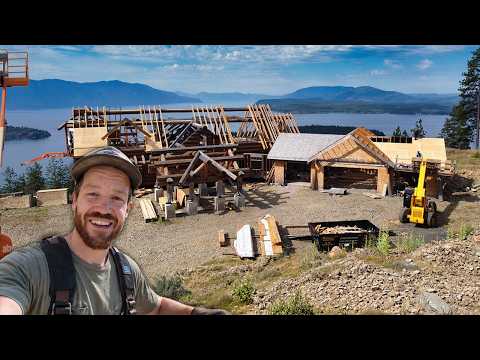
Years of exposure have left large sections of the mansion’s roof sheathing badly deteriorated, making replacement considerably more complicated than simply stripping everything off and starting again. The crew works one section at a time so the remaining sheathing can continue holding the trusses and walls square, immediately establishing both the scale of the restoration and the consequences of getting it wrong. Seeing fresh plywood gradually replace delaminating material gives the project satisfying visual progress while also making clear why getting the structure protected before another North Idaho winter matters.
Much of the presentation succeeds because the construction explanations are attached directly to work happening on screen. Small details such as leaving expansion gaps between plywood sheets lead naturally into discussions of moisture movement, while blocking, straps, web stiffeners, joist hangers, and bearing points are explained as they are installed. The walkthrough of how loads travel through an I-joist assembly is particularly useful because it connects a collection of seemingly minor pieces to their structural purpose. The hosts are also appropriately careful about the limits of the format, explicitly describing the channel as showing what they are doing rather than presenting itself as a universal how-to guide.
The mansion’s unconventional geometry supplies the most interesting construction challenges. Multiple roof pitches, intersecting valleys, dormers, large logs, missing manufacturer plans, and leftover trusses force the crew to solve problems that cannot always be handled by straightforward measurements. One especially awkward connection requires blocks, stiffeners, a hanger, and sufficient bearing to transfer the load into an LVL. Elsewhere, existing trusses are repurposed as usable framing components and adjusted to fit a hallway connection. These sequences communicate how much improvisation can exist alongside engineered plans without pretending every field solution was predetermined.
There is also a welcome emphasis on the less dramatic work necessary before the plywood can cover everything. Hundreds of blocks, structural fasteners, hold-down screws, straps, and hangers consume days even though they produce less obvious visual transformation than framing a dormer or sheathing an entire roof face. Riley’s frustration with staying ahead of the professional crew gives this portion some genuine tension, particularly because he repeatedly checks unfinished details before they disappear beneath the sheathing. His admission that the responsibility for following applicable codes and building a durable structure weighs on him adds useful perspective to what could otherwise become a simple construction montage.
Safety receives noticeably more attention as the work moves onto increasingly exposed roof surfaces. Hard hats, a harness, an anchor point, and an auto-retracting line appear alongside repeated acknowledgment of the difficulty of moving around on steep framing. The eventual decision to stop work after rain makes the roof too slippery and nearby lightning strikes are reported is a sensible conclusion to that theme. It also produces a more credible ending: instead of manufacturing the promised triumph, the project stops short of being completely dried in because conditions no longer allow the crew to work safely.
The biggest weakness is how frequently the main restoration narrative is interrupted. Extended visits to the coffee trailer and screen-printing shop, discussions of a possible merchandise store, clothing promotions, and a dog-food sponsorship all compete with an already lengthy construction story. Some personality-driven diversions and crew banter help humanize a technically dense project, but the promotional segments become substantial enough to dilute momentum just when the roof work is most engaging. The construction itself has more than enough variety and stakes to carry the presentation without so many commercial detours.
Pros
- Detailed explanations connect plywood spacing, blocking, straps, web stiffeners, hangers, and other components to their practical purposes.
- The mansion’s unusual roof geometry creates genuinely interesting framing and problem-solving sequences.
- Visible progress from deteriorated sheathing to newly covered roof sections gives the restoration a strong sense of accomplishment.
- Crew coordination and division of labor demonstrate why hiring experienced additional help dramatically accelerates the project.
- Frustration, mistakes, changing weather, and unresolved details prevent the restoration from feeling artificially effortless.
- The decision to stop because of wet roofing and nearby lightning reinforces the increased attention given to job-site safety.
Cons
- Coffee, merchandise, and sponsorship segments repeatedly interrupt the central construction narrative.
- The long runtime includes several tangents that could be tightened without sacrificing the useful technical material.
- Some field solutions are explained with considerable confidence despite acknowledgment that particular details were not explicitly covered by the structural plans.
- The anticipated milestone of completely drying in the mansion remains unfinished when weather ends the crew’s final day.
Complex framing, rapid progress, and unusually detailed explanations make the roof restoration both informative and satisfying to follow, while the weather-imposed ending gives the project an appropriately unfinished reality. The frequent promotional diversions weaken an otherwise focused construction story, but the combination of skilled teamwork, practical problem-solving, and visible transformation remains compelling.