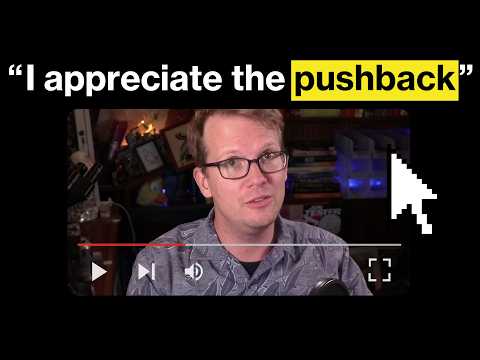
The video examines a recent controversy surrounding Hank Green's admitted use of AI in parts of his creative workflow, using it as a springboard for a broader discussion about authenticity in online content. Rather than dwelling on personal criticism, the presenter makes it clear that the focus is less on Hank Green as an individual and more on what the situation reveals about the growing normalization of AI-assisted creation. That framing keeps the discussion relatively measured, even though the opinions expressed throughout are firmly held.
Much of the video's strength comes from grounding its arguments in the creator's own experience as a writer and video producer. Instead of relying on abstract warnings about artificial intelligence, he explains his drafting process, the value of revision, and why struggling through imperfect early work is, in his view, essential to developing creative skill. These sections are thoughtful and coherent because they connect broad philosophical claims to concrete examples from his own workflow rather than presenting productivity advice in isolation.
The central argument is that creative work derives its value from human expression and personal growth, not simply from producing finished content more efficiently. The video repeatedly argues that delegating creative decisions to large language models weakens both the finished work and the creator's long-term development. These are ultimately value judgments rather than established facts, but they are presented consistently and supported by the speaker's reasoning rather than being portrayed as objectively proven conclusions.
The discussion also challenges the increasingly common marketing of AI as a frictionless productivity tool. The presenter argues that creativity necessarily involves uncertainty, revision, and failure, making those difficult stages inseparable from meaningful artistic work. The comparison between relying on AI and allowing an overpowered game character to eliminate meaningful progression is an effective analogy that makes the broader point accessible without becoming overly technical.
The latter portion shifts toward the psychology of AI chatbots, recounting the creator's own experiences experimenting with conversational AI. He describes feeling unexpectedly drawn to the positive reinforcement these systems provided before deciding to stop using them. From there, he expresses concern that similar reinforcement mechanisms could foster unhealthy dependence in vulnerable users. While these observations are clearly framed as personal experiences and concerns rather than scientific evidence, the discussion avoids overstating them as established psychological findings and instead uses them to explain why the Hank Green situation resonated with him.
As commentary, the presentation is engaging thanks to its conversational pacing, humor, and willingness to acknowledge uncertainty where appropriate. At the same time, the video remains largely one-sided, giving relatively little attention to circumstances where AI might serve as a limited editing or accessibility tool without replacing creative authorship. Viewers looking for a broader examination of AI's potential benefits alongside its risks may find the discussion less balanced than its thoughtful delivery initially suggests.
Pros
- Uses the Hank Green controversy as a starting point for a broader discussion instead of turning it into a personal attack.
- Explains the creative process through concrete examples from the presenter's own writing and revision workflow.
- Clearly distinguishes personal opinions about creativity from objective claims, making its philosophical arguments easy to follow.
- Strong pacing, conversational delivery, and memorable analogies keep a discussion-heavy video engaging.
Cons
- Focuses almost entirely on the drawbacks of AI while giving little consideration to more limited or constructive uses within creative work.
- The concerns about chatbot addiction and psychological effects rely primarily on personal experience rather than broader supporting evidence.
- Some arguments become repetitive as the same core message is reinforced through multiple examples.
This is a thoughtful opinion piece that uses a high-profile creator's experience to explore larger questions about authenticity, artistic growth, and the appeal of AI-assisted productivity. Even viewers who disagree with its conclusions are likely to find the reasoning sincere and clearly articulated. Its strongest moments come from reflecting on the creative process itself rather than the controversy that inspired it.