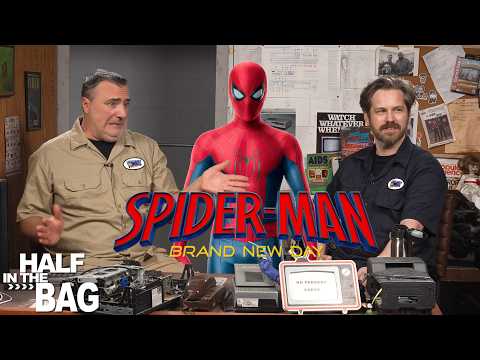
The discussion works best when Jessica Clemons and Erik Voss examine the film’s emotional consequences rather than simply cataloging references. Their strongest material concerns Jean Grey’s anger, Peter Parker’s grief, MJ’s discomfort around a stranger claiming an intimate history with her, and Ned’s possible recognition of his former best friend. Both hosts clearly enjoyed the movie, but they still consider whether Jean’s actions cross serious moral boundaries and whether the ending offers redemption without excusing her behavior.
Jean’s portrayal generates the most substantial debate. The hosts argue that her violence, psychic control, and use of MJ’s body make her genuinely frightening while also establishing why ordinary people might eventually fear mutants. Their comparison with Wanda Maximoff, Loki, and Tony Stark places her within the MCU’s tradition of compromised characters seeking redemption. However, much of the wider mutant interpretation—Phoenix Force influence, dormant X-genes, Charles Xavier’s activities, Madelyne Pryor, Mister Sinister, Cerebro, and future Sentinel technology—is conjecture rather than information established by the movie.
The examination of the memory spell is more focused and useful. The hosts consider whether Hulk’s submerged personality might remember Peter Parker, what Matt Murdock would recall about defending Spider-Man, and whether Ned’s final handshake represents restored memories or ordinary muscle memory. Their disagreement gives the segment welcome tension, and Jessica’s argument that Ned may simply connect Peter’s name with Spider-Man is a credible alternative to Erik’s more emotionally satisfying interpretation that the spell has begun to break.
The post-credits discussion illustrates both the appeal and the weakness of the format. The hosts propose Nick Fury, Kamala Khan, Tobey Maguire’s Spider-Man, another universe, an incursion, or a purely symbolic setup for future crossover films. They repeatedly acknowledge that the scene is ambiguous, but the number of possibilities eventually overwhelms the available evidence. Speculation about casting Miles Morales, Emma Frost, Beast, Rogue, Magneto, and Cable pushes the conversation even farther from reviewing the film itself.
The looser sections contain lively chemistry but frequently become prolonged comedic detours. Extended riffs about Rogue’s Southern identity, the Hand’s working conditions, Peter’s apartment expenses, product placement, potatoes as a rating system, and unrelated superhero movies can be funny in isolation. Together, they make the episode feel considerably less disciplined, especially when the hosts interrupt, repeat points, or debate jokes longer than the underlying question warrants.
As a review, the episode ultimately communicates a clear verdict: both hosts found the movie funny, emotionally human, visually exciting, and among the better Tom Holland Spider-Man entries. They praise the fight choreography, comic-accurate villains, natural humor, character interactions, and a more mature presentation of Peter. Yet those judgments are scattered across a sprawling Q&A dominated by franchise forecasting, making the video more valuable as an enthusiastic fan conversation than as a concise critical evaluation.
Pros
- Provides thoughtful discussion of Jean Grey’s morality, grief, abuse of power, and potential redemption.
- Offers several plausible interpretations of Ned’s final interaction with Peter and the continuing effects of the memory spell.
- The hosts’ disagreements create an energetic, conversational examination rather than a single predetermined reading.
- Identifies specific strengths in the film’s humor, fight choreography, supporting villains, and more mature portrayal of Peter.
- Clearly labels many future-character and mutant-saga ideas as theories or rumors rather than confirmed developments.
Cons
- Devotes far more time to speculative MCU forecasting than to evaluating the movie’s completed story and filmmaking.
- Numerous tangents about casting, regional stereotypes, apartment prices, product placement, and unrelated films weaken the structure.
- Several theories rely on elaborate assumptions that the movie itself apparently does not establish.
- Repetition, interruptions, and extended improvised jokes make key arguments harder to follow.
- The overall critical verdict arrives late and remains less developed than the franchise speculation surrounding it.
This is an entertaining and occasionally insightful spoiler conversation driven by strong host chemistry and genuine affection for the film. Its best observations concern grief, memory, moral responsibility, and the evolving relationships around Peter Parker, but those ideas are diluted by excessive theorizing and long comedic digressions. Viewers seeking exuberant fandom discussion will find plenty to enjoy, while those wanting a tightly organized review may find the episode unfocused.