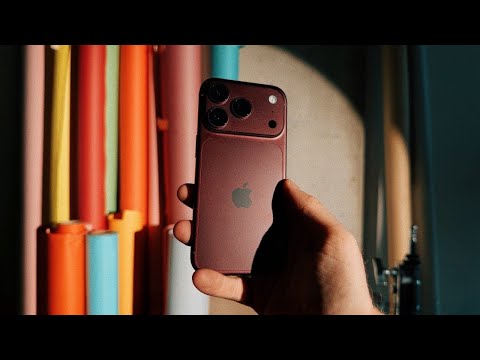
A seven-minute battery victory over a 7,000mAh rival gives the iPhone 18 Pro Max an unusually concrete opening argument. The presenter initially dismisses battery life as a solved problem, only to be confronted with a controlled comparison in which the smaller-capacity physical-SIM model reportedly outlasts the competing phone. That result makes efficiency more interesting than raw battery capacity, while the claim that the eSIM version would extend the lead is not independently demonstrated here. Improved charging also addresses an area where the presenter readily admits Apple had been lagging.
Performance is handled with more nuance than the usual benchmark-driven upgrade pitch. A racing game works perfectly well on the 15 Pro Max, seemingly undermining the need for the latest A20 Pro, but testing on the 14 Pro Max provides the counterargument: older hardware can eventually lose the smooth performance newer chips preserve. The resulting case for the two-nanometer chip, improved thermals, graphics capability, and AI processing is therefore about three-to-four-year headroom rather than an immediate transformation. That is a sensible distinction, although future software demand is necessarily a prediction rather than something the current testing can prove.
The deliberately argumentative format also gives the review room to challenge Apple's upgrade strategy. Apple Intelligence is criticized as underwhelming, while the Action button, Camera Control, shifting titanium-and-aluminum messaging, annual colors, and Apple's tendency to adopt features later than competitors all become examples of why yearly upgrades can feel stagnant. The opposing argument—that waiting can allow experimental technology to mature—is reasonable, but the review never pretends novelty itself is enough. Most importantly, it eventually concedes that an average 17 Pro owner is unlikely to pick up the new model and immediately experience a dramatic leap.
Camera testing produces the most effective reversal. The initial criticism is that Apple has retained the same sensor while promoting variable aperture instead of adopting a larger one, but blind side-by-side comparisons show noticeably greater detail from the 18 Pro Max. The reveal that variable aperture had been disabled makes the test more informative: within the comparison presented, the improvement is attributed to image processing rather than the headline hardware feature. Further comparisons claim advantages over Samsung in video detail, noise, skin tones, resolution, and night photography, although these broader competitive conclusions are asserted from selected examples rather than established through a comprehensive camera test.
The discussion becomes more useful when it moves beyond pure image quality. Upgraded Photographic Styles are presented as a way to add stronger color profiles, skin treatment, and film grain to Apple's comparatively neutral output, while customizable Pro camera controls can simplify the interface by exposing only the settings a creator actually wants. Those additions may indeed matter more to enthusiasts than casual photographers, a limitation the skeptical side of the conversation explicitly recognizes. That self-awareness helps prevent specialized creator features from being presented as universal reasons to upgrade.
Structurally, the staged debate is an effective way to expose the contradiction at the center of the phone: many of its improvements require careful testing to appreciate, yet those improvements can still make it a better long-term purchase. Battery tests, generational gaming comparisons, controlled camera examples, and the final admission that 17 Pro owners have little reason to rush all give the argument useful balance. The late case promotion is lengthy and arrives immediately after the aluminum's scratching becomes part of the discussion, making the transition into sponsorship particularly conspicuous, but it does not erase the review's strongest conclusion: the case for this generation rests more on longevity than launch-day excitement.
Pros
- The battery argument is supported by a direct endurance comparison rather than battery-capacity figures alone.
- Gaming comparisons across multiple iPhone generations effectively illustrate the distinction between immediate performance needs and longer-term headroom.
- Disabling variable aperture during the camera comparison creates a clever test of image-processing improvements rather than simply validating Apple's headline feature.
- The debate format gives substantial space to criticisms of Apple's incremental upgrades, delayed features, AI shortcomings, and marketing.
- The conclusion appropriately distinguishes the phone's overall quality from whether a 17 Pro owner needs to upgrade.
Cons
- Claims about future performance headroom depend partly on assumptions about software demands over the next several years.
- Broad claims of iPhone camera superiority over Samsung are supported by selected examples rather than a comprehensive comparative test.
- Several improvements require magnification, slow-motion comparisons, or specialized testing to reveal, reinforcing the criticism that the launch-day difference for typical recent-iPhone owners is modest.
- The extended case promotion interrupts the closing discussion and follows conveniently from the criticism of the aluminum body's scratching.
Careful testing makes a persuasive case that incremental improvements in efficiency, sustained performance, and computational photography can matter even when the phone feels familiar on day one. Just as importantly, the review acknowledges that those gains do not make an immediate upgrade compelling for a typical 17 Pro owner, leaving longevity rather than novelty as the strongest reason to value this generation.