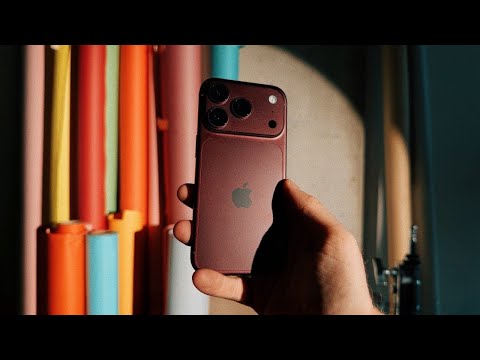
Turning an ordinary 4K clip into cinematic footage after it has already been recorded is one of the more tangible upgrades demonstrated here. The ability to select subjects, create focus pulls, adjust the simulated depth of field, and reverse the effect gives the feature considerably more flexibility than simply shooting in a dedicated cinematic mode. Shooting the review itself on an iPhone 18 Pro also provides an unusually practical demonstration of the camera rather than relying entirely on isolated test clips, although the new conversion feature is limited to the main camera and apparently did not work with the log footage tested in a third-party camera app.
The variable-aperture main camera receives similarly useful hands-on treatment. Moving between f/1.48 and f/4 visibly changes depth of field, and the physical aperture blades make this more than a software photography trick. Yet the review is refreshingly restrained about the resulting image quality: despite the wider aperture being described as capable of admitting 50 percent more light, the examples reportedly show only modest differences from the 17 Pro, including slightly more natural fine detail and less aggressive processing. Night photography does not become noticeably faster in these tests, while the ultra-wide, telephoto, and selfie hardware remain unchanged. The argument is therefore less that Apple has transformed smartphone photography and more that it has polished an already versatile camera system, particularly for users interested in manual controls, 4K/60 cinematic recording, 4K time-lapses, ProRes, and Apple Log 2.
Performance testing gives the review some of its best evidence. A thermal camera makes the larger vapor chamber's effect easy to visualize, with heat appearing more evenly distributed across the 18 Pro Max than on the earlier models, while the reported gaming temperatures are a couple of degrees lower than last year's phone. War Thunder also provides an interesting real-world illustration, with the 18 Pro models maintaining performance near 119 frames per second during the shown comparison while the older Pros fall lower. The synthetic graphics test adds important qualification: the A20 Pro scores roughly a third higher initially than the A19 Pro in this particular test, but sustained performance drops under a demanding 20-minute workload, narrowing the advantage to about 20 percent. That distinction between peak speed and sustained performance keeps the presentation from simply repeating Apple's claimed 40 percent graphics improvement.
Battery testing is equally valuable because the results complicate the marketing story. The smaller 18 Pro still has 7 percent remaining when the 17 Pro dies at 7 hours 51 minutes, while the 18 Pro Max retains 8 percent when its predecessor reaches zero at 10 hours 35 minutes. Those figures support a meaningful year-over-year improvement within this particular test, but they also lead the reviewer to question the suggestion that the smaller model can match the previous Pro Max. He appropriately notes that his phones are physical-SIM versions and that the U.S. eSIM configuration has a larger battery, preventing an imperfect comparison from being presented as universally definitive. Faster charging at up to a claimed 60 watts rounds out an upgrade that looks worthwhile without being transformative.
The compromises become harder to ignore when price and weight enter the discussion. According to the review, the base models cost at least $100 more in the U.S. and UK, while the Pro gains five grams and the Pro Max jumps from the stated 232 grams to 249 grams. The larger battery and vapor chamber provide understandable reasons for that increase, but a 249-gram conventional phone approaching the weight of Apple's folding model is a meaningful ergonomic tradeoff. Visually, there is little compensation beyond new colors, improved color matching, and a Dynamic Island said to be 25 percent smaller. The latter is technically interesting because part of the TrueDepth system has moved beneath the display, but the overall hardware remains extremely close to the previous generation.
A subtler display improvement may matter more to photographers and editors. Although the fundamental 120Hz, 3,000-nit specifications are described as essentially unchanged, the new models are said to receive individual calibration that produces more accurate color and more consistent off-axis viewing. The side-by-side demonstration makes the older display appear warmer while the newer panel remains more neutral, which fits the review's broader theme: most of the 18 Pro's gains are refinements that become apparent through direct comparison rather than dramatic changes visible immediately. The later Siri and Apple Intelligence section is less convincing as an argument for buying this specific generation because several capabilities also extend to older Pro models, but it does usefully distinguishes which features are available across different generations.
Pros
- Shooting the entire review on an iPhone 18 Pro gives viewers an extended practical example of its standard video output.
- Camera demonstrations clearly show the variable aperture, post-capture cinematic conversion, focus controls, and other new creative options.
- Thermal imaging and sustained graphics testing provide more useful performance evidence than peak benchmark numbers alone.
- Battery results include concrete runtimes and remaining percentages while acknowledging the physical-SIM versus U.S. eSIM hardware difference.
- The review openly identifies modest image-quality gains, thermal throttling, increased weight, and higher pricing instead of treating every change as a major upgrade.
- Side-by-side comparisons make subtle changes in display calibration, image processing, and thermal behavior easier to understand.
Cons
- The lengthy sponsored case segment substantially interrupts the transition from the camera demonstrations into the broader hardware review.
- Some comparisons rely on observational impressions or workloads with acknowledged variability, limiting how precisely the differences can be quantified.
- Several software features discussed near the end also exist on older iPhones, making that section less useful for isolating the value of the 18 Pro hardware itself.
- Durability concerns about the aluminum finish chipping or scratching are presented as expectations rather than demonstrated through testing.
Strong comparative testing makes a persuasive case that the 18 Pro generation is primarily about better sustained performance, battery life, camera flexibility, and small refinements rather than a dramatic redesign. The presentation is especially effective when measurements temper Apple's performance claims, while the higher price, substantial Pro Max weight gain, and modest photographic improvement make the upgrade argument considerably less compelling for recent iPhone owners.