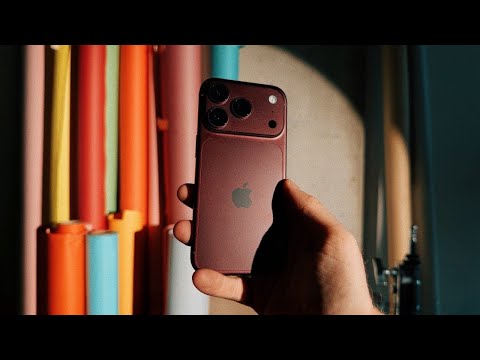
Apple’s variable-aperture camera sounds like the kind of upgrade that could redefine smartphone photography, but the testing here finds a more complicated reality. Moving between f/1.48 and f/4 can alter depth of field, create star-shaped highlights, and help control shutter speed in bright video conditions, yet the visible depth-of-field difference is relatively modest. The new Pro Controls are arguably more consequential, bringing manual shutter speed, aperture, focus, white balance, and histogram tools into the camera experience. That practical explanation makes the feature easier to understand without overselling what it accomplishes.
Camera testing also uncovers one of the phone’s clearest weaknesses. Bright lights can produce a curved streak of flare and, at smaller apertures, conspicuous petal-shaped artifacts, with a comparison suggesting the effect is worse than on the 17 Pro under similar conditions. The demonstration is especially useful because it goes beyond identifying the problem: a 3D-printed lens hood is tested as a partial remedy. Photographic Styles 3, film-like grain and glow effects, and natural-looking skin smoothing add creative flexibility, while the comparison with an iPhone 5 provides a welcome reminder that technically cleaner images are not automatically more appealing photographs.
Performance is where the 18 Pro makes its strongest case. The presented Geekbench results show substantial CPU and GPU gains, but the gaming and thermal tests are more informative than benchmark numbers alone. Death Stranding reaches a considerably more playable frame rate, while the 18 Pro Max maintains its performance ceiling instead of showing the throttling observed on the 17 Pro Max. The explanation of side-by-side memory placement and a much larger vapor chamber gives those results useful technical context, and the 30-minute 4K/120 FPS recording test further supports the argument that sustained performance has improved rather than merely peak scores.
Battery life and charging provide similarly tangible gains. Despite only a small capacity increase, the standard Pro lasts 6 hours and 38 minutes in the presented stress test, nearly two hours longer than its predecessor, while the Pro Max reaches 7 hours and 57 minutes. Charging reaches a reported 52W peak, with both models reaching 50 percent in 15 minutes. The storage discussion adds an important caveat: the tested 1TB model uses QLC rather than TLC flash, which the review describes as a cost-saving move with lower endurance, although its own usage estimate suggests that longevity is unlikely to become a practical problem for typical ownership periods.
Apple’s C2 modem gets an unusually nuanced examination. Ten strong-signal tests favor the 17 Pro for download speed, upload speed, and latency, while the 18 Pro performs better in the weak-signal garage test. Poor-signal calls are similarly unreliable on both devices, and the 18 Pro takes much longer to reconnect after signal loss in the repeated isolation-box experiment. Those mixed results justify the restrained conclusion that Apple’s modem remains somewhat behind overall rather than turning one favorable scenario into a sweeping claim of superiority.
The software discussion is less convincing when it moves from measured improvements into broader conclusions about AI and the technology industry. iOS 27 appears smoother in use, although the measured AirDrop improvement is small, and the redesigned Siri demonstrates an important distinction between conversational intelligence and system integration: it performs poorly on several trick questions but successfully executes a complicated request spanning messages, flight information, reminders, and the calendar. From there, claims about Apple’s AI investment, industry spending, component shortages, manufacturing costs, future memory prices, and the consequences of AI become increasingly ambitious relative to the evidence presented within the review. The closing reflection on technological change is thoughtful and gives the one-take production concept thematic purpose, but it also pulls attention away from what is otherwise an exceptionally detailed phone evaluation.
Pros
- Variable aperture is explained through concrete photographic and video examples rather than treated as a specification upgrade alone.
- Gaming, sustained-performance, temperature, battery, charging, and modem tests provide useful measurements across several real-world scenarios.
- The lens-flare comparison openly identifies a meaningful camera weakness and tests a practical mitigation.
- Mixed C2 modem results are presented with appropriate nuance instead of selecting only the tests that favor the new phone.
- The continuous-shot presentation is an ambitious creative choice that complements the closing discussion about technological change.
Cons
- Several industry-wide claims about AI investment, component shortages, manufacturing costs, and future pricing are asserted more confidently than the material presented here can independently establish.
- The variable aperture produces less dramatic photographic depth-of-field differences than its prominence initially suggests.
- Significant lens flare can undermine the otherwise sophisticated camera system in challenging lighting.
- The extended philosophical discussion about AI and the future of technology eventually overshadows the phone-focused analysis.
- Siri’s comparison with competing assistants relies on only a handful of selected prompts and therefore cannot establish their broader relative capabilities.
Rigorous hardware testing makes a strong case that the meaningful advances are endurance, sustained performance, charging, and deeper camera control rather than cosmetic changes such as the smaller Dynamic Island. The ambitious one-take presentation gives the review personality, although its expansive AI commentary sometimes reaches beyond the evidence that makes the device testing so persuasive.