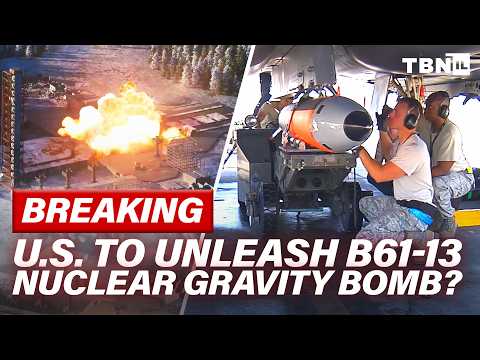
Renewed U.S. strikes on Iranian targets provide the immediate news hook, with the report identifying air-defense and communications sites, radar systems, and mine-laying capabilities among the stated targets. The justification presented is similarly specific: Iranian attacks on shipping and American forces, an alleged attempt to deploy sea mines, and eight missiles reportedly intercepted after being fired at a U.S. base in Jordan. These details establish the administration’s rationale efficiently, but they are presented as statements from U.S. officials rather than independently demonstrated facts.
President Trump’s comments push the segment beyond a straightforward military update. His claim that Iran’s economy is “totally collapsing,” combined with his question about when Iranians will “rise up and fight,” frames the pressure campaign as potentially having consequences for the regime itself. Secretary of State Mark Rubio, meanwhile, emphasizes preventing Iran from obtaining a nuclear weapon and preserving the option of military action. The presentation clearly communicates the administration’s position, though it offers little examination of Iran’s capabilities, intentions, response, or the wider risks of escalation.
Congressman Tim Burchett then delivers an unequivocal defense of the strikes, arguing that economic and military pressure are both necessary to prevent Iranian nuclear capabilities. His comments add political reaction but not much analytical balance. Assertions about what officials previously said regarding Iranian missiles and nuclear capabilities, as well as claims about the effectiveness and international economic impact of the strategy, are largely allowed to stand without supporting evidence or challenge.
The abrupt move from Iran to Flock license-plate cameras makes the segment feel like two separate interviews joined together. That transition weakens the focus promised by the headline, but the surveillance discussion is actually more developed than the foreign-policy portion. Burchett explains his proposal to eliminate federal funding for the cameras and grounds his objection in warrants, constitutional protections, government surveillance abuses, and his preference for local decision-making.
There is also at least some acknowledgment of the opposing position. Flock’s statement argues that license-plate-reading technology can serve public safety while being governed by privacy, transparency, and accountability safeguards. Burchett rejects that reassurance in characteristically forceful language, but including the company’s response gives viewers a clearer sense of the dispute than they receive during the Iran discussion. His example involving contracts allegedly being kept below a bidding threshold also introduces a concrete government-procurement concern, although it is not independently substantiated within the segment.
Presentation is energetic and accessible throughout, particularly once Burchett joins and turns the discussion into a more conversational exchange. His blunt analogies and emphatic delivery make his position unmistakable, but phrases such as calling a company executive a “clown” move the interview toward partisan talk-show rhetoric rather than careful policy analysis. The result works reasonably well as a quick snapshot of administration messaging and one congressman’s reaction, but viewers seeking a rigorous assessment of either the Iran strikes or automated license-plate surveillance will find important factual and opposing perspectives underdeveloped.
Pros
- The opening efficiently summarizes the stated targets of the U.S. strikes and the administration’s publicly presented justification for renewed military action.
- Trump’s, Rubio’s, and Burchett’s comments provide a clear picture of the administration and congressman’s arguments for combining military and economic pressure on Iran.
- The Flock discussion identifies specific privacy, warrant, funding, procurement, and local-control concerns rather than remaining entirely at the level of slogans.
- Including Flock’s response gives the surveillance portion at least a meaningful statement of the counterargument.
Cons
- Major claims about Iran’s military and nuclear capabilities, economic condition, and the effectiveness of U.S. pressure receive little supporting evidence or independent scrutiny.
- The Iran discussion offers limited perspective on escalation risks, Iranian responses, or competing interpretations of the administration’s strategy.
- Switching midway to license-plate cameras substantially dilutes the focus of a segment introduced around renewed U.S. strikes.
- Burchett’s insults and sweeping assertions sometimes replace the more detailed policy examination that both subjects would benefit from.
The segment is effective at communicating the administration’s rationale for renewed pressure on Iran and becomes unexpectedly substantive when it turns to surveillance cameras, but neither subject receives fully rounded treatment. Clear sourcing of official claims and a genuine counterposition in the Flock discussion help, while the limited scrutiny of the Iran assertions and the jarring topic change keep the piece from becoming a particularly strong piece of analysis.