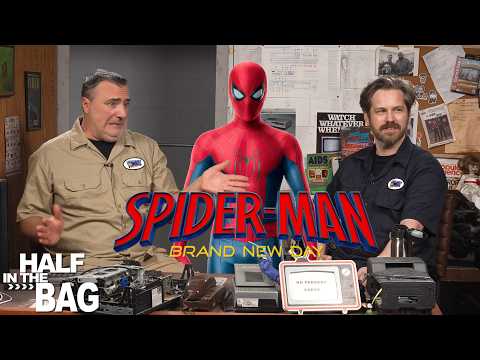
The most effective part of this breakdown is its reading of Peter Parker’s central conflict as the inverse of the familiar Spider-Man dilemma. Rather than struggling to make enough room for Spider-Man, Peter has spent years allowing the superhero identity to consume his ordinary life, with the video connecting his increasing aggression and changing biology to that imbalance. Punisher, Banner, and Jean Grey are then used as variations on the same idea: people whose extraordinary abilities, missions, or trauma threaten to overwhelm the person underneath. That gives the discussion a coherent thematic foundation rather than treating the ending purely as a collection of franchise clues.
Jean’s role in the climax receives particularly thoughtful attention. The video connects the discovery of what happened to her sister with the sudden expansion of her powers, then contrasts Frank’s violent solution with Peter choosing empathy. Peter allowing Jean into his memory of Aunt May becomes the emotional centerpiece of the interpretation, because May’s advice can apply to both characters simultaneously. The later hospital sequence and cheering crowd extend that idea effectively: Peter can recognize Spider-Man’s importance without allowing Spider-Man to become his entire existence. His decision to approach Ned without the mask provides an appropriately personal consequence of that realization.
The explanation of Ned apparently remembering Peter is more speculative. The video proposes that Ned’s inherent magical ability, the pair’s old handshake, and a kind of muscle memory combine to penetrate the memory spell. Those connections are imaginative and draw on earlier events, but the proposed mechanism is an interpretation rather than something demonstrated by the scene as described. The discussion of MJ goes even further into preferred future storytelling, arguing that her memories should remain erased so Peter can pursue relationships with characters such as Black Cat or Gwen Stacy. That may be a viable direction, but it shifts from explaining the ending toward advocating for a particular version of Peter’s future.
The mutant material similarly mixes useful setup analysis with increasingly elaborate forecasting. Damage Control’s experiments on Jean, Metzger’s actions, power-inhibiting technology, and Jean ending the story on the run provide concrete material for discussing future hostility toward mutants. From there, however, the video constructs a much larger possible trajectory involving registration, mutant arrests, Sentinels, power-dampening collars, Mr. Sinister, Xavier’s school, and Jean becoming its first student. Comic parallels make those possibilities understandable, but they do not establish that the MCU will actually follow that route. The breakdown is strongest when it identifies thematic or narrative ingredients already present and weaker when those ingredients become evidence for a highly specific roadmap.
The post-credits analysis follows the same pattern. The Spider-Tracker locating Spider-Man somewhere in space is treated as a bridge to the coming Avengers films, and the video builds a detailed Secret Wars scenario around Peter surviving the destruction of the multiverse aboard a space ark. It then imagines Doom’s Tony Stark appearance becoming an emotional conflict for Peter and suggests meetings with other Spider-Man variants. The presenter generally signals these ideas as speculation, but the sheer number of connected predictions can make the proposed scenario sound more settled than the underlying evidence warrants. The explanation for Spider-Man’s location also depends on assumptions about how the Spider-Tracker receives sightings that are not established within the discussion.
The final stretch extends that forecasting to the black suit and Venom, using the original Secret Wars connection, Jean DeWolf’s comic history, and Damage Control’s sonic weapons to predict not merely a symbiote storyline but an entire progression toward a Spider-Man-versus-Venom sixth film. This is entertaining franchise theorizing, and the comic references give viewers useful context for why these possibilities are being considered. Yet statements of near-certainty exceed what the presented clues can support. Presentation also suffers from interruptions: a lengthy privacy-service sponsorship arrives during the Damage Control discussion, followed later by an extended merchandise promotion just as the mutant material begins. Both break the momentum of an otherwise energetic and densely connected analysis.
Pros
- The Peter Parker/Spider-Man identity conflict provides a strong thematic framework for interpreting the ending.
- Jean Grey’s climax is analyzed through character development, trauma, empathy, and Peter’s Aunt May memory rather than powers alone.
- Ned’s handshake, Damage Control, Jean’s escape, the Spider-Tracker, and sonic weapons are connected to earlier story details instead of being treated as isolated Easter eggs.
- Comic references provide useful context for the X-Men, Secret Wars, the black suit, Jean DeWolf, and Venom possibilities.
- The breakdown usually makes clear when it is proposing possible future MCU directions rather than recounting events already shown.
Cons
- Theories about Ned breaking the memory spell through magic and muscle memory rely on an unconfirmed mechanism.
- The mutant discussion escalates quickly from concrete Damage Control developments into speculative predictions about Sentinels, mutant registration, Mr. Sinister, Xavier’s school, and future X-Men structure.
- The proposed Doomsday and Secret Wars storyline depends on multiple assumptions about Peter’s whereabouts, the multiverse’s destruction, a space ark, and which characters survive.
- Predictions of a black-suit film followed by a Spider-Man-versus-Venom sixth movie are presented with more confidence than the cited clues justify.
- Lengthy sponsor and merchandise segments interrupt important transitions in the analysis.
This is at its best when examining what the ending says about Peter and Jean, particularly the idea that both have allowed extraordinary circumstances to separate them from ordinary human connection. The comic knowledge also makes the wider franchise speculation entertaining and gives seemingly small details potential context, but the argument becomes increasingly conjectural as it moves from the film’s immediate character resolution into elaborate X-Men, Secret Wars, symbiote, and Venom predictions. As an ending analysis it offers several perceptive observations; as a roadmap for the MCU’s future, it is better treated as enthusiastic theorycrafting than firm explanation.