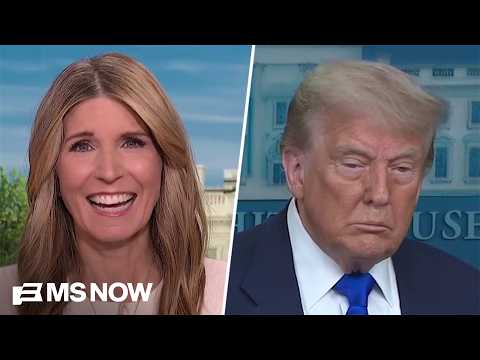
Donald Trump’s attempt to rename Lake Ontario becomes an opening case study in presidential power, political intimidation and the limits of executive orders. The discussion usefully distinguishes an executive order from legislation and argues that changing the federal government’s preferred geographic terminology cannot compel ordinary Americans, Canadians or international institutions to adopt it. That explanation is accessible, and the detour into Civil War-era government administration adds historical texture, but the segment quickly moves from explaining governmental mechanics to interpreting Trump’s motives as bullying and authoritarianism. That shift establishes the approach used throughout: factual explanation, historical analogy and forceful political judgment are interwoven rather than clearly separated.
The treatment of Canada, tariffs and trade demonstrates both the strengths and weaknesses of that method. The speaker describes an escalating confrontation involving Prime Minister Mark Carney, retaliatory Canadian tariffs and efforts to deepen Canadian ties with the European Union, while openly declining to repeat rumored negotiating details she has not independently seen. That restraint is welcome. Elsewhere, however, conclusions such as describing automotive tariffs as effectively unworkable or characterizing the Iran situation as a historically catastrophic American mistake are delivered with much greater certainty than the supporting material presented here allows, leaving viewers dependent on the speaker’s interpretation rather than a demonstrated evidentiary chain.
Election administration receives the most sustained attention and produces some of the clearest practical information. The distinction between individual voter fraud and manipulation by officials is plainly explained, while the discussion of voter-roll disputes, mail voting and proposed ICE activity around polling places builds toward straightforward advice to verify registration and make a voting plan. Yet the argument also repeatedly treats disputed intentions as established: proposed election measures are characterized as efforts to frighten naturalized citizens, suppress turnout and preserve Republican power. Historical comparisons to voter intimidation after the Civil War help clarify why the speaker considers such tactics dangerous, but the analogy is rhetorically powerful enough that it needs particularly strong evidence to separate demonstrated conduct from predictions about motive and effect.
A similar pattern runs through the Kennedy Center, CIA and Epstein-file sections. The speaker is commendably willing to say that she does not know what CIA Director John Ratcliffe discussed during a reported Moscow visit, offering possible explanations without pretending certainty. Her account of litigation over Epstein-related records likewise emphasizes questions of compliance, redaction and judicial oversight rather than claiming to know what unreleased documents contain. By contrast, the Kennedy Center dispute is framed through a mafia-style threat analogy, and Ratcliffe is dismissed as unqualified without much supporting detail, illustrating how quickly the presentation can move from useful uncertainty to categorical political assessment.
The final third is more substantial because it connects the midterms to the institutional consequences of congressional control rather than treating an election simply as a scoreboard. The comparison with the post-Watergate Congress explains why winning one or both chambers would not automatically allow Democrats to enact their legislative agenda while a Republican remains president. More importantly, the speaker argues that committee investigations and oversight could expose misuse of public money, then points to alleged connections among government contracts, energy arrangements, private companies and political donations. Those examples give the corruption theme concrete shape, but the severity of the accusations demands more careful differentiation between documented payments, suspicious timing, conflicts of interest and proof of illegal quid pro quo conduct. The presentation frequently moves from reporting that transactions occurred to describing the broader system as a corrupt slush fund.
As political commentary, the stream is unusually candid about its objective. The speaker ultimately urges viewers to elect Democrats, pressure representatives, scrutinize candidates claiming new partisan identities and view the current Republican Party as an autocratic threat. There is little pretense of neutrality, which at least makes the ideological perspective easy to understand, and the conversational format benefits from moments of self-correction, uncertainty and even mundane humor about an unsuccessful cake. Those qualities make a lengthy, wide-ranging discussion personable and often engaging. Still, viewers looking for a rigorous briefing rather than advocacy will need to distinguish the useful explanations and explicitly qualified claims from assertions about motives, corruption and democratic collapse that are presented more confidently than the evidence supplied within the discussion can independently establish.
Pros
- Explains executive orders, congressional oversight and the practical limits of divided government in accessible language.
- Explicitly declines to repeat some rumors and acknowledges uncertainty about the CIA director’s reported Moscow discussions.
- Gives viewers concrete civic advice about checking registration and planning how to vote rather than relying solely on political rhetoric.
- Historical comparisons provide useful context for presidential power, post-Watergate congressional politics and voter intimidation.
- Specific examples of contracts, political contributions and government spending give the broader accountability argument something tangible to examine.
Cons
- Commentary and factual explanation are frequently blended, making it difficult to tell where established events end and interpretations of motive begin.
- Serious allegations of corruption, voter suppression and authoritarian intent are sometimes stated more conclusively than the evidence presented supports.
- Historical analogies to post-Civil War intimidation and organized-crime threats add rhetorical force but can outrun the demonstrated similarities.
- Numerous digressions and conversational tangents make an already broad discussion less focused.
- The openly partisan conclusion limits the usefulness of the presentation for viewers seeking a comparatively neutral assessment of the disputes discussed.
Accessible institutional explanations, historical context and occasional restraint make this a more substantive political stream than simple partisan venting. Its value is nevertheless reduced by the tendency to move too quickly from documented events to confident conclusions about motives, corruption and authoritarian strategy, making it strongest as clearly identified political commentary rather than an independently demonstrated factual briefing.