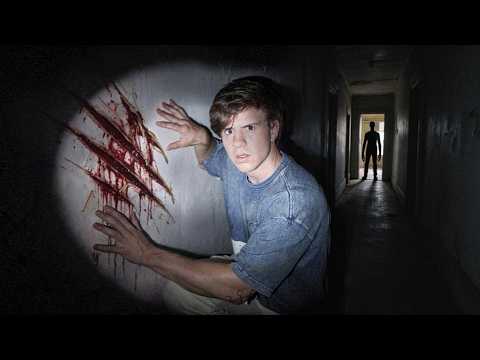
An old basement, a rocking chair and a story about a deceased man provide all the ingredients needed for a straightforward haunted-house challenge. The group enters already nervous, with the claim that visitors have supposedly heard the former resident walking around or rocking his chair. That backstory immediately creates tension, but the paranormal premise is presented almost entirely through what the participants have been told rather than through verifiable information about the house or its history.
Much of the entertainment comes from the group's escalating reactions to an environment that is naturally unsettling. Spider webs, stored belongings, old equipment, boxes and dark corners repeatedly become sources of suspicion, while the participants argue about whether to stay or leave. Their genuine-seeming reluctance gives the sequence energy, especially because the planned sleepover quickly starts feeling less like a confident challenge and more like a test of how long everyone can tolerate being downstairs.
Winnie, described as a service animal, is also treated as a kind of supernatural warning system, with barking, shaking and attention toward particular areas interpreted as possible signs of a presence. That may work dramatically, but the dog's behavior does not establish paranormal activity, and the suggestion that he can detect ghosts or supernatural "energy" is not supported within the presentation. Ordinary reactions to unfamiliar surroundings, people, noises or smells are not seriously considered before the behavior is folded into the haunting narrative.
The same limitation affects the other supposed evidence. A camera briefly going blurry is described as though something may have passed in front of it, a high handprint raises questions about who could have made it, and unexplained footsteps or noises trigger increasingly alarmed reactions. These moments are effective scare beats, but none receives enough investigation to establish what caused it. The participants generally move quickly from an ambiguous event to a paranormal possibility, which preserves the suspense while leaving the evidence weak.
The rocking chair becomes the clearest attempt at a payoff when the group notices what they perceive as unexplained movement or a change involving it. Their immediate panic makes the moment lively, but the presentation again emphasizes reaction over verification. There is no controlled observation, sustained examination of the chair or demonstrated elimination of mundane explanations, so the scene works better as haunted-house entertainment than as evidence that anything supernatural occurred.
There is also an interesting tension between curiosity and the homeowner's stated privacy rules. The group says they have permission to be in the basement and repeatedly acknowledges that they should not go upstairs or open things, yet they still inspect stored possessions and speculate about what belongs to the woman's late husband. Those boundaries are mostly respected, but the repeated temptation to investigate private belongings sometimes distracts from the central challenge rather than adding meaningful information.
As a piece of suspense-driven entertainment, the visit succeeds through atmosphere, nervous banter and the group's willingness to abandon the original sleepover once the experience becomes too uncomfortable. As a paranormal investigation, however, it offers little documentation beyond personal reactions and ambiguous sights and sounds. The decision to leave before completing the night also makes the advertised challenge somewhat anticlimactic, although that failure becomes part of the comedy and chaos of the ending.
Pros
- The cluttered basement, old rocking chair and limited visibility create an effective naturally creepy setting.
- Nervous interactions among the group give the visit energy and keep the simple premise moving.
- Several escalating incidents, including noises, the camera problem and the chair scare, provide clear suspense beats.
- The participants' decision to abandon the challenge gives the ending a spontaneous quality rather than forcing the original plan.
Cons
- Claims about the house's history and supposed haunting receive almost no supporting detail or verification.
- Winnie's behavior is treated as potential evidence of ghosts without establishing that the dog can detect anything supernatural.
- Ambiguous noises, a handprint, camera blur and the rocking chair are not investigated thoroughly enough to rule out ordinary explanations.
- The group repeatedly interprets uncertainty through the haunting premise instead of seriously considering competing explanations.
- Abandoning the planned overnight stay leaves the central sleepover challenge incomplete.
The basement setting and increasingly frightened reactions make this an entertaining scare challenge, particularly once small unexplained events begin piling up. Its paranormal case is far less convincing because nearly every supposed sign remains ambiguous and largely untested, while the abandoned sleepover limits the payoff promised by the premise.