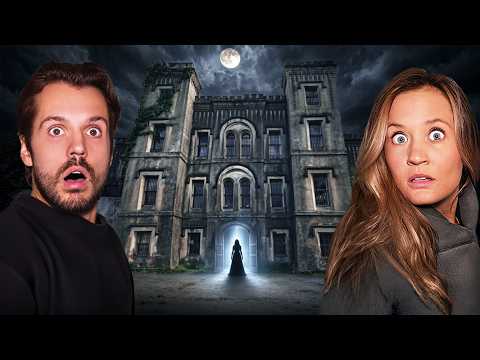
A supposed child spirit, a basement surgery, unexplained scratches, small fires, and visitors fleeing after only a few days have turned this house into a frightening local legend. The investigation initially embraces that reputation with nervous jokes, dark-room challenges, and warnings from people in the neighborhood, but it becomes considerably more interesting once the group starts asking whether the story behind the haunting can actually be supported. That tension between paranormal entertainment and basic historical verification gives the visit more purpose than a standard overnight ghost hunt.
The early tour effectively establishes why the location has accumulated its reputation. A local man recounts hearing about a brick flying from a wall, the owner says unusual things happen in the house, and multiple people repeat stories about scratching and other disturbances. None of these accounts independently establishes a paranormal cause, and the presentation generally understands that distinction. Even when one participant immediately thinks he feels a bite, the group checks for a physical mark rather than treating the sensation itself as proof.
The strongest investigative turn comes when the familiar Sally story begins falling apart. Records support the existence of Dr. Charles C. Finney, but place him at a different address, while the person identified through historical research as Sally Isabel Hall does not resemble the little girl described in the popular legend. According to the records presented, Hall was an adult Black woman who had been married for 16 years and had 14 children. That does not explain the strange experiences attributed to the house, but it provides a valuable corrective to a story that apparently became accepted through repetition rather than demonstrated historical evidence.
Finding Tony and Deborah Pickman’s son by chance also gives the investigation an unusually direct connection to the people associated with the house's modern reputation. Contact with Deborah then informs the later experiments, allowing the group to test reported phenomena such as moving stuffed animals, malfunctioning electronics, unexplained writing, photographic orbs, temperature changes, and scratching. The methodology remains informal, but choosing specific claims to test is more useful than relying entirely on ambiguous ghost-hunting equipment whose operation the host openly admits he does not understand.
Most of those experiments produce nothing remarkable. The stuffed animals apparently remain where they were placed, photographs reveal no unusual figures or orbs, the thermal camera finds no unexplained temperature anomalies, and the initial timer comparison works normally. When a mark is later noticed on the host's back, the group examines it and rejects it as convincing evidence of a scratch. Those negative results matter because the participants repeatedly resist the temptation to convert every unsettling sensation into paranormal confirmation.
The electronics provide the night's main unresolved curiosity. The television repeatedly switches off, a microwave clock stops, and a separate timer reportedly stops as well, while earlier lights appear to flicker. These events resemble claims made about the house, which understandably makes them interesting, but the investigation never establishes that the equipment is functioning reliably enough to exclude ordinary electrical or mechanical explanations. Similarly, lights noticed while sitting alone in the basement are treated cautiously, with possible gaps or other sources considered rather than immediately labeled apparitions.
Presentation is considerably less disciplined than the underlying investigation. The friends' fear, teasing, and willingness to separate throughout the house create an entertaining atmosphere, but extended crude jokes sometimes overwhelm potentially interesting observations. More disruptive is the lengthy Trophy Hunter promotion inserted directly into the owner's discussion of the property's history; repeatedly jumping between his answers and advertising breaks the momentum of one of the most useful interviews. The sexually explicit joke used to close the overnight investigation is similarly unnecessary and leaves a weaker final impression than the evidence-focused portions deserve.
Pros
- Historical records are used to challenge important elements of the popular Sally legend rather than simply repeating them as fact.
- Contact with the Pickman family helps connect the experiments to specific experiences previously attributed to the house.
- Tests focus on concrete claims involving toys, electronics, photographs, temperature changes, writing, and physical scratches.
- Negative and ambiguous findings are frequently acknowledged instead of being forced into paranormal explanations.
- The investigation distinguishes between confirming that something unusual happened and establishing that a ghost caused it.
Cons
- The experiments lack enough controls and equipment verification to meaningfully explain the electronic malfunctions.
- Eyewitness stories provide atmosphere but cannot independently establish the supernatural claims attached to the house.
- The extended sponsor integration badly interrupts an otherwise valuable conversation with the property owner.
- Frequent crude humor sometimes undercuts the more thoughtful historical and investigative work.
- The overnight stay produces several curiosities but no evidence strong enough to resolve the central paranormal question.
Historical research ultimately proves more revealing than anything that happens in the dark, especially when it exposes major problems with the story commonly used to explain the alleged haunting. The investigation remains entertainment rather than a controlled paranormal study, but its willingness to report failures, question ambiguous experiences, and leave the central mystery unresolved makes it more credible and engaging than its rowdier presentation sometimes suggests.