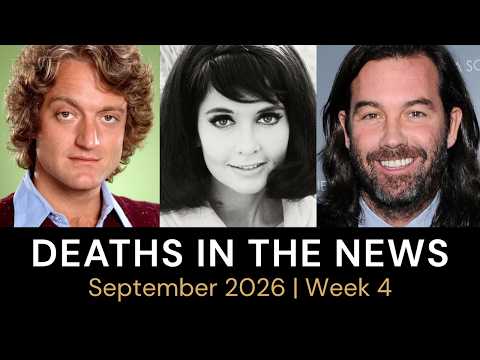
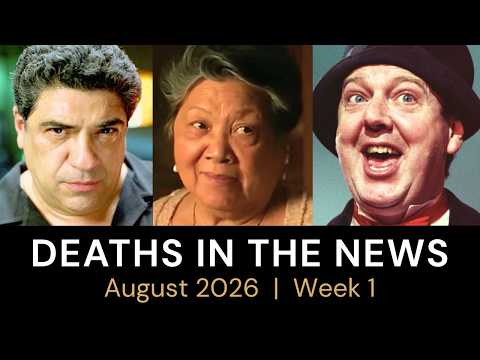
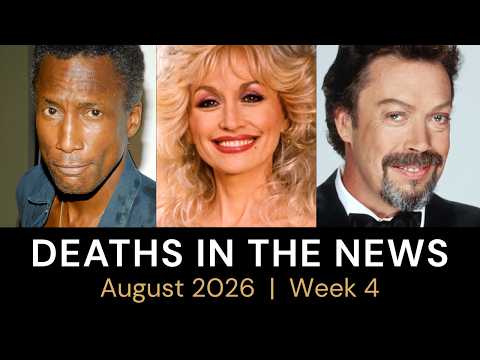
The strongest quality of this weekly memorial roundup is its straightforward emphasis on what each person did rather than simply announcing a succession of deaths. Joan Blackman is connected to her films with Elvis Presley, Ben Jones to both The Dukes of Hazzard and his later political career, Don Nelson to his accomplishments as a player and coach, and Reggie Bannister to the Phantasm films and his relationship with horror fans. These compact biographical sketches give viewers enough context to understand why each person was notable without turning the program into a series of lengthy obituaries.
That brevity becomes especially effective when the video has a more complicated story to communicate. Boxer Pritchard Colón's entry explains the 2015 fight that left him severely brain damaged and ended his career, while Sidney Towle's segment focuses not merely on her death from complications of metastatic bile duct cancer but on how she publicly documented living with the disease. The presentation remains restrained rather than exploiting either story for additional drama. Similarly, the account of Gary Dwyer identifies his place in the Teardrop Explodes and the Colourfield, while William Orbit's section emphasizes his production work and the importance attributed to his collaboration with Madonna.
The format also benefits from acknowledging the difference between when someone died and when the death became public. Blackman and Abbe Lane both died months earlier but are included because their deaths were announced during the week being covered, while Orbit's July death is likewise presented as part of the current news roundup. That distinction is important in a program whose title and weekly structure could otherwise create the impression that every featured death occurred within the same few days. The opening explicitly establishes that these are recent deaths in the news, which better describes what follows.
The retrospective section broadens the concept beyond current obituary reporting. Anniversaries for Don Everly, Aretha Franklin, and Elvis Presley provide brief reminders of major musical careers, while the birthdays of Wilt Chamberlain and Robert Redford allow the video to commemorate people whose significance extends into sports and filmmaking. These entries are necessarily compressed, but the selection of recognizable accomplishments—such as Chamberlain's championships and All-Star appearances or Redford's acting, directing, and Sundance connection—keeps the section informative rather than reducing it to dates alone.
The half-staff portion is a worthwhile expansion because it recognizes people whose deaths may not generate the same national entertainment coverage. Former public officials appear alongside firefighters, military personnel whose remains were recently identified, and people who died during firefighting operations. The references to Korean War service members Jackie Lee Thurman and Norman Ronald Blavask are particularly effective examples of how a memorial can concern events from decades earlier while still representing current news for surviving families and communities.
The main limitation is that the relentless succession of names, ages, occupations, causes of death, credits, anniversaries, and memorial honors leaves little room for individual stories to register. Some entries contain enough biographical detail to form a recognizable portrait, but others amount to only a few career credits before the program moves on. The half-staff section is especially compressed, often providing little beyond a name, position or service, and reason for the honor. The result is efficient and appropriately restrained, but the sheer density can make the later portion feel more like a memorial bulletin than an exploration of the lives being commemorated.
Pros
- The individual obituary segments usually identify specific accomplishments that explain each person's cultural or professional significance.
- The video clearly accommodates deaths announced during the week even when the person died earlier, making the roundup broader than a literal list of that week's death dates.
- Sensitive stories involving severe injury, cancer, neurological illness, and line-of-duty deaths are presented without sensationalism.
- Anniversary entries add useful historical context rather than limiting the format entirely to current death announcements.
- The half-staff section expands recognition beyond celebrities to public servants, military personnel, firefighters, and local officials.
Cons
- The rapid movement between a large number of people gives several subjects too little time for their lives or careers to make much impression.
- Some biographical entries are substantially richer than others, producing an uneven sense of depth across the roundup.
- The half-staff segment becomes particularly list-like because most honorees receive only minimal contextual information.
This is a restrained and useful memorial roundup whose greatest strength is treating a wide range of public figures and community honorees with the same matter-of-fact respect. Its compressed format inevitably sacrifices depth, but the combination of current obituary news, historical anniversaries, and half-staff honors gives the program more scope than a simple celebrity death list.