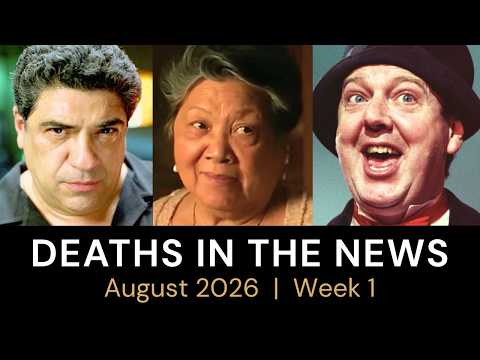
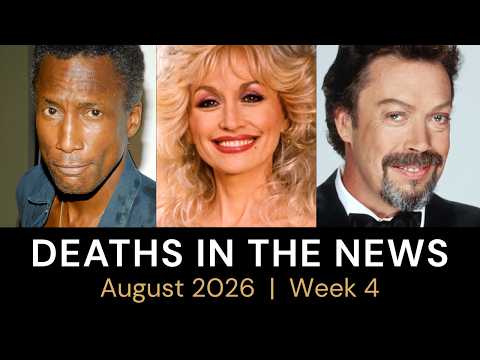
Bob Mackie’s glittering costumes, Annie Dillard’s celebrated writing and George Chuvalo’s remarkably durable boxing career illustrate the breadth of lives covered in this weekly memorial roundup. Rather than concentrating only on the biggest celebrity names, the presentation moves briskly through fashion, art, literature, sports, music, journalism, comedy and voice acting, giving each person a compact summary of why they were notable.
The individual profiles are concise but usually specific enough to provide meaningful context. Mackie’s work with Cher, Dolly Parton, Tina Turner and The Carol Burnett Show receives recognizable examples, while Dillard’s Pilgrim at Tinker Creek and Chuvalo’s fights against Muhammad Ali, Joe Frazier and George Foreman quickly establish their respective places in literature and boxing. Similar attention is given to figures who may be less familiar to general audiences, including Ismael Laguna, Cheetah Chrome, Fred Young and André Pronovost.
That efficiency is also a limitation. Careers spanning decades are sometimes compressed into only a few achievements, and the rapid succession of names leaves little opportunity to explain their broader influence. The repeated “is being remembered for” construction creates consistency but also gives much of the central segment a formulaic rhythm. Causes of death are appropriately identified as unannounced when the presentation says they have not been disclosed, rather than filling those gaps with speculation.
The shift from nationally known figures to family-written obituaries is a worthwhile expansion of the concept. Bill Engel, Elizabeth Downes Riley and El Dean Hurd are presented as examples of lives worthy of remembrance without celebrity status, reinforcing the idea that an obituary can preserve personal accomplishments and community contributions as well as public fame. However, this section also functions as promotion for Legacy.com’s obituary service, so the editorial and commercial purposes become closely intertwined.
A Blood Cancer Awareness Month segment similarly combines remembrance with advocacy. It connects several deceased public figures with forms of blood cancer before citing a figure of more than 1.5 million Americans living with or in remission from blood cancer and promoting Legacy’s charity partner, Blood Cancer United. The cause is presented respectfully, but the health statistic and reference to more than 100 types of blood cancer are asserted without supporting sources or methodological context within the presentation itself.
The anniversary portion gives the roundup a useful historical dimension, revisiting Arnold Palmer, Bill Nunn and Dr. Seuss while also marking birth anniversaries for Cass Elliot and James Lipton. These short entries follow the same accessible approach as the current-deaths section, emphasizing recognizable achievements rather than attempting full biographies. A concluding half-staff notice for Charleston County Sheriff’s Office Deputy Michael Wade Hendrix then broadens the memorial focus once more, though this final section is considerably shorter than the celebrity coverage.
Pros
- Covers a notably broad range of figures from fashion, literature, sports, music, television, journalism and other fields.
- Uses specific works, roles, teams and career achievements to explain why each person was notable.
- Clearly states when a cause of death has not been announced rather than speculating.
- The non-celebrity obituary section gives meaningful attention to accomplished lives outside national fame.
- Anniversary entries provide historical context beyond the week’s recent deaths.
Cons
- The fast succession of short profiles can reduce substantial careers to a handful of familiar accomplishments.
- Repetitive phrasing makes portions of the presentation feel formulaic.
- The blood-cancer discussion introduces significant health statistics without showing their sources or explaining their basis.
- Promotional material for Legacy.com and its charity partnership occupies substantial space within an otherwise editorial memorial roundup.
- The half-staff memorial section is much less developed than the celebrity-focused portions.
The roundup succeeds as a concise and respectful introduction to a diverse group of recently deceased public figures while making room for ordinary families and historical anniversaries. Its accessible format is useful for discovering names and accomplishments worth exploring further, though deeper context, less repetitive presentation and clearer support for health-related statistics would strengthen its authority.