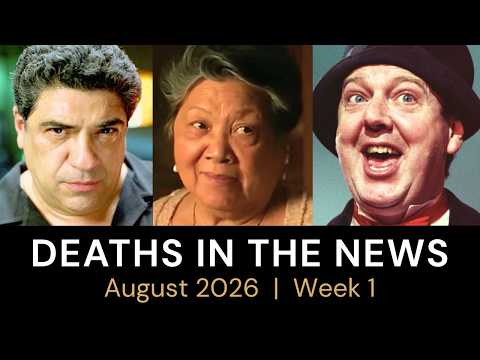
Presley Gerber, Chad Gilbert, Chris Patola and Sway Desafo open a remarkably wide-ranging collection of recent deaths, immediately establishing the format as more than a conventional Hollywood obituary roundup. Musicians, athletes, actors, broadcasters, political figures and other public personalities receive concise summaries of their careers and the reasons they are being remembered. The breadth is valuable because lesser-known figures sit alongside recognizable names rather than being treated as secondary material.
The individual notices are generally efficient and respectful. Gerrit Graham’s varied acting career, Michael Sweetney’s basketball background and mental-health advocacy, Angry Anderson’s music and film work, and Duncan Sheik’s transition from pop success to Broadway are each reduced to a few defining details without becoming merely a list of dates. The repeated structure—death date, age, cause when reported, career highlights and legacy—also makes a large number of entries easy to follow. When no cause of death was announced, the presentation says so rather than filling the gap with speculation.
That consistency does create a somewhat mechanical rhythm. Nearly every entry follows the same biographical template, and with so many people covered in succession, there is limited opportunity to explain why particular careers or achievements mattered beyond a handful of recognizable credits. Some descriptions also move quickly through names, titles and organizations, making the segment information-dense enough that viewers unfamiliar with a person may have little time to absorb one life before the next begins.
The blood-cancer memorial section changes the emphasis in a meaningful way. After discussing Anjanec Comer, the presentation moves from celebrities toward ordinary people whose families have published obituaries, highlighting a Tennessee grandfather, an Ohio sister and aunt, and a Mississippi father with very different interests and life stories. That shift reinforces the underlying idea that remembrance should not depend on fame. At the same time, the connection to Legacy.com’s charity partnership and memorial initiative gives this portion a promotional dimension that is noticeably different from the editorial obituary summaries preceding it.
Historical anniversaries broaden the concept further, revisiting Jean Shepard, Andy Williams, Linda McCartney, Jim Henson and John Coltrane. These selections provide some welcome historical perspective and prevent the format from being entirely focused on recent loss. The concise descriptions identify major works and accomplishments effectively, although the anniversary section remains introductory rather than attempting deeper career assessment.
The closing half-staff segment is another useful expansion, drawing attention to community leaders, former public officials, military veterans and firefighters being memorialized in individual states. Particularly notable is the attention given to firefighters who died in the line of duty or from line-of-duty-related illness, placing local public service alongside nationally recognized careers. Because these entries are even shorter than the celebrity notices, however, they function primarily as acknowledgments rather than substantial portraits.
Overall, the presentation succeeds through clarity, restraint and unusually broad ideas about whose lives deserve recognition. Its greatest limitation is inherent in the roundup format: covering this many deaths, anniversaries and memorial observances leaves little space for depth, while the Legacy.com promotional material occasionally interrupts the otherwise straightforward editorial flow. Still, the refusal to speculate about unannounced causes of death and the effort to include achievements beyond the most obvious claim to fame give the program an appropriately respectful tone.
Pros
- Covers an unusually broad range of musicians, actors, athletes, broadcasters, public officials and community figures.
- Clearly states when a cause of death has not been announced rather than speculating.
- Concise biographical details usually provide more context than simply listing names, ages and occupations.
- The blood-cancer memorial and half-staff sections extend the focus beyond celebrity deaths to less-famous lives and local service.
- Historical anniversaries add useful variety and connect current remembrance with notable figures from earlier generations.
Cons
- The repeated obituary structure becomes formulaic across such a large number of entries.
- Most subjects receive too little time for much explanation of the significance of their careers or accomplishments.
- The blood-cancer memorial section shifts noticeably from editorial remembrance into promotion of Legacy.com and its charity partnership.
- The density of names, dates, credits and organizations can make individual entries pass quickly.
Respectful delivery and a broad definition of remembrance make this a useful weekly obituary roundup, particularly when it moves beyond famous names to recognize community members and public servants. Its rapid, repetitive format limits depth, but the careful handling of unknown causes of death and concise career context keep the presentation informative without becoming sensational.