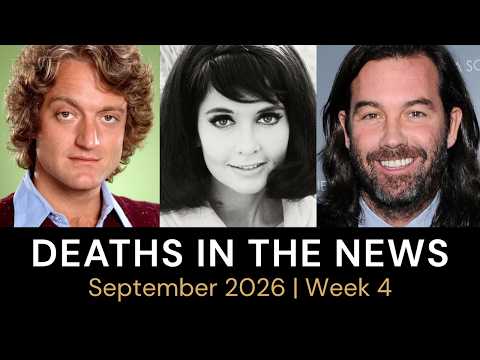
Freddie Jackson, Margaret Hamilton, and Eva Marie Saint represent three very different kinds of achievement, yet their inclusion in this weekly remembrance illustrates the broad cultural reach of Legacy.com's obituary coverage. Hosted by news editor Lenea Crowther, the presentation surveys notable deaths from early October 2026, recognizing entertainers, athletes, scientists, and public figures while also highlighting ordinary people whose lives deserve recognition. Its respectful delivery and accessible format make it a useful remembrance, although the rapid succession of biographies leaves limited room for deeper reflection.
The entertainment coverage provides some of the most recognizable names and career milestones. Jackson's R&B hits, George Fenton's film scores, and Vern Allison's contributions to the Dells demonstrate the musical diversity represented. Mary Louise Weller's association with Animal House, Marjoe Gortner's unusual transition from childhood evangelist to documentary subject and actor, and Eva Marie Saint's Academy Award-winning debut offer similarly distinctive stories. These concise summaries efficiently establish why each individual mattered, though several rely heavily on lists of credits rather than exploring the lasting significance of their work.
Margaret Hamilton's contributions to NASA's Apollo missions provide one of the strongest examples of historical importance beyond entertainment. Her leadership in developing onboard software for the moon landings and her association with the term software engineering give viewers a clear understanding of her technological legacy. The inclusion of Brooke Eby, who publicly documented her experience with ALS and advocated for research, adds a more personal dimension. Together, these profiles demonstrate the value of recognizing achievements in science, public education, and advocacy alongside celebrity accomplishments.
Sports figures receive similarly straightforward treatment, with Jeff Van Note's Atlanta Falcons career, Sam McDowell's baseball accomplishments, and Lyle Odelein's Stanley Cup victory and Columbus Blue Jackets captaincy establishing their professional significance. The presentation also acknowledges lesser-known television personalities and performers, broadening its appeal beyond household names. However, the consistent pattern of announcing a death, summarizing career highlights, and identifying what the person will be remembered for becomes repetitive. The coverage remains informative, but its compressed structure rarely provides the personal anecdotes or historical context that might make individual tributes more memorable.
The segment devoted to family-submitted obituaries is a particularly worthwhile addition. Stories about a pioneering Connecticut machinist, an Ohio woman whose childhood heart operation inspired a career in cardiac surgery, and an adventurous Colorado grandfather emphasize that meaningful lives are not limited to public recognition. These examples give the presentation emotional variety and reinforce Legacy.com's broader mission. The subsequent anniversary section, remembering figures such as Steve Jobs, Fred Shuttlesworth, Rodney Dangerfield, and Ted Bessell, provides additional historical perspective, although moving between current deaths, personal tributes, and anniversaries slightly interrupts the program's central focus.
The blood cancer awareness message and half-staff flag memorials expand the presentation's purpose beyond obituary reporting. The partnership with Blood Cancer United introduces a constructive charitable dimension, while the flag honors recognize public servants, elected officials, military personnel, and victims of terrorism. These additions are relevant to a publication devoted to remembrance, but the combination of promotional messaging, charitable advocacy, and numerous memorial announcements creates an increasingly crowded format. More importantly, the presentation offers no visible source citations or supporting documentation for its individual death announcements beyond its general attribution to Legacy.com. That matters particularly when reporting precise dates, causes of death, and sensitive allegations involving public figures. The mention of Dennis Hastert and Jim Bakker, for example, compresses serious criminal histories into brief descriptions without explaining the underlying circumstances. Such material warrants especially careful sourcing and context.
Pros
- Recognizes a diverse selection of entertainers, athletes, scientists, public figures, and advocates rather than concentrating exclusively on major celebrities.
- Provides useful career highlights, notable accomplishments, ages, and reported dates of death in an accessible format.
- Gives meaningful attention to Margaret Hamilton's technological contributions and Brooke Eby's ALS advocacy.
- Includes family-submitted obituaries that celebrate ordinary lives and add emotional depth to the presentation.
- Connects current memorial coverage with historical anniversaries, charitable awareness, and public flag honors.
- Maintains a respectful, measured presentation appropriate for sensitive subject matter.
Cons
- The rapid succession of short biographies limits historical context, personal storytelling, and deeper appreciation of individual achievements.
- Repetitive descriptions of career accomplishments and remembrance create a predictable rhythm.
- Death announcements and reported causes are not accompanied by individually identified sources or supporting documentation within the presentation.
- The combination of obituary coverage, promotional material, charity messaging, anniversaries, and flag memorials occasionally weakens the central narrative.
- Brief references to controversial public figures and their criminal histories lack the context necessary for a fully informative account.
Legacy.com's weekly remembrance offers a respectful and wide-ranging overview of notable deaths while making a worthwhile effort to honor people whose accomplishments never attracted national attention. Its greatest strengths are accessibility, breadth, and the recognition that personal legacies extend far beyond celebrity, although repetitive formatting and limited sourcing reduce its journalistic depth. As a concise memorial roundup, it succeeds more convincingly than it does as a comprehensive examination of the lives and histories it presents.