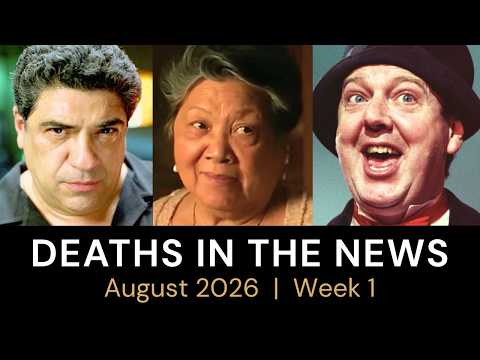
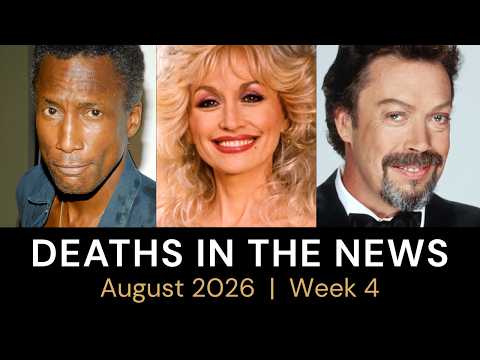
The 25th anniversary of the September 11 attacks gives this installment an unusually solemn opening, with Lenea Crowther emphasizing the nearly 3,000 lives lost and Legacy’s effort to preserve individual stories rather than reduce those people to the tragedy itself. That framing fits the subject well and establishes remembrance, rather than celebrity, as the broader purpose of the format. The introduction is restrained and respectful, though its promotion of Legacy’s relaunched September 11 memorial inevitably gives the passage a partly institutional character.
From there, the roundup moves efficiently through deaths spanning entertainment, sports, art, activism, military service and music. Richard O’Sullivan’s sitcom career, Robin Morgan’s feminist activism, Barry Melrose’s hockey career and Matt Suhey’s decade with the Chicago Bears are summarized with enough biographical context to explain why each person mattered. Lesser-known figures receive similarly concise treatment, including Lucien Smith’s transition from celebrated young artist to nonprofit work and Roy Drinkard’s combination of World War II service and Alabama business activity. The consistent structure makes a large collection of names surprisingly easy to follow.
That breadth is also the format’s main limitation. Most entries amount to a death date, age and a few career highlights, leaving little room for nuance or a fuller sense of personality. Latimore, Craig Douglas, John Small, Andy Williams and Bill Dundee are introduced through recognizable achievements, but the brisk procession can make substantially different lives feel mechanically similar. The repeated construction that each person “is being remembered” for something reinforces the memorial purpose while also making the narration increasingly formulaic.
Several details deserve particular caution because the presentation treats them as settled facts without showing its sourcing beyond the general reference to Legacy.com. Causes of death are appropriately identified as unannounced when that is all the account provides, while illnesses such as Parkinson’s disease, dementia and cancer are stated more specifically in other cases. That distinction is responsible, but viewers still have little means within the presentation itself to assess the underlying reporting. For a current-deaths roundup, where accuracy is more important than analysis, clearer attribution would strengthen confidence.
The anniversary segment is a useful change of pace, connecting the current week with Norm Macdonald, Tupac Shakur, James Gandolfini, Anne Bancroft, George Jones and Ian Holm. Their accomplishments are communicated economically, and the mix of death anniversaries and birth anniversaries broadens the idea of remembrance beyond recent news. However, the transition also extends an already information-dense collection without offering much additional interpretation, so its value depends heavily on viewers wanting a compact memorial calendar rather than deeper profiles.
The half-staff section creates the most serious credibility problem. It says North Carolina flags were lowered in memory of journalist and social movement activist Gloria Steinem, despite the earlier segment identifying Robin Morgan as the feminist activist who died and specifically describing Morgan’s work alongside Steinem. With no explanation for this apparent contradiction, the closing memorial list introduces a significant internal inconsistency into a format whose usefulness rests overwhelmingly on dependable names, dates and biographical details. Smaller verbal or naming irregularities elsewhere further make the presentation feel as though it could have benefited from a more careful final fact-check and edit.
Pros
- The September 11 remembrance focuses thoughtfully on the individual lives behind the scale of the tragedy.
- A wide range of cultural, sporting, artistic and public-service figures receives concise biographical context rather than merely a list of names and dates.
- Unknown causes of death are explicitly identified as unannounced instead of being filled with speculation.
- The anniversary section provides useful historical context for several major entertainment figures.
Cons
- The rapid, repetitive format gives many subjects only a superficial biographical treatment.
- The North Carolina half-staff reference to Gloria Steinem appears inconsistent with the earlier account of Robin Morgan’s death and seriously weakens confidence in the closing section.
- Current biographical and medical details are generally presented without specific sourcing within the narration.
- Several apparent verbal or naming irregularities suggest the material needed tighter editorial checking before publication.
The roundup succeeds best as a respectful, accessible memorial digest, particularly when it briefly explains why less universally familiar people were significant. Its efficiency and broad coverage are useful, but an internally contradictory half-staff item is a substantial flaw in a format where factual reliability is fundamental, making stronger verification and editing essential.