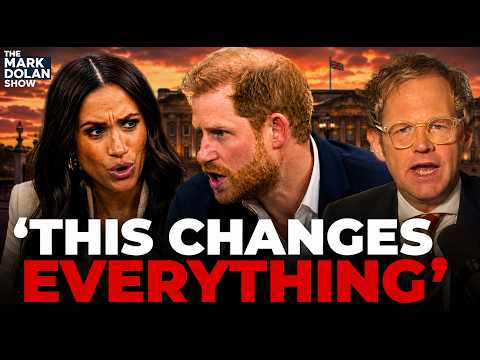
Uganda’s reported withdrawal from the 2027 Invictus Games gives the discussion a concrete development around which to build its larger argument about Prince Harry’s increasingly complicated relationship with the monarchy. The hosts present comments attributed to Uganda’s military chief, Muhoozi Kainerugaba, saying the country would withdraw rather than appear opposed to King Charles and dismissing what he calls “Harry Meghan nonsense.” That is potentially significant for Invictus, particularly because Uganda had apparently announced its participation only two months earlier, but the discussion quickly stretches the development into evidence of an international diplomatic crisis without establishing that other participating countries share Uganda’s position.
The strongest portion examines the contradiction between Harry and Meghan reportedly objecting to being described as “private citizens” while preferring “public figures.” The hosts reasonably identify why that terminology matters to the continuing dispute over the Sussexes’ relationship with the monarchy, commercial activities and public profile. However, their interpretation is relentlessly adversarial: suggestions that the couple are motivated by jealousy, need the “royal sheen” to make money or deliberately manufacture confusion are presented with far greater certainty than the information discussed can substantiate.
There is useful media analysis when competing reports about whether Harry and Charles have communicated are placed side by side. A Daily Mirror account says Harry had not scheduled a call with his father, while a Sunday Times report attributed to sources close to Harry says father and son did speak during the week of the Sussexes’ return. Importantly, the hosts eventually acknowledge that both accounts could technically be accurate because a brief exchange and a scheduled conversation are not necessarily the same thing. That qualification is considerably more careful than much of the surrounding commentary, although extensive speculation about which reporters are receiving briefings from which camps makes the segment increasingly difficult to separate into established information and conjecture.
The discussion of Invictus itself raises questions but does not adequately answer them. Paula Froelich mentions the cost of the Games and asks about financial accounts, while the hosts repeatedly characterize the organization as being in trouble and suggest additional countries could withdraw. Yet no financial documentation, participation trend or evidence of impending withdrawals is supplied here to demonstrate the scale of the claimed crisis. Even the Uganda story comes with an acknowledged complication: the hosts note Kainerugaba’s controversial political history and concede that internal Ugandan politics could be involved.
A similar problem affects the later security discussion. The possibility that Theo Rycroft has replaced Clive Alderton on RAVEC is treated as potentially consequential for Harry’s security arrangements, but the speakers themselves describe the personnel change as unconfirmed. They then build several possible scenarios around what it might mean. Exploring those possibilities can be interesting, but the segment would be stronger if confirmed developments, sourced reporting, personal sources and outright hypotheses were separated much more consistently.
Presentation is energetic and detailed, with the hosts clearly familiar with the personalities, publications and long-running disputes surrounding the Sussexes. Unfortunately, that familiarity is accompanied by openly contemptuous language toward Harry, Meghan and journalists perceived as sympathetic to them, including labels such as “propagandist” and “Monteseo mafia.” The claim of providing “zero spin” is particularly difficult to reconcile with such rhetoric. An unrelated promotional segment about a supplement also interrupts an already sprawling discussion before it moves into security, palace staffing and speculation about Harry’s future career.
Pros
- Uses Uganda’s reported Invictus withdrawal as a specific development rather than relying entirely on generalized royal commentary.
- Directly compares conflicting media reports about communication between Harry and King Charles and eventually recognizes how both accounts might coexist.
- Acknowledges important uncertainties, including possible internal Ugandan politics and the unconfirmed nature of the reported RAVEC personnel change.
- Explains why terminology such as “private citizens” and “public figures” has become significant within the broader dispute.
Cons
- Frequently turns plausible interpretation into confident claims about Harry and Meghan’s motives without establishing supporting evidence.
- Describing Uganda’s withdrawal as an international diplomatic crisis substantially outruns what is demonstrated in the discussion.
- Claims that Invictus is in serious trouble are not supported here with enough financial documentation, participation data or evidence of wider withdrawals.
- Hostile labels for the Sussexes and journalists undermine the program’s stated commitment to presenting events without spin.
- The discussion repeatedly moves from reported facts into palace-source claims, assumptions and hypothetical scenarios without maintaining clear distinctions between them.
- The lengthy advertisement and sprawling later sections weaken the focus of the central Uganda and Invictus story.
The discussion has a legitimate newsworthy development at its center and becomes most useful when it compares contradictory reporting and acknowledges unresolved questions. Its credibility suffers when one country’s decision becomes evidence for a sweeping royal crisis and speculative interpretations of private motives are delivered as near-certainties. A more disciplined separation of reporting, commentary and conjecture would make the substantial amount of royal-media detail far more persuasive.