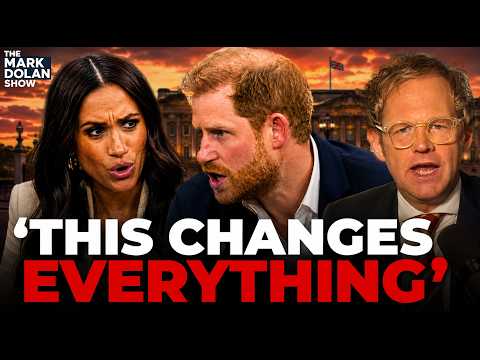
The strongest immediate material here is also the simplest: Meghan Markle posted conspicuously playful birthday imagery despite the discussion of previously reported “quiet” plans, giving the hosts an obvious contradiction to scrutinize. The plastic tiara, party hats, kitchen setting and Harry’s audible “oh dear” provide plenty of material for sarcastic commentary. The hosts are energetic and specific about what they find embarrassing, but the analysis quickly moves beyond criticizing an awkward social-media performance into assigning motives and significance that the available material does not establish.
That problem is especially pronounced in the discussion of Harry and Meghan’s marriage. Harry saying “oh dear” during a lighthearted clip is treated as potentially meaningful evidence of wider frustration, while photographs of the couple and their children are interpreted as signs that they resemble people who are merely co-parenting. The hosts repeatedly infer emotional distance from selected images, Harry’s facial expressions and what Meghan does or does not show publicly. Those observations can support commentary about how the family chooses to present itself, but they cannot establish the private state of a marriage. References to rumors about Harry’s alleged friendship with another woman further heighten the speculation without evidence being presented here to verify either those rumors or the proposed connection to Meghan’s posts.
The discussion of celebrity birthday messages has a similarly shaky evidentiary foundation. The absence of public congratulations from various famous acquaintances is presented as a meaningful “snub,” particularly where the Kardashians are concerned, yet a lack of visible social-media messages does not demonstrate that private messages or celebrations did not occur. There is a fair media-analysis point underneath the mockery: highly curated public sharing invites audiences to inspect what is and is not displayed. The video would be more convincing if it stopped there rather than repeatedly treating missing public posts as evidence about Meghan’s friendships and social standing.
A lengthy section on alleged “cosplaying” has some useful comparative structure because the hosts identify specific photographs, poses, clothing, gestures and videos they believe resemble Princess Diana, Victoria Beckham, Nara Smith and others. Showing examples gives viewers something concrete to consider instead of relying entirely on description. However, resemblance repeatedly becomes proof of intention: Meghan is described as deliberately studying Diana, calculating expressions and even using similarities to Harry’s mother to manipulate him. The claim that this makes Harry “malleable” is particularly serious psychological speculation, and suggestions about what a psychiatrist might make of Meghan are inappropriate substitutes for evidence. Similar imagery can reasonably invite discussion about influence or imitation, but it cannot establish the elaborate motives attributed to it here.
The Nara Smith comparison demonstrates the same divide between an interesting observation and an overstated conclusion. Placing the flower-gathering material alongside Meghan’s subsequent imagery allows viewers to judge the similarities, but the guest immediately broadens that example into a sweeping assertion that Meghan plagiarizes essentially everything. The conversation then extends the accusation to speeches, products and businesses without establishing those individual cases in enough detail. A more disciplined segment could have examined precisely which elements appear unusually similar and which are simply common lifestyle-content conventions.
The discussion of Princess Eugenie’s new daughter introduces happier royal news but soon becomes another exercise in inferred motives. The hosts present the announced birth details and then speculate that the timing of the public announcement was deliberate retaliation for Meghan reportedly revealing her pregnancy around Eugenie’s wedding. One host explicitly says she chooses to believe Eugenie timed it intentionally because the idea is “too delicious,” which at least makes the speculative nature of that conclusion unusually clear. Later observations about Prince George resembling Diana are considerably lighter, although claims about inherited expressions and mannerisms still drift beyond what visual resemblance alone can demonstrate.
Presentation is lively throughout, with the hosts bouncing effectively between clips, social-media reactions and conversational commentary, and their chemistry makes a long sequence of royal gossip move quickly. Yet the relentlessly derisive language also undermines the analysis. Meghan is called “crazy,” “insufferable,” “sick and twisted” and effectively psychologically abnormal, while even ordinary family photographs become material for hostile interpretation. The extended Bub’s Naturals advertisement is another substantial interruption, and although the creatine segment contains broadly framed statements about exercise and cognition, it also makes numerous health and performance claims without presenting evidence sufficient for viewers to assess them. By the end, the show is much more effective as opinionated anti-Sussex entertainment than as a careful examination of what the birthday posts actually demonstrate.
Pros
- Uses specific birthday imagery, social-media posts and comparison clips rather than relying entirely on generalized criticism.
- The hosts have energetic conversational chemistry and keep a lengthy royal-news discussion moving.
- The visual comparisons involving Diana, Victoria Beckham and Nara Smith give viewers concrete material they can assess for themselves.
- At least some of the Eugenie announcement discussion explicitly acknowledges that the proposed retaliatory motive is speculation.
Cons
- Treats Harry’s “oh dear,” selected photographs and social-media behavior as evidence for marriage problems that the material does not establish.
- Infers celebrity snubs and damaged friendships largely from the absence of public birthday messages.
- Repeatedly converts visual similarities into confident claims about Meghan’s motives, personality and alleged manipulation of Harry.
- Psychological insults and highly personal ridicule overwhelm potentially legitimate criticism of curated celebrity image-making.
- Sweeping plagiarism accusations go substantially further than the individual comparisons demonstrated.
- Speculation that Eugenie deliberately timed her daughter’s birth announcement as retaliation is entertaining conjecture rather than an established explanation.
- The lengthy supplement advertisement interrupts the discussion and includes health and performance claims without enough supporting evidence presented to evaluate them.
The video has enough specific imagery and social-media material to support a pointed critique of Meghan Markle’s carefully managed public persona, and its combative chemistry will likely satisfy viewers already receptive to that approach. Its credibility suffers, however, whenever awkward posts and visual similarities are transformed into conclusions about marriage troubles, psychological motives, manipulation and private relationships. As royal gossip commentary it is energetic and occasionally perceptive, but as evidence-based analysis it repeatedly outruns what its examples can prove.