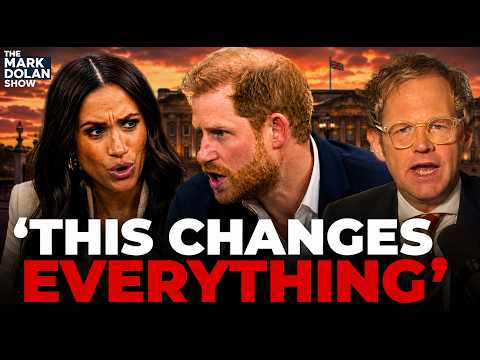
Harry and Meghan’s reported return to Britain gives the commentary an obvious satirical premise: a couple repeatedly portrayed here as rejecting royal life may now be moving closer to the institution they left. The presentation understands why that reversal could appeal to South Park, especially after the show’s earlier parody of the Sussexes’ public demands for privacy. Where the piece becomes much less secure is its insistence that a specific new South Park episode has already been announced and will target precisely these developments, even though no concrete announcement, episode title, release information, creator statement, or other direct confirmation is actually presented.
The strongest material focuses on contradiction. Clips and commentary repeatedly contrast Harry and Meghan’s past complaints about Britain, the royal family, security and media scrutiny with reports that they will return to the UK and enroll their children in British schools. The privacy argument is similarly easy to follow: the couple are criticized for seeking extensive publicity through interviews, streaming projects and books while also objecting to intrusive attention. These points provide recognizable material for satire, but the narrator frequently upgrades disputed interpretations into definitive motives, repeatedly asserting that the couple are “crawling back” because Hollywood has rejected them or because they are financially desperate.
That certainty becomes especially problematic in the discussion of Harry’s immigration status. The piece correctly frames the Heritage Foundation dispute around attempts to obtain immigration-related records and connects that controversy to Harry’s publicly described drug use. Yet it then reduces the possibilities to Harry having lied on a federal form or having received extraordinary preferential treatment, before escalating further to language suggesting he is effectively fleeing a federal investigation or possible arrest. Within the material presented, those conclusions are not established. Questions surrounding immigration records can legitimately be discussed, but legal uncertainty is repeatedly converted into a dramatic criminal narrative.
The financial section has a similar problem. Court costs, potential liabilities and reported insurance coverage provide a potentially substantive basis for discussing whether Harry faces significant financial pressure. Instead of carefully distinguishing an initial payment, possible future exposure and final liability, the narration repeatedly moves among different pound and dollar figures while describing financial ruin as already settled fact. That prosecutorial tone may energize viewers already hostile to the Sussexes, but it makes the accounting harder to evaluate and leaves little room for uncertainty about outcomes that the commentary itself indicates are not yet fully determined.
Comparisons with Catherine and William push the argument even further from reporting into character judgment. Catherine is presented as an almost ideal counterexample to Meghan, while William is described as embodying strength, clarity and dignified silence. Those contrasts clearly reveal the narrator’s perspective, but predictions about future encounters, curtsies, title removals and William’s eventual actions are speculative scenarios rather than documented developments. They might indeed become useful material for political or celebrity satire, but repeatedly asserting what South Park “will absolutely” do turns imagined scenes into the backbone of the presentation.
There is nevertheless an effective understanding of why South Park works culturally. The commentary identifies hypocrisy, public image and contradiction as fertile comic territory and recalls how the earlier “Worldwide Privacy Tour” caricature drew humor from the tension between demands for privacy and relentless public branding. That could have supported a focused analysis of why another Sussex parody might be timely. Instead, the supposed forthcoming episode becomes a vehicle for an extended catalogue of grievances against Harry and Meghan, with repeated declarations that their careers, finances, popularity and American ambitions have completely collapsed.
The result is lively, forceful celebrity commentary whose rhetorical confidence substantially exceeds the evidence it provides. Poll numbers, media clips, legal disputes and past public statements give the piece enough concrete material to build an argument about damaged popularity and perceived hypocrisy. But its central promise—the claimed new South Park episode and detailed predictions about its contents—remains inadequately substantiated within the presentation, while speculation about criminal exposure, finances and royal motives is frequently delivered as certainty.
Pros
- Effectively explains why Harry and Meghan’s reported UK return could provide strong material for satire centered on contradiction and public image.
- Uses earlier South Park treatment of the Sussexes to establish a clear thematic connection with the privacy and branding arguments.
- Incorporates specific controversies involving immigration records, litigation costs, public polling and previous media appearances rather than relying entirely on generalized criticism.
- The energetic presentation maintains momentum across a long and densely packed celebrity commentary.
Cons
- The central claim that a new South Park episode has been announced is not supported with concrete announcement details or direct evidence from the show’s creators.
- Predictions about what Trey Parker and Matt Stone have supposedly written are repeatedly presented with unjustified certainty.
- The immigration discussion turns unresolved questions about Harry’s records into suggestions of federal criminal exposure, arrest and flight from America without establishing those conclusions.
- Financial liabilities and possible future legal costs are frequently described as settled financial ruin despite acknowledged uncertainty about final amounts.
- Catherine and William are idealized while Meghan and Harry are characterized in overwhelmingly hostile terms, making the piece more prosecutorial than analytical.
- Repetition of claims about hypocrisy, Hollywood failure and financial collapse makes the latter sections feel increasingly cumulative rather than evidentiary.
There is a credible and potentially entertaining argument that Harry and Meghan’s reported return to Britain would give South Park abundant satirical material. Unfortunately, the commentary repeatedly treats predictions, legal possibilities and inferred motives as established developments, including the most important claim about what the show itself has supposedly announced. A sharper distinction between confirmed events and imagined future satire would make the piece considerably more persuasive.