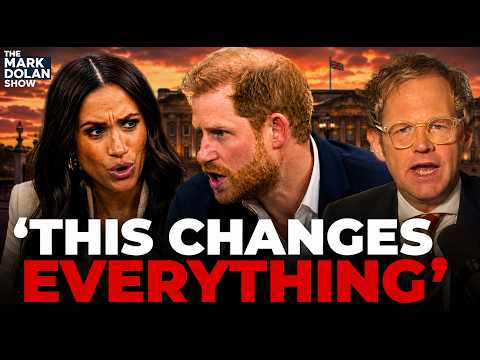
Meghan Markle’s reported return to Britain is treated here less as a royal development than as evidence that Oprah Winfrey and Gayle King were supposedly humiliated by their past support for Harry and Meghan. Dan Wootton and Rob Shuter repeatedly argue that claims made during the couple’s high-profile interview have since collapsed, leaving Oprah looking foolish for failing to challenge them. That is a potentially interesting media-criticism angle, particularly when the discussion focuses on Oprah’s interviewing choices, but the presentation quickly moves beyond what is demonstrated into confident assertions about what Oprah privately feels and what she may eventually do.
The strongest section revisits clips of Oprah and King discussing the original interview and questions whether Oprah behaved more like a sympathetic facilitator than a skeptical journalist. Wootton argues that damaging allegations required basic follow-up questions, while Shuter says Oprah placed too much trust in her guests. That criticism is specific enough to evaluate on its own terms: the hosts identify the lack of pushback as the central journalistic failure rather than merely objecting to the interview’s conclusions. Their case becomes weaker, however, when phrases such as “lies,” “proven not to be true” and claims that Oprah has been permanently embarrassed are presented far more definitively than the material shown establishes.
The pair’s prediction that Oprah could eventually turn publicly against Harry and Meghan is even more speculative. Wootton uses Oprah’s later involvement in programming concerning Michael Jackson as an analogy for how she might reassess a defining interview in order to protect her legacy. Shuter adds anecdotes about Oprah and King caring closely about media coverage, including an account of King contacting him after one of his reports. These details give the theory some internal logic, but they still do not establish that Oprah currently plans a rupture, and the repeated references to unnamed sources and private attitudes make the argument difficult to independently assess from what is presented.
The conversation then broadens into claims about Meghan and Harry’s motivations for reconnecting with Britain. Shuter cites sources alleging that William and Catherine were blindsided, that financial independence has fallen short of expectations, and that Meghan needs renewed royal proximity because her American ventures have struggled. Wootton and Shuter go much further, attributing specific emotions and strategies to Meghan, including desperation, dislike of Britain, concern about her marriage and a calculated need for royal relevance. These interpretations are delivered with confidence, but they remain interpretations and source-based allegations rather than established facts within the program.
A later discussion about a possible role in Guy Ritchie’s The Gentlemen is even less grounded. Royal commentator Hugo Vickers openly frames his thoughts about contractual boundaries and intimate scenes as speculation, which is appropriately cautious. Shuter then goes considerably further by guessing what Meghan might agree to do on screen and how she would rationalize it, despite offering no evidence about the actual negotiations or her intentions. The extended focus on her past appearance, sexuality and supposed desperation feels more provocative than informative, and it shifts the segment from media analysis toward personal conjecture.
Presentation is energetic and conversational, and the rapport between Wootton and Shuter keeps a long discussion moving, but discipline is inconsistent. The central critique of Oprah could have supported a focused examination of journalistic standards, yet the segment repeatedly detours into Meghan’s personality, acting career, finances, marriage, a speculative novel, subscription promotion and a lengthy health-product advertisement. The result is entertaining for viewers already receptive to the hosts’ perspective, but the mixture of source claims, predictions, personal judgments and commercial interruptions makes it difficult to separate substantiated criticism from commentary designed primarily to provoke.
Pros
- The criticism of Oprah’s lack of follow-up questions identifies a clear and legitimate journalistic issue for discussion.
- Revisiting Oprah and Gayle King’s own public comments gives the argument more substance than relying entirely on present-day commentary.
- The comparison with Oprah’s handling of the Michael Jackson controversy provides a coherent basis for discussing how she may think about her long-term media legacy.
- Wootton and Shuter maintain an energetic conversational rhythm despite the length and number of subjects covered.
Cons
- Major assertions about Oprah being embarrassed, privately furious or likely to turn against Harry and Meghan are presented with more certainty than the evidence shown supports.
- Claims about Meghan’s finances, marriage, motives, emotions and planned return to Britain depend heavily on unnamed sources and interpretation.
- Speculation about Meghan’s acting negotiations and willingness to perform intimate scenes becomes personal and largely unsupported.
- Frequent repetition, promotional material and an extended health advertisement dilute what could have been a tighter examination of Oprah’s interviewing standards.
A potentially worthwhile critique of celebrity journalism is buried beneath a much broader effort to assign motives, humiliation and future behavior to nearly everyone involved. The discussion is lively and occasionally specific, but its strongest observations are weakened by repeated speculation being delivered almost as established reality.