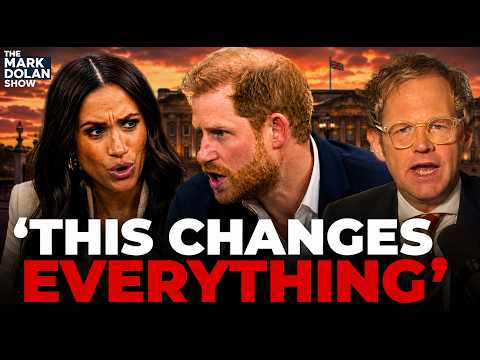
Archie and Lilibet changing schools after only two days gives the discussion a legitimate question to examine: how did a supposedly security-conscious family select a school before discovering that the daily journey was impractical? The presenter argues that this was not merely poor planning but a deliberate setup designed to strengthen Harry and Meghan’s case for protection through RAVEC. That is a much more serious allegation, however, and the central problem is that the claimed conspiracy rests primarily on what the presenter says she has been told and what she considers believable rather than evidence presented to viewers.
There is a potentially useful logistical argument underneath the accusation. The presenter points to Oxford traffic, roadworks and congestion, and questions why a security assessment conducted during the quieter summer holiday period would adequately represent a normal school-term commute. She also argues that professional security personnel should have anticipated the difference. Those observations can support skepticism about the planning process, but they do not establish the much larger conclusion that the original school was deliberately selected so it could later be abandoned as part of an effort to influence RAVEC. The leap from foreseeable traffic problems to intentional manipulation is simply too large without documentation or attributable sourcing.
The discussion becomes still less disciplined when the presenter attributes motives and personality traits to Harry and Meghan. Assertions that Meghan will use any trick to achieve her objectives, that the couple deliberately manufactured the situation, and that their conduct reflects personality disorders are presented with considerable confidence. No evidence here establishes those psychological conclusions or the alleged scheme. The insults, jokes about Meghan’s hair and appearance, and extended comparisons with the presenter’s own family experiences may appeal to an audience already receptive to the commentary, but they weaken the piece as an evidentiary examination of a security dispute.
The episode also ranges well beyond the school issue into King Charles, Uganda and the Invictus Games. Here the presenter occasionally shows more restraint, correcting a viewer’s interpretation by explaining her understanding that a Ugandan official contacted the Palace rather than Charles initiating an intervention on Harry’s behalf. She also distinguishes criticism of Charles from her view that maintaining support for Invictus could protect veterans from becoming collateral damage in a dispute involving Harry. That willingness to complicate a narrative rather than automatically take the most hostile interpretation is one of the more thoughtful elements of the discussion, even though the account itself is still presented largely through unnamed information rather than verifiable documentation.
A later political detour is much weaker. The presenter characterizes Harry and Meghan as authoritarian or totalitarian while moving into broad claims about left-wing politicians, Marxists, Leninists and democratic socialists. These sweeping ideological comparisons are neither necessary to assess the Sussexes’ security arrangements nor adequately substantiated. They turn a specific question about RAVEC and a school commute into generalized political commentary, making the argument less focused and considerably harder to separate into established information, interpretation and rhetoric.
The closing discussion about Harry’s relationship with William follows a similar pattern. Sibling rivalry is a reasonable subject to discuss given the brothers’ publicly strained relationship, but the presenter moves from that general concept to declaring that Harry has a “fully blown second son complex” and then ranks the brothers’ intelligence, appearance and personalities. Those are personal judgments rather than demonstrated psychological findings. The final clarification concerning Archie’s place in the line of succession is more careful in its wording, particularly when discussing what could be inferred from apparently valid documentation, but even that section becomes entangled with insinuations about the children’s parentage that are not substantiated here.
Pros
- Raises a reasonable question about why predictable school-term traffic and commute conditions were apparently not resolved before the children began attending.
- Clearly identifies the distinction between an ordinary planning failure and the presenter’s theory that the situation was intended to influence RAVEC, even if the latter is not proven.
- Offers some nuance when discussing King Charles, Uganda and Invictus rather than simply accepting the harshest interpretation offered by viewers.
- The presenter is energetic and responsive to audience comments, giving the lengthy discussion a conversational rhythm.
Cons
- The central claim of a deliberately engineered school-security problem is asserted without evidence sufficient to establish such a scheme.
- Unnamed sources and statements about what is supposedly happening behind the scenes are repeatedly treated as support for consequential allegations.
- Psychological diagnoses, motive attribution and personal insults replace evidence at several important points.
- Extended political generalizations and ideological attacks take the discussion far away from the specific RAVEC and school-security question.
- Speculation surrounding the Sussex children and their parentage introduces serious insinuations without substantiation.
- The lengthy diversions into personal anecdotes, audience comments and unrelated grievances dilute what could have been a much tighter examination of the security issue.
There is a worthwhile question here about how a security-sensitive school commute apparently survived advance planning only to become unacceptable after two days, and the presenter identifies several practical inconsistencies worth examining. The argument becomes far less persuasive when those inconsistencies are treated as proof of an intentional RAVEC manipulation scheme and surrounded by psychological judgments, political generalizations and personal attacks that are not established by the material presented.