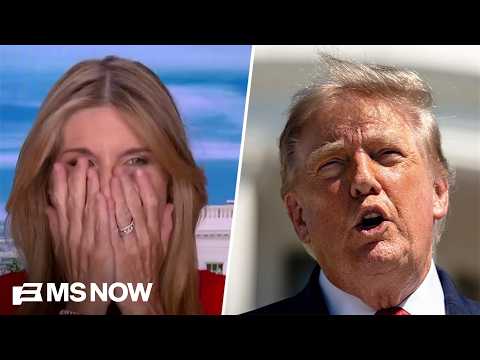
Robert De Niro’s profane call to keep Donald Trump’s “hands off our vote” supplies the explosive centerpiece, but the broader discussion is really about something larger: whether artists, celebrities and mass demonstrations are becoming a more visible cultural force against Trump. Nicolle Wallace frames recent protests, polling and the Power to the People music festival as signs of an American public increasingly prepared to defend democratic institutions itself. It is energetic television, although the opening moves quickly from evidence into a sweeping interpretation of what “the American people” have decided.
Ari Melber provides the most substantial argument by placing the weekend’s celebrity activism within the longer relationship between culture and politics. His comparison with protest movements of the 1960s and 1970s is useful precisely because he warns against viewing earlier movements through comforting nostalgia. His point that artists now regarded as obvious representatives of important social movements were not necessarily mainstream or universally admired at the time adds needed historical perspective, though these comparisons remain interpretive rather than a detailed historical analysis.
The festival itself gives the panel plenty of concrete material. Bruce Springsteen, Tom Morello, Dave Grohl and other performers become examples of political expression moving through music and popular culture rather than conventional campaign messaging. Jack Smith’s appearance in a No Kings shirt and Grohl’s shirt referencing a recent political controversy are treated as demonstrations of how political moments can escape the news cycle and acquire a longer life through concerts, photographs, clips and social media. That is one of the discussion’s sharper observations, particularly when Wallace notes that people encountering those images later may then investigate the political story behind them.
Eddie Glaude introduces the most important restraint on the panel’s enthusiasm. He describes culture as messy and contested, invokes John Wayne as a prominent counterexample to the counterculture of the 1960s, and cautions against assuming that contemporary cultural energy moves exclusively in one political direction. His reminder that conservative cultural forces exist alongside the activism being celebrated prevents the segment from becoming entirely self-confirming, even if that competing cultural landscape receives much less attention than the anti-Trump side.
Wallace also makes an interesting distinction between the current moment and the period immediately following Trump’s return to power. She recalls a climate in which law firms, universities and technology leaders appeared to accommodate the administration while many expected cultural voices remained comparatively quiet. Glaude reinforces that observation with his description of changing attitudes on campuses. These anecdotes help explain why the hosts regard the present burst of celebrity activism as significant, but they do not by themselves demonstrate the scale or durability of the change being claimed.
The biggest weakness is that the panel frequently treats several different indicators—polls, protests, celebrity participation, Trump’s approval, cultural symbolism and electoral prospects—as pieces of one coherent national awakening without doing much to test that conclusion. Wallace’s commentary is openly adversarial toward Trump, and Melber largely shares the premise, so viewers receive relatively little examination of whether celebrity activism actually changes votes, whether concert audiences represent broader public opinion, or how countervailing political movements compare. The segment is therefore more convincing as an examination of renewed anti-Trump cultural energy than as proof that this energy represents the country as a whole.
Pros
- De Niro’s blunt appearance provides a vivid example of the political activism the panel is discussing rather than leaving the conversation entirely abstract.
- Melber offers useful context about the complicated historical relationship between political movements, popular culture and later nostalgia.
- The discussion perceptively explains how concerts, clothing, photographs and short clips can extend political stories beyond the conventional news cycle.
- Glaude adds valuable caution by emphasizing that culture remains contested and can support competing political movements.
- The panel connects several specific recent examples into a clear argument about the reemergence of celebrity-led political expression.
Cons
- Broad claims about what Americans collectively believe go beyond what the examples presented can establish.
- Polling, protest turnout, celebrity activism and electoral momentum are sometimes treated as interchangeable evidence despite measuring different things.
- The panel spends little time testing whether highly visible cultural activism actually persuades voters outside an already sympathetic audience.
- Strongly anti-Trump framing leaves limited room for examining competing interpretations of the same cultural moment.
- Historical comparisons are provocative but not developed deeply enough to support some of the larger conclusions drawn from them.
The segment succeeds best as a lively examination of how anti-Trump activism is again becoming conspicuous in American popular culture, with Melber and Glaude adding enough historical perspective to move the conversation beyond celebrity sound bites. Its larger claim of a broad national political awakening is less firmly demonstrated, making the discussion engaging and perceptive but more persuasive as cultural commentary than as evidence of where the entire electorate is heading.