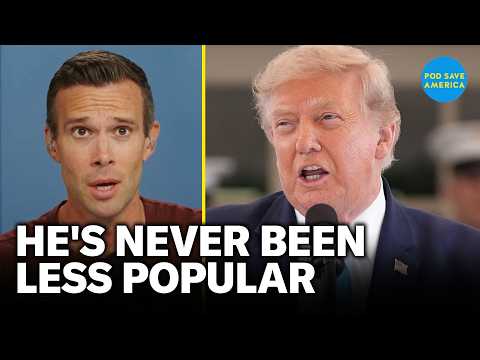
Joe Rogan’s description of Trump supporters as “rabid” provides a sharp opening for a broader argument that parts of the Republican coalition are distancing themselves from Trump ahead of the midterms. The segment builds that case through Maria Elvira Salazar’s criticism of immigration enforcement, reports of candidates minimizing Trump on campaign websites, Republicans opposing the Iran war, and Rogan’s increasingly critical comments. These examples give the argument more substance than Rogan’s remarks alone, but the host repeatedly moves from evidence of individual defections or competitive races to sweeping conclusions about Trump’s standing with Republicans without establishing how representative those examples actually are.
Polling becomes the main evidence for the claim that Republican vulnerabilities are spreading into previously comfortable territory. Several Senate contests, Trump’s reported approval numbers, campaign spending, and JD Vance campaigning in Kansas are presented as signs of trouble, while the host does acknowledge that polls are uncertain and elections ultimately depend on turnout. That qualification is useful, but it competes with much stronger language describing Trump as a “train wreck,” characterizing a proposed $5,000 payment as a bribe, and treating shifting races as part of an increasingly obvious collapse. The result is energetic political commentary rather than a detached assessment of the electoral evidence.
The Hasan Piker and Axios dispute is handled with more balance. Viewers get enough of Piker’s actual response to understand why the “worse than Al Qaeda” framing generated outrage and why critics considered the headline reductive. The discussion also explains the political consequences for Abdul El-Sayed, including Republican efforts to connect him to Piker and El-Sayed’s own rejection of the Al-Qaeda comparison. Importantly, the host recognizes two ideas simultaneously: Axios may have framed the exchange for maximum outrage, while Piker’s underlying comments can still create problems for candidates associated with him. That distinction is one of the show’s better analytical moments.
The Macklemore and Ed Sheeran controversy similarly benefits from laying out the sequence of claims, responses, withdrawals, and announced donations rather than reducing the dispute to a single viral moment. Macklemore’s account of Robert Kraft’s intervention is presented alongside Sheeran’s response that removing Macklemore was the promoter’s decision, followed by the reported departures of other supporting performers and subsequent donation announcements. However, the host plainly takes a side, repeatedly using the language of censorship and treating Sheeran’s response skeptically. On a dispute involving competing accounts and politically charged interpretations, clearer separation between documented actions, participants’ allegations, and the host’s conclusions would make the coverage stronger.
The Flock camera investigation is the most focused reporting in the show. Specific findings—including roughly 1.6 million images generated over 21 days, the camera’s object-detection behavior, local storage, errors, encryption, and the apparent absence of enabled facial recognition—give viewers a concrete picture of what investigators reportedly discovered. Flock’s response is also included, along with the important limitation that some sensitive storage remained encrypted. The host is openly alarmed by the surveillance implications, but he also explicitly avoids encouraging vandalism and includes the argument that destroying cameras could strengthen official support for them.
The rapid-fire closing stories demonstrate both the strengths and weaknesses of the show’s format. The Philadelphia missing-women investigation appropriately retains uncertainty about who may have committed which crimes, while the Federal Reserve discussion and Diddy legal dispute compress complicated subjects into brief summaries with strong commentary layered over them. Across the full program, that density keeps the pace lively but creates an uneven evidentiary standard: specific reporting and explicit caveats sometimes sit alongside unsupported motive assumptions, insults, predictions, and categorical political conclusions. Two substantial sponsor breaks plus tour, podcast, and merchandise promotion also make an already packed news program feel longer and less disciplined than its strongest reporting deserves.
Pros
- The Republican midterm discussion draws on several different indicators rather than relying entirely on Rogan’s comments.
- The Hasan Piker section provides enough of the disputed exchange and surrounding political reaction to show why both his remarks and Axios’ framing became controversial.
- The Flock investigation includes unusually specific technical findings, important limitations, the company’s response, and competing views about resistance to surveillance cameras.
- Several developing stories are presented with appropriate uncertainty about what remains unknown or disputed.
Cons
- Strong partisan language and repeated insults blur the distinction between reporting developments and advocating a political interpretation of them.
- Electoral trends and individual Republican defections are sometimes extrapolated into broader conclusions that the evidence presented does not fully establish.
- The Macklemore-Sheeran dispute receives less neutral treatment than the Hasan Piker controversy, particularly when contested interpretations are described as censorship or complicity.
- Polling, economic assertions, and other consequential political claims often lack enough methodological or sourcing context for viewers to independently judge their strength.
- Sponsor segments and extensive closing promotion interrupt an already crowded collection of unrelated stories.
The program is at its best when it supplies primary-source remarks, competing responses, concrete reporting, and explicit uncertainty, particularly in the Piker and Flock sections. Its usefulness drops when colorful partisan commentary becomes more certain than the evidence presented, leaving a substantial and engaging news roundup that would benefit from tighter sourcing discipline and a clearer boundary between reporting and opinion.