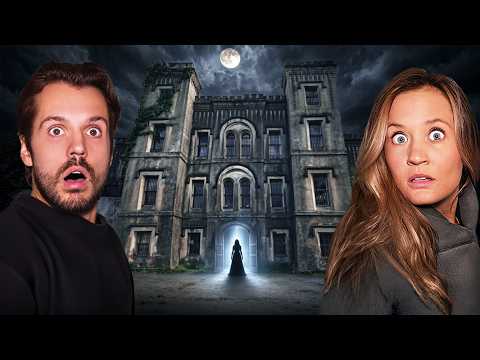
Five Romanian witches surrounding a participant in a candlelit forest provide a dramatic opening to an ambitious investigation into paranormal communication. Sam and Colby travel between Romania, an abandoned hospital in West Virginia, and their own allegedly haunted school to examine whether ghost-hunting equipment, the Estes Method, and psychic readings can produce convincing evidence of supernatural activity. Rather than simply exploring frightening locations, they attempt to address skepticism through comparisons, isolation procedures, and repeated questions. The result is an entertaining paranormal documentary with some genuinely interesting experimental ideas, although its repeated declarations of proof frequently exceed what the evidence establishes.
The Romanian investigation begins in Hoia Baciu Forest, where the hosts describe local legends involving unexplained disappearances, unusual photographs, and an allegedly mysterious clearing where vegetation struggles to grow. These stories create an effective atmosphere, but they are presented without sufficient historical or scientific verification. The central ritual involves protective circles, mirrors, chanting, and the sacrifice of an ox heart, with Sam participating while Colby declines for religious reasons. That distinction adds a personal dimension to the investigation, particularly when Sam later questions whether he has pushed his pursuit of paranormal evidence too far. Comparing equipment responses in an ordinary Las Vegas park with those recorded after the ritual is a worthwhile concept, but the experiment lacks the environmental measurements, repeated trials, and controlled conditions necessary to establish that supernatural forces caused the differences.
The equipment investigation becomes increasingly dramatic as music boxes, flashlights, static detectors, and motion-activated balls appear to respond to the investigators' questions. Several activations occur immediately after specific requests, creating moments that are understandably exciting for the participants. However, electronic devices can respond to environmental interference, sensitivity settings, movement, and ordinary physical conditions. The assumption that an isolated forest contains no relevant electromagnetic interference is not independently demonstrated, and the absence of activations during the initial park test does not establish that later activations are paranormal. Sam's sudden congestion after the ritual also becomes part of the supernatural speculation, although he reasonably acknowledges smoke exposure and allergies as possible explanations. These competing possibilities deserve considerably more attention than the investigation ultimately gives them.
The West Virginia hospital provides the documentary's most interesting attempt at experimental control. Sam and Colby use an acoustically isolated room, noise-canceling headphones, and radio communication to test the Estes Method, in which one participant repeats words heard through a scanning radio while others ask questions outside the participant's hearing. Skeptical guests Gavin and Tyler add welcome variety, and the investigators progressively increase the physical separation between participants. Reported responses involving doors, hospital staff, warnings, and historical references create intriguing coincidences, while the later discovery of a physician named Charles Abraham becomes a particularly celebrated moment. Nevertheless, the apparent connections depend heavily on interpreting fragmented phrases, selecting relevant responses, and researching possible matches afterward. Demonstrating that someone cannot hear the questions addresses one potential source of contamination, but it does not establish that the resulting words originated with spirits.
The hospital sequences are also among the most engaging portions of the production because the investigation combines suspense, humor, and increasingly demanding arrangements. Gavin's isolation in the basement, particularly with the audience allowed to hear the radio feed, offers a more transparent experience than the earlier sessions. His discomfort feels genuine, and the group's occasional acknowledgment that responses do not always match the questions introduces some welcome uncertainty. Unfortunately, that caution rarely lasts. Ambiguous statements are frequently incorporated into developing supernatural narratives, while inconsistencies receive less consideration than apparent confirmations. The hospital's alleged history, including its reported hauntings and individual tragedies, also serves as background without sufficiently distinguishing documented events from local stories and investigators' interpretations.
The final experiment moves to the former school owned by Sam and Colby, where two psychics independently attempt to answer identical questions through tarot cards and bone divination. Separating the participants, checking whether they can hear each other, and requesting simultaneous answers give this section a clearer comparative structure. The most striking apparent agreement concerns descriptions of a young male spirit who lost his mother and remained connected to the property. Both psychics subsequently describe themes involving maternal affection, childhood difficulties, and a desire for companionship. These similarities are interesting, but the interpretation is less decisive than the hosts suggest. Broad emotional themes can overlap without establishing communication with the same entity, and the participants' prior familiarity with the location and investigators complicates claims of complete independence. More precise questions, advance scoring criteria, and blinded comparisons would make the results substantially more persuasive.
Presentation remains one of the production's biggest strengths, even when its reasoning becomes questionable. The international locations, imposing hospital corridors, elaborate ritual setting, and multiple camera arrangements give the investigation an appropriately cinematic scale. Sam and Colby's lively chemistry keeps the lengthy proceedings accessible, and their willingness to involve skeptical friends and different practitioners prevents the documentary from feeling entirely repetitive. However, the constant excited reactions, repeated claims that individual moments prove the paranormal, and extended promotional interruptions weaken the investigative credibility. The Rocket Money sponsorship and later Explore Club promotion are especially disruptive when placed between sequences that otherwise build toward serious experimental conclusions. The closing reflection, which shifts the emphasis from proving ghosts exist to finding purpose through curiosity and shared experiences, is more thoughtful and convincing than many of the conclusions drawn along the way.
Pros
- Three distinct investigations across Romania, West Virginia, and a reportedly haunted school create an ambitious, varied documentary with a clear central objective.
- The Romanian ritual provides an atmospheric opening while introducing meaningful personal differences between Sam and Colby's approaches to paranormal practices.
- Comparing equipment in different environments and testing the Estes Method through acoustic isolation and increasing distances demonstrate an effort to engage with common skeptical objections.
- Gavin and Tyler bring entertaining reactions and an outside perspective to the hospital investigation, helping balance the hosts' established enthusiasm.
- Recording the radio audio during the basement Estes Method session gives viewers a more direct opportunity to assess the reported responses.
- Independent psychic readings produce several interesting thematic similarities, particularly concerning the alleged child spirit and its relationship with its mother.
- Strong location choices, energetic group interactions, and a reflective conclusion make the documentary engaging beyond its supernatural claims.
Cons
- Repeated declarations that paranormal activity has been proven are not justified by the experimental controls or the evidence presented.
- The equipment comparisons lack sufficient measurements, repeated baseline testing, and investigation of ordinary environmental causes for device activations.
- The Estes Method relies heavily on subjective interpretations of fragmented radio responses, while apparent historical matches are sometimes identified after the sessions.
- The psychic experiment does not adequately address prior knowledge, interpretive flexibility, or the possibility that broadly similar descriptions could arise without supernatural communication.
- Historical legends, reported hauntings, and claims about spiritual entities receive limited independent verification.
- Frequent exaggerated reactions and selective emphasis on apparent confirmations undermine the otherwise worthwhile attempts at methodological rigor.
- Extended sponsorship and membership promotions interrupt the documentary's investigative momentum.
Sam and Colby deliver an ambitious, atmospheric paranormal investigation that is considerably more interesting when treated as an exploration of unusual experiences than as definitive scientific proof. The varied experimental designs, memorable locations, and entertaining participants create a compelling viewing experience, but insufficient controls and overly confident interpretations prevent the findings from supporting the documentary's central claims. Its closing emphasis on curiosity, friendship, and the personal meaning of the search ultimately provides a more satisfying conclusion than its attempts to establish supernatural certainty.