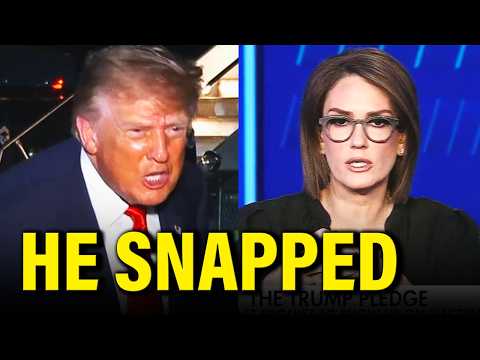
Donald Trump’s remarks about Dolly Parton give the commentary an immediate example of the behavior its host wants to criticize. After playing Trump’s remembrance, which includes the assertion that Parton “really liked” him, the host argues that Trump unnecessarily turns a tribute into a statement about himself. The criticism is clearly expressed, but the response quickly moves from questioning the appropriateness of those remarks to treating them as evidence of narcissism, a much broader psychological judgment that the material presented cannot establish on its own.
That tendency toward escalation shapes much of the commentary. Trump’s comments about the Strait of Hormuz are challenged with the claim that only one ship had traversed the waterway two days earlier and that there was no demonstrated evidence in the segment that all mines had been cleared. Those are potentially important challenges to Trump’s portrayal of the strait as functioning normally, particularly because the host emphasizes its importance to global oil movements. Yet the discussion would be considerably stronger if it spent more time establishing the underlying evidence rather than rapidly moving from disputed factual claims to conclusions about Trump’s competence and motives.
The exchange over Canada provides the most substantive portion because there are identifiable claims to compare. Trump argues that Canada has taken advantage of the United States through tariffs, says the United States does not need anything Canada provides, and describes a $60 billion annual loss. The host counters with Trump’s alleged earlier statement that the United States desperately needs Canadian aluminum and later cites figures attributed to CNN fact-checker Daniel Dale that place the trade deficit below Trump’s figure depending on whether services are included. The explanation that a trade deficit does not literally mean a country has “lost” that amount of money is also useful context for evaluating Trump’s rhetoric.
Where the analysis becomes less persuasive is in predicting Canadian behavior and assigning motives. The host speculates that antagonizing Canadians will make them more willing to endure economic consequences simply to resist Trump, but no evidence is presented to demonstrate that reaction. Similarly, claims that Trump’s overriding priority is self-aggrandizement and that this explains both domestic and foreign policy are presented as conclusions rather than interpretations. The political argument may be consistent with the host’s reading of the interview, but the certainty of the language exceeds what these clips alone can establish.
Glenn Beck’s interruption supplies the most memorable moment, although the framing oversells what actually occurs. Beck tells Trump that he has a network break, offers him the option of holding on, acknowledges that he is busy and thanks him for his time. Characterizing this as Beck having to “shut him up” is amusing partisan commentary, but the exchange itself sounds considerably more conventional than that description suggests. The discrepancy illustrates the broader presentation style: energetic and entertaining for an audience already receptive to the host’s viewpoint, but frequently more dramatic than the underlying material requires.
The final section connects the interview to Trump’s previous promise to end inflation and make America affordable, then argues that voters are entitled to judge him against that pledge. Holding a politician’s current performance against a quoted campaign promise is a reasonable analytical framework. However, assertions that current affordability problems are specifically the product of Trump’s policies, that Republican congressional control is seriously endangered because of these decisions, and that Republicans are headed toward a “total disaster” in November receive little supporting evidence within the discussion. The explicit call to “make that a reality” also removes any ambiguity about the host’s political position, making this advocacy-oriented commentary rather than a detached assessment.
Overall, the presentation succeeds when it isolates specific Trump statements and tests their internal consistency or compares them with competing figures. It is less convincing when mockery, psychological characterization and electoral advocacy substitute for demonstrating the larger conclusions being drawn. The brisk clips and forceful delivery make the argument easy to follow, but a more disciplined separation between documented contradictions, reasonable interpretation and partisan prediction would make the critique substantially more credible to viewers outside its natural audience.
Pros
- Uses Trump’s own remarks extensively, giving viewers substantial material on which to judge the criticism.
- The Canada discussion identifies specific claims about trade, tariffs, aluminum and the trade deficit rather than relying entirely on personality-based criticism.
- Comparing Trump’s affordability rhetoric with his stated campaign promise provides a relevant standard for political accountability.
- The commentary is energetic, clearly structured and rarely leaves viewers uncertain about the host’s argument.
Cons
- Psychological judgments about Trump’s narcissism and motives are stated with greater certainty than the presented evidence supports.
- Several important factual assertions about the Strait of Hormuz, economic conditions and electoral consequences receive limited substantiation within the discussion.
- Speculation about how Canadians will respond to Trump is treated as a likely political consequence without supporting evidence.
- The description of Glenn Beck effectively “shutting up” Trump exaggerates what is presented as a polite interruption for a network break.
- Open electoral advocacy and frequent ridicule reduce the analysis’s usefulness for viewers seeking a more neutral examination of the interview.
Specific contradictions involving trade and affordability give the commentary a firmer foundation than its more personality-driven attacks, and the selected interview clips provide useful material for scrutiny. Its credibility weakens whenever interpretation becomes certainty, especially around motives, psychological traits and future electoral consequences, leaving an energetic partisan critique that would benefit from more rigorous evidentiary discipline.